Get Full Government Meeting Transcripts, Videos, & Alerts Forever!
Get email alerts on the Wastewater topic
No spam. Unsubscribe anytime.
Sandy reviews wastewater treatment options as regulators, costs and timelines constrain local fixes
Summary
Councilors and consultants held a workshop to review Sandy’s wastewater studies and next steps as state dilution rules, limited nearby receiving waters and land availability constrained locally based fixes.
Councilors and consultants on March 3 held a workshop on Sandy’s long-running wastewater challenges, reviewing what analyses have been done, which options are viable and the timetable and price pressure facing any solution.
City staff and Stantec consultants said the central constraint is how and where treated effluent can legally and practically be discharged. Heather Stevens, a Stantec wastewater planner, said Oregon rules limit how much effluent can enter small receiving streams and that the commonly cited “three‑basin” limits and a roughly 10:1 dilution requirement are key constraints. Stevens said those state water‑quality rules and dilution limits make continuing to rely on Tickle Creek difficult in the long term.
Stantec program manager Jake Talley said reinvesting in the existing treatment plant would buy time but would not be a permanent fix. Talley said recent flow monitoring and modeling indicate even an upgraded plant would likely exceed the state dilution limit in about 10–14 years because local stream flows are declining while wastewater volumes increase. “It buys us a little time, but it doesn’t fix the problem,” Talley said.
Why it matters
The discussion matters because the city is under an enforcement agreement with federal regulators and must find a compliant, sustainable path for treated effluent as growth and seasonal variability reduce the creek’s capacity to accept wastewater. City staff repeatedly told the council that timing, permitting and construction costs will affect whether Sandy can rely on local solutions or must pursue regional connections.
What was considered and why many options were ruled out
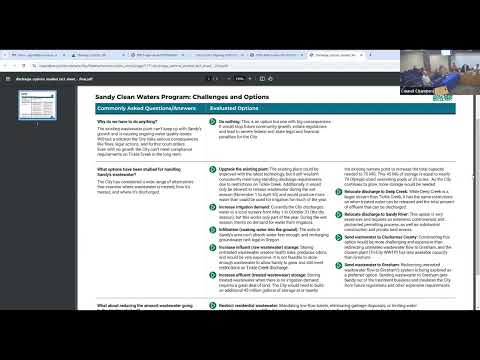
- Upgrade on‑site treatment: Consultants said upgrading the 60‑year‑old plant would require near‑complete replacement of process units and still leave Sandy constrained by the stream’s dilution and other water‑quality standards. Talley emphasized limited salvage value and the risk of “stranding” investments if regulation or flows change.
- Infiltration/soil disposal: Stantec reported field tests and test pits showed local soils have low infiltration rates at the locations studied. Engineers said even where infiltration is possible, long‑term security is a concern if the city does not own or control the land used for disposal.
- Constructed wetlands or land application: Naturalized wetland treatment works in some Oregon communities, but consultants said it typically needs very large acreage. Councilor Laurie Hokanson and others discussed Prineville and Redmond as examples; consultants said Redmond’s project sits on hundreds of acres (often public/BLM land) and that Sandy has not identified a comparable nearby 150–200‑acre site that is economically and legally available. Talley said wetlands also complicate sludge handling and require sizable land and long pipelines if sited far from the plant.
- Groundwater recharge and direct reuse: Consultants said Oregon’s regulatory framework currently does not support “groundwater insertion” or direct potable reuse the way some other Western states do. Heather Stevens said Oregon lacks a robust reuse rule set that would allow direct recharge or direct potable reuse without new state regulations. Councilors and consultants noted that changing state policy is possible but outside local control and could take years.
Regional options and the Gresham intertie
Consultants and staff described the intertie approach — sending Sandy’s wastewater to a regional partner for treatment — as an implementable path that avoids some regulatory uncertainty, though it also carries high up‑front capital and SDC (system development charge) costs. Stantec and staff said an MOU is in place with the City of Gresham establishing them as a willing partner and that negotiations on connection fees and payment terms are underway. City staff said those terms (lump sum vs. multi‑year payment, interest, and SDC credits) will materially affect the utility rate model.
Cost, timing and rate implications
Staff presented a program budget approach that builds base capital costs, contingencies and an escalation factor (3.75% annual compounded in their planning model) to the midpoint of construction. Finance Director Tyler Wallace told the council the rate model in the staff presentation projects wastewater bills rising substantially under the proposed program: using the current model assumptions, the average monthly wastewater bill could be about $275.20 by 2034, up from roughly $98.11 today. Wallace and consultants added that phasing projects, extending loan terms or securing grants can materially reduce near‑term rate pressure.
Regulatory and schedule risks
Consultants cautioned that options tied to state rule changes (recharge/direct reuse) add timing and political risk. Talley urged council members to use their political channels and intergovernmental relationships as the project moves into negotiations (for example, zippering communications with Gresham: council‑to‑council and mayor‑to‑mayor) to speed decisions and preserve cost certainty.
Council reaction and next steps
Councilors pressed for more modeling of rate impacts under different funding assumptions (grant levels, SDC payment terms, loan lengths). Staff agreed to run additional scenarios and to keep the council updated as capacity analyses and pipeline preliminary alignments are completed in the coming months. City staff also stressed the need for clearer public communications to explain why rates are rising and what grants or alternatives might change the outcome.
Ending
Councilors and the consultants described the workshop as an informational step toward a decision path rather than a voteable action. Staff said several follow‑up technical studies and ongoing negotiations (including funding conversations and an IGA with Gresham) will be required before the council sets final project scope and financing.