Get Full Government Meeting Transcripts, Videos, & Alerts Forever!
Get email alerts on the Housing Production topic
No spam. Unsubscribe anytime.
Sandy officials lay out housing production strategy; wastewater moratorium identified as central barrier
Summary
City staff and consultants presented a draft Housing Production Strategy (HPS), emphasizing that wastewater capacity and a roughly $200 million funding gap are the main constraints to meeting the state housing target of about 2,400 units over 20 years.
City of Sandy staff and consultants presented a draft Housing Production Strategy at a joint council–planning commission workshop, emphasizing that the city’s wastewater capacity limits are the primary constraint on meeting the state-mandated housing goals.
Tim Wood, a consultant with FCS Group who led the presentation, said the HPS is “really around strategies that can help Sandy’s housing economy grow effectively” and described the document as a menu of the strategies the city could pursue. He told elected officials the strategy list — organized around zoning, financial incentives, tax tools, land partnerships and custom options — will be the meat of the final HPS.
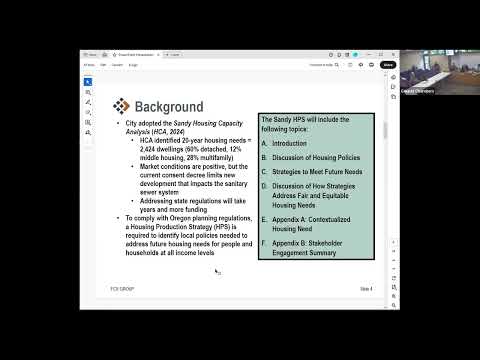
The presentation framed the HPS as a response to the housing capacity analysis (HCA) the city completed earlier; that analysis estimates Sandy needs roughly 2,400 new dwelling units over the next 20 years, a figure Wood called aspirational given the current sewer moratorium. “You’re not getting to that 2,400 number without these things being implemented,” Wood said, listing five wastewater‑related strategies in the draft that range from changing permit approaches to constructing new conveyance and treatment infrastructure.
City staff and the consultant repeatedly said the HPS is intended as both a planning document and a messaging tool for state reviewers. Kelly, a city staffer on the project, told the group the HPS will be used to document which strategies the city will pursue and to seek state assistance, including grant funding. Kelly said the department expects four‑year check‑ins with the state on progress and stressed that including a strategy in the HPS does not commit the city to immediate implementation.
Consistent criticisms from council members during the workshop centered on realism and sequencing. Several elected officials noted the HCA’s growth assumptions were based on a 20‑year forecast with no moratorium and questioned how the city should present targets it cannot meet under existing sewer limits. Wood and staff answered that the HCA is a statutory snapshot and that the HPS should explain the constraints — including the moratorium — and make a case for state support and concessions from regulators.
The draft HPS also describes options beyond wastewater work: a construction excise tax (CET) to build a capital fund for affordable housing, zoning and code changes (including “cottage cluster” or middle‑housing options), regulations for short‑term rentals, and policies to preserve manufactured‑home parks. The workshop included detailed discussion of the CET mechanics (a 1% example, revenue modeling and how permit value is calculated) and concern from council members about impacts on development economics.
Next steps outlined at the meeting: staff will incorporate council and planning commission feedback into a draft report, the city will circulate that draft to the Department of Land Conservation and Development (DLCD) for review, and staff will return to council with a final HPS for adoption. Wood said several of the HPS strategies are interdependent and that the council’s prioritization will shape which items the city pursues first.
Why it matters: the HPS is now a required statewide planning document intended to show how a city will address its forecast housing need. For Sandy, the strategy will also be the public record the city uses to request state resources or regulatory flexibility while a local wastewater moratorium constrains new development.
Council and staff expect to return with a draft HPS for review and to use the final document when seeking nonlocal funding and regulatory accommodations.