
Fairview leaders continue study of fire district after consultant poll shows limited near-term voter support
Get AI-powered insights, summaries, and transcripts
Sign Up Free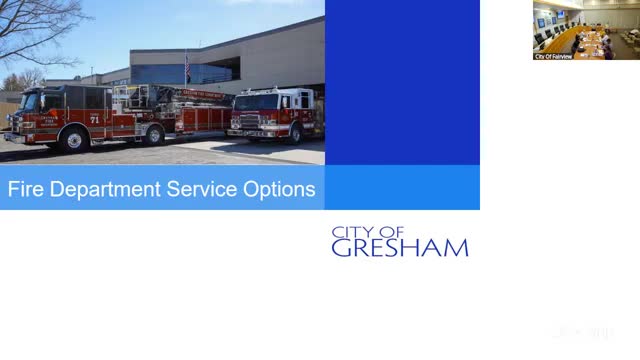
Summary
City Manager Nathan George and a communications consultant presented polling and financial models on Sept. 3 as Fairview continues to study options for delivering fire services, including creating a fire district, joining Clackamas Fire or retaining contract services with the City of Gresham.
City Manager Nathan George and consultant Megan Mever briefed Fairview city councilors on Sept. 3 on options to change how fire services are provided to Fairview, including creation of a new local fire district, annexation into Clackamas Fire or continued contracts with the City of Gresham. The presentation included a public-opinion poll that showed initial support below the level generally required to pass a ballot measure and several financial scenarios for a potential district.
The poll and modeling matter because any shift in service model could change residents' property-tax bills, the city’s general fund and the location and number of future fire facilities. ``Response times are the number one most important thing to people when it comes to fire and emergency services,'' Megan Mever, partner at a local communications and political consulting firm, told the council.
Mever summarized two related pieces of analysis: a public-opinion survey of registered voters in the cities under study and a financial analysis prepared for the region. The survey asked baseline support for creating a permanent-tax-rate-funded fire district and then tested reactions after voters were shown specific information (for example, whether joining a district would save or cost them money). The financial analysis modeled multiple scenarios, including a baseline operations scenario and an enhanced-growth scenario.
Key figures from the presentations, as stated by staff and consultants: under one baseline scenario the modeled operating costs were roughly $39.9 million in fiscal year 2025 and $59.1 million in fiscal year 2034, with an estimated tax rate of about $3.73 per $1,000 of assessed value and estimated revenue of about $36.4 million in FY25 and $49.2 million in FY34. An enhanced-growth scenario showed higher costs (about $41.4 million in FY25 and $80.3 million in FY34) and an estimated tax rate near $4.69 per $1,000, with higher projected revenues in later years. Mever and Nathan George emphasized those numbers were model outputs using FY23–24 data and specific assumptions and should be treated as illustrative.
On public sentiment, Mever reported initial topline results: "32% supported, 51% opposed, 16% don't know" when respondents were asked generally whether they would support a ballot measure to create a local fire district funded by a permanent tax rate. After respondents were shown city-specific cost implications, support rose in some places but "support for a new fire district increases into all areas except Wood Village, but does not reach the required level to pass," Mever said. She repeatedly cautioned that sample sizes for the smaller cities were small and margin of error for those subgroups was large; for Fairview the survey subgroup was small enough that results should be interpreted cautiously.
Councilors pressed staff for operational detail about Fire District 10, which was often discussed as an existing entity that some cities might annex into. City Manager Nathan George described District 10 as a small district with limited current capacity: "they have two part-time people who do all the books," he said, and they own a training facility and at least one station. Councilors and staff repeatedly noted District 10 would need to ramp up substantially to provide full-service municipal fire protection at the scale of Gresham Fire.
On process and timing, staff and Mever told the council that building reliable voter support would require a sustained communications effort and likely more time than the city’s next available election cycle. Mever said, "to go out for a ballot measure you want to be at 60% in your poll. I think people certainly started much lower than that," and she added that a more modest threshold to consider moving forward is being above 50% in internal tracking polls. City managers signaled May of the following year was a tight timeline; multiple participants said it was "probably not feasible" to pass a new district measure that soon without significant education and outreach.
Council discussion also focused on the city’s recent $20 public-safety fee, the effect of any new district on the general fund, and how shifting fire payments from the general fund to a district could free city money for other local priorities. Staff clarified the public-safety fee generates roughly $1.1 million and that the city faces a multi-million-dollar budget gap; even if a district removed fire costs from the general fund the city would still need to manage other budget pressures.
Council and staff described next steps as further study, continued city-manager-level talks with Gresham and other partners, and a communications work plan led by Mever to test messages and engage residents over months. Nathan George told the council there was an internal goal to have an intergovernmental agreement (IGA) framework on the table by Dec. 31 for further consideration, but he and Mever said that more time is likely required before a ballot measure would be viable.
Ending: The council did not vote on a change in fire service model on Sept. 3. The meeting produced a staff direction to continue analysis, refine financial estimates, pursue intergovernmental discussions, and begin a multi-month public-education effort; Mever will develop messaging and outreach materials, and city managers will keep meeting with potential partners and seek any short-term contract extensions needed to avoid disruption while study continues.