Get Full Government Meeting Transcripts, Videos, & Alerts Forever!
Get email alerts on the Fire Services Restructure topic
No spam. Unsubscribe anytime.
Poll shows limited voter support as Fairview weighs fire-district options; council to study extension and outreach
Summary
City Manager Nathan George and consultant Megan Mever told the Fairview City Council that recent polling and financial analyses show voter support for creating a regional fire district is below the level needed for a May ballot; staff will pursue more study, communications and likely a contract extension with Gresham.
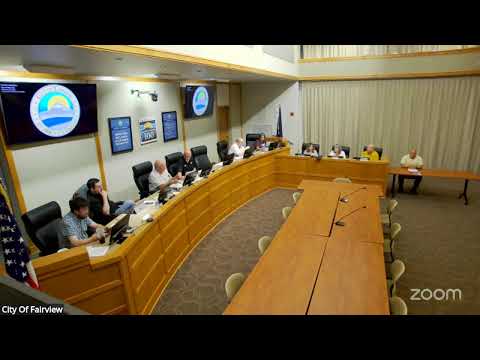
City Manager Nathan George told the Fairview City Council on Sept. 3 that recent polling and financial analyses show voter support for creating a regional fire district remains below the level needed to pass in the near term, and that staff will continue studying options while pursuing temporary contract extensions.
The finding follows two sets of research presented at the work session: a financial analysis of possible district models and a voter survey prepared for the three smaller cities (Fairview, Troutdale and Wood Village) by consultant Megan Mever. "Response times are the number one most important thing to people when it comes to fire and emergency services," Mever said as she summarized messages that moved public opinion most.
Why it matters: City leaders are weighing whether to continue contracting with the Gresham Fire Department, form a new multi-city fire district, annex into an existing district such as Clackamas Fire District 10, or pursue other permutations. The decision affects property tax rates, the city budget and whether the city’s recent public-safety fee must be retained to cover remaining general-fund obligations.
Most important facts first: The polling and financial work together indicate current voter support is below typical pass thresholds. Mever said that initial polling of the three smaller cities showed Fairview respondents starting at about 38% support on a ballot-style question and moving slightly when told about cost savings or service improvements, but the level did not exceed 50% after messages were tested. A larger Gresham-focused poll presented to the council showed roughly 32% support, 51% opposed and 16% undecided on an initial question about creating a new permanent tax to form a fire district.
The financial analysis presented to council staff (summarized by George) modeled multiple scenarios. One baseline scenario estimated operating costs near $39.9 million in fiscal 2025 rising to about $59.1 million by fiscal 2034 and projected a tax rate of about $3.73 per $1,000 of assessed value producing roughly $36.4 million in fiscal 2025. An enhanced-growth scenario showed higher costs, higher reserves and an estimated tax rate around $4.69 per $1,000 in the study’s assumptions.
Discussion versus direction: Councilors and staff discussed three themes repeatedly—feasibility (including what Clackamas Fire District 10 could realistically provide), ballot timing, and how to frame public messages. George told the council the city managers and mayors from the partner cities generally concluded that a May ballot is unlikely to succeed without substantial sustained education and outreach. He said the city has until Dec. 31 to notify Gresham of official renewal intentions for the current contract, and staff intend to seek an extension to avoid a last-minute decision.
Next steps and staff direction: The council’s immediate near-term plan is twofold: 1) staff will pursue additional study of options—including further financial clarification about how the city’s recently adopted $20 public-safety fee interacts with district cost estimates—and 2) staff will develop a communications and community-engagement plan to give residents clear information over time. Mever described a short-term campaign focused on the public-safety fee and a longer-term education program about the potential benefits of a regional fire district.
Concerns and constraints noted: Several councilors and staff emphasized that polling samples for the smaller cities were small and that question wording and context materially affected results. Council members also stressed the city’s broader budget gap: George and staff noted the city faces a near-term structural deficit and that if fire services were moved out of the general fund, remaining city revenue needs (including maintaining police and other services) would still require attention. "If we enter another extension, even if we get a cost-of-living increase only, that fee is still only covering half of our fire," George said, noting the public-safety fee generates roughly $1.1 million and the city faces an estimated $2 million shortfall against prior cost levels.
What was not decided: The council did not take a formal vote on any of the fire-district options at the Sept. 3 meeting. No ordinance, resolution or intergovernmental agreement was approved. Staff emphasized that any ballot measure would require additional outreach and that May is likely not a viable deadline for a successful measure.
Background and context: Options discussed in earlier staff and city-manager meetings included keeping Gresham Fire under the city, creating an independent multi-city fire district, annexing into an existing district such as Clackamas Fire District 10, or combinations with continued contractual services. George and other managers told the council that Clackamas Fire District 10 currently provides limited direct services and would require significant ramp-up to be a full-service partner.
Looking ahead: Staff said they will return with clarified financial numbers (including how the adopted $20 public-safety fee is factored), refined outreach messages, and a proposed timeline for next steps. Mever recommended sustained, unified messaging and coalition-building over multiple election cycles if the cities intend to pursue a district, saying short-term timelines are unlikely to produce a winning ballot outcome without considerable voter education.