
Consultant tells Fairview council: 'Urban renewal is not a tax'; briefing outlines projects, funds and limits
Get AI-powered insights, summaries, and transcripts
Subscribe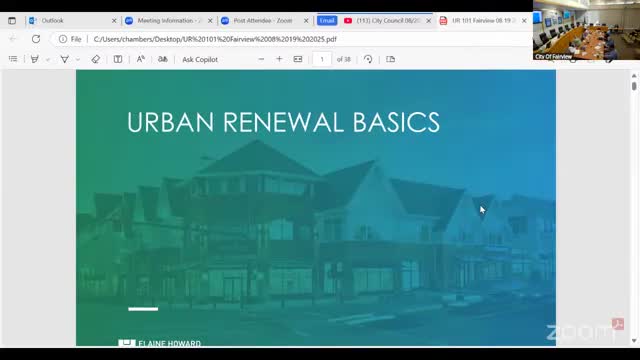
Summary
At an Aug. 20 Fairview City Council meeting, urban-renewal consultant Elaine Howard explained how Tax Increment Financing (TIF) works, reviewed the city—s URA projects and budgets, and answered council questions about maximum indebtedness, revenue flows and recent expenditures.
Elaine Howard, an urban-renewal consultant who said she —his done probably 85 percent of the urban renewal consulting in the state,— told the Fairview City Council on Aug. 20 that —urban renewal is not a tax— and explained how tax-increment financing funnels growth in assessed value to a city—s urban renewal agency.
Howard said the amount that appears as a line item on property tax statements is a —division of taxes that are already paid— and that —if urban renewal were to go away tomorrow, nobody's property tax bill would go down.— The presentation summarized how assessed-value growth inside Fairview's urban renewal area becomes tax-increment revenues that the URA can spend on eligible projects until the district reaches its maximum indebtedness.
The briefing matters because Fairview—s URA has funded infrastructure and private-development incentives that city staff and the consultant said have produced new housing, commercial space and public amenities. Howard and staff presented the URA—s major projects, recent spending, and constraints such as the district—s maximum indebtedness and statutory limits.
Howard walked council through the URA mechanics and local figures. She said Fairview—s plan lists public-infrastructure work (including the Halsey/220th roundabout and designs for a rail undercrossing), developer incentives, utility-system development charge assistance and a recently leased food-cart plaza. Howard said the URA—s stated maximum indebtedness is $51,000,000 and that the remaining amount as of fiscal year 2024 was $40,649,851. She told council the URA—s projected tax-increment revenue for the coming year is roughly $1,500,000.
Councilors and staff asked for clarifications about what counts as —blight— under Oregon law, who is responsible for addressing dangerous buildings, and how the URA—s program income (for example, lease income from the Fairview Food Plaza) can be used. Howard noted that Oregon law requires a jurisdiction to justify —blighting influences— in the ordinance that forms an urban renewal area and said Fairview—s original plan cited infrastructure deficiencies.
Howard and staff described projects funded since 2018: SDC assistance for several developments, industrial and mixed-use projects that contributed to assessed-value increases, redevelopment work on the Fairview Creek site, a 119-unit residential development with 10,000 square feet of commercial space, and ongoing work on the Halsey/220th corridor and the railroad undercrossing design. She said agency project income (lease revenue from the food plaza) does not count against maximum indebtedness and can be used for certain maintenance or program expenses.
Council and staff also reviewed URA administration and accounting. Howard reminded the council the agency must file an annual report (she said it is due Jan. 31 for the preceding fiscal year) and monitor maximum indebtedness. Finance staff told council prior-year personnel charges to the URA totalled about $352,406 and contract services about $600,000; council asked staff to ensure those allocations are tracked and billed consistently.
No formal ordinance or vote on URA policy occurred at the meeting. Councilors asked staff to return with a work plan; city staff and Howard said they will prepare materials (Howard offered to prepare a fact sheet using a 2018 vs. 2019 tax statement example) and present draft revisions to the URA grant program at a council work session scheduled for Sept. 17.
The presentation closed with council comments that the URA has produced visible projects such as the food-cart plaza and new housing, and with staff and the consultant advising a pause on issuing new long-term debt until the council sets updated grant rules and confirms staffing capacity to manage projects.