
Fairview leaders consider joining fire district after study finds response times below national standard
Get AI-powered insights, summaries, and transcripts
Subscribe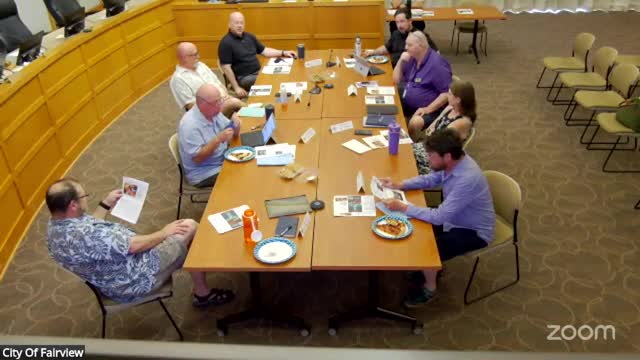
Summary
City staff and consultants told the Fairview City Council on July 2 that independent reviews show the city’s emergency response times miss a four-minute national benchmark most of the time; councilors discussed options including joining a fire district, building a new station and a public outreach campaign but made no decision.
City Manager Paulette presented findings from consultants and regional partners at the Fairview City Council work session on July 2, saying independent studies show the city’s current emergency response model is not meeting national response-time goals and that funding to change the system is lacking.
The presentations, drawn from a Praxis outreach package and the two technical reports the city reviewed, outlined options ranging from continuing the current contract model with Gresham to joining a special fire district that would provide local ownership of stations, equipment and dedicated taxing authority. “We don’t have funding. We just don’t have the funding,” the city manager said when summarizing the financial constraint that the four‑city group repeatedly identified.
The consultants’ maps—shown to councilors during the presentation—put most of Fairview in a response-time “red” zone. Staff said response times failed to meet the cited national standard roughly 90% of the time in the period cited in the reports (2021 through February 2024). Councilors and staff discussed multiple paths: forming or joining a fire district (the presentation referenced Clackamas Fire District as one example), negotiating different contracts with Gresham or other districts, and building a new centrally located station (Praxis’s mock-up placed a notional station near Sandy Boulevard).
Councilors and staff emphasized that any change would require new ongoing revenue or voter approval. City staff presented preliminary tax-impact examples drawn from the consultants’ materials: using an illustrative $200,000 home, the city manager said the city’s 3.4 per‑$1,000 tax rate equates to roughly $621 a year in city revenue from that property, and consultant scenarios suggested incremental property tax or district charges that could be on the order of “$50 and change per month” in some models. Staff stressed those numbers were illustrative and dependent on choices about boundaries, services and partners.
Councilors asked about alternatives to reduce cost, federal funding possibilities and interagency models. Several members flagged operational constraints in parts of the city—narrow streets and “pinch points” that challenge truck access—and suggested exploring federal funding tied to airport and port protection where applicable. Councilor discussion also covered the political and practical differences between “renting” fire coverage under a contract and “owning” services through a district: ownership could provide dedicated revenue and more local control over staffing and equipment but would require voter approval and new tax lines.
The council discussed public outreach at length. Staff described a planned campaign using the consultant’s “elevator pitch” templates, triage messaging (15‑second, one‑minute and five‑minute versions) and community events, and recommended elected officials lead much of the face‑to‑face public education. Staff also cautioned about limits on city staff involvement in campaign‑style activities and said they will seek legal advice about what city employees may do in outreach. The city manager said the four‑city group will continue coordination and that staff will bring options and refined financial models back to council for future action.
Councilors did not take a formal vote on service model selection. The item remains in the study/decision stage: staff will return with more detailed cost estimates, a refined outreach plan and legal guidance about staff roles and next steps if the council signals interest in pursuing a district or other structural change.