Get Full Government Meeting Transcripts, Videos, & Alerts Forever!
Get email alerts on the Budget And Fees topic
No spam. Unsubscribe anytime.
Fairview council adopts budget; city plans outreach for utility, safety and parks fees
Summary
Council adopted the 2025–26 budget and declared its election to receive state shared revenues; staff outlined a public outreach plan for proposed utility rate increases and new fees — a $15 public safety fee and a $5 parks fee — that still require ordinance and fee-resolution steps before collection.
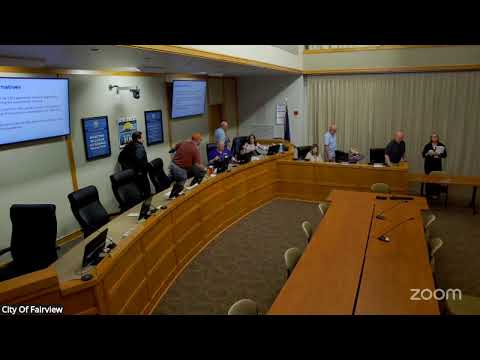
The Fairview City Council voted to adopt the fiscal 2025–26 budget on June 4 and to elect to receive state shared revenues, while staff outlined how the city will notify residents about proposed utility-rate changes and two new service fees.
City finance staff said the city expects to receive about $1.2 million in state shared revenues in fiscal 2025–26 and presented a budget that assumes a 2.91% change in assessed values, an 8% utility-rate increase (water, sewer, stormwater) and two proposed new fees: a $15 public safety fee per household and a $5 parks services fee per household. Council adopted Resolution 17‑20‑25 (election to receive state shared revenues) and Resolution 18‑20‑25 (adoption of the 2025–26 budget) at the meeting.
Why it matters: The budget package lays out revenue steps staff says are needed to maintain services as costs rise. The two proposed fees are not yet being charged; the city must adopt ordinances to authorize the fee types and then a separate fee resolution to set amounts before those revenues can be collected.
Key details
- Budget adoption and state revenues: The council adopted the budget recommended by the budget committee and formally elected to receive state shared revenues. Staff said the city’s projected state shared revenue for the coming fiscal year is about $1,200,000.
- Fee mechanics and timing: City staff explained the multi-step process: (1) Council adopts ordinances establishing the fee types (parks services, public safety); (2) council adopts a fee-resolution that sets the per-unit dollar amounts; (3) fees become effective only after the resolution and a statutory waiting period (the staff timeline noted 30 days before a fee would appear on utility bills).
- Proposed amounts: The budget presented assumes a $15 public safety fee and a $5 parks fee per household; those figures were included in materials distributed during the budget process but must be enacted by separate ordinance and resolution votes before collection.
- Public outreach: City Manager Nathan George said the city mailed notices with utility bills and plans additional outreach (website materials, social media, Nextdoor, text alerts and an Every Door Direct Mail run). He added staff will provide a question-and-answer page and utility-assistance links for low-income households. “We’re trying to be as transparent as we possibly can, shy of knocking on doors,” George said.
Public comments and council reaction
Budget committee member Eric Mueller addressed council before the vote and urged support, saying the budget committee considered “a lot of hard choices” and recommended the package as “fiscally responsible.”
Councilors asked staff to do additional outreach targeted to residents who do not receive utility bills directly (renters and tenants) and to include utility-assistance options. Staff said the city will use EDDM mailers, posts to Facebook and Nextdoor, and the city’s newsletter and that staff will provide a central online link to application and assistance information.
Actions taken
- Resolution 17‑20‑25 (electing to receive state shared revenues) was approved by council by voice vote. - Resolution 18‑20‑25 (adopt fiscal 2025–26 budget and impose taxes as described in the budget committee packet) was approved by council by voice vote.
Ending
Staff said they will bring the required ordinances and fee resolutions to upcoming council meetings; if council adopts the ordinances and fee resolution, staff indicated the earliest practical billing date would be the August utility bill after the required 30‑day effective period.