Get Full Government Meeting Transcripts, Videos, & Alerts Forever!
Get email alerts on the Fire Services topic
No spam. Unsubscribe anytime.
Fire chief urges regional view of response times and warns losses if cities leave service pact
Summary
Gresham-area Fire Chief Derek Menard presented 2024–25 response data to Fairview councilors, describing staffing limits, response-time goals and how station closures or a separate fire district could reduce coverage and risk firefighter layoffs.
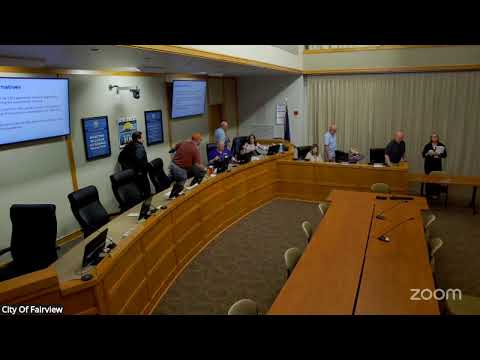
Derek Menard, fire chief for the Gresham-area fire service, told the Fairview City Council on June 4 that call volumes and unit deployments show the system must be managed as a seven-station network and that reductions in participation by neighboring cities could leave gaps in coverage.
Menard said the combined response area had 17,518 calls in 2024 and about 22,000 unit responses, and that Fairview itself saw 1,077 responses in 2024 with roughly 639 of those EMS/rescue calls. He said planners use NFPA 1710 standards, a standard-of-cover produced by Fitch & Associates in 2021–22, and time-tested NIST task studies to set response targets such as arrival of an initial unit in under four minutes and a full initial alarm within eight minutes.
“ We are understaffed. We are thin. We are as lean as we could be for the amount of call volume that we have,” Chief Derek Menard said, summarizing the department’s staffing posture and the rationale for seeking additional, sustainable funding.
Why it matters: Menard framed station placement, reliability and mutual aid as a single system. He showed heat maps and percent-availability figures that the department uses to assess whether to add apparatus or facilities. Council members asked whether proposed changes in interlocal arrangements — for example, if one or more partner cities formed their own fire district or contracted elsewhere — would reduce coverage or create layoffs.
Most important facts and supporting details
- System volumes and composition. Menard said the total response area saw 17,518 calls in 2024, about 10,000 of which were EMS/rescue calls and roughly 7,000 fire or other incidents. Fairview had 1,077 calls in 2024.
- Station reliability and overlap. Menard showed overlap maps for Station 74 (serving Fairview) and Station 75 and said station 74 was available about 82% of the time in 2022 analyses; overlap calls constituted about 23% of both stations’ volumes in that year.
- Response-time benchmarks. The department tracks dispatch, alarm processing, turnout and travel times and uses NFPA 1710 and a local standard of cover to set targets (for example, first engine on scene in four minutes 90% of the time for certain incident classes).
- Examples that shaped strategy. Menard walked councilors through an April structure fire in Troutdale that was upgraded to a multi-company response; he said, “we had 19 people on scene in 6 and a half minutes,” and that rapid multi‑unit deployment can be decisive for rescue outcomes.
- Planning tools. Menard described the community risk assessment, computer-aided dispatch AVL (automatic vehicle location) and monthly data dashboards available to city managers.
Discussion and foreseeable next steps
Council members asked about price-setting for services and whether consolidation of fire services into a single district would reduce municipal bills. Menard said firefighter pay and equipment costs are driven by regional comparables and large capital prices; he gave examples (new engines that cost about $700,000–$1,000,000, aerial truck costs in the low millions) to explain upward pressure on budgets.
On the possibility of a separate fire district that excludes Gresham, Menard warned the council about direct operational consequences: “If Station 75 went into this district, then, yes, we would lose that station. Yes. We would lose those people.” He said those employees might be laid off or would have to be absorbed by the district, depending on contract terms.
Council direction and outcomes
This was a staff presentation and discussion; no formal action was taken. Councilors asked staff to schedule longer, follow-up briefings and to share the department’s data dashboards and cost assumptions with elected officials for all affected jurisdictions. Menard said he wants to be part of any interjurisdictional conversations about districts or service realignment.
Ending
Chief Menard urged the councils of Fairview and neighboring cities to treat fire service planning as a regional exercise and asked to remain engaged as cities consider structural changes to how fire protection is funded and delivered. He said the department will continue providing monthly data and work with city managers and councilors on public outreach and options analysis.