Fairview planning staff proposes three-phase tree-code overhaul, seeks public task force and Tree City USA application
Summary
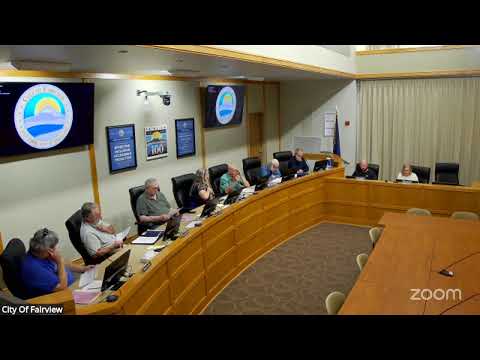
City planning staff told the Fairview Planning Commission on May 27 that it will pursue a three-phase update to the city’s tree standards, form a community task force and apply for Tree City USA. Staff emphasized outreach and clarified limits on regulating trees on private property.
City planning staff presented a three-phase plan May 27 to update Fairview’s tree-related rules, ask residents for input and apply to become a Tree City USA community.
The work session, led by planning staff, proposed Phase 1 as community outreach and street-tree updates, Phase 2 as revisions for trees in natural resource areas and development projects, and Phase 3 as new rules for private-property trees not tied to development. "We're going to be creating a community engagement plan for the outreach and some concepts for the outreach during future phases of the project," staff said.
Staff said Fairview already meets most Tree City USA requirements and could apply now that the city issued an Arbor Day proclamation this year. "We could go ahead and apply to become a Tree City USA community," staff said, adding the designation itself does not guarantee grant funding but can strengthen future grant applications.
The nut graf: the proposed code updates aim to make standards clearer for residents and staff, preserve canopy where the city can legally act, and start a longer community conversation about whether and how the city should regulate trees on private property.
Planning staff described three main code locations that govern trees: chapter 12 (street trees and right-of-way standards), chapter 19 (development code, including natural resource areas) and the sidewalk and street tree maintenance handbook (adopted by reference into chapter 12). Staff recommended a phased approach because the issues and potential limits on city authority differ across those sections.
Phase 1 would revise the street-tree handbook and chapter 12, update the approved street‑tree lists used in specific neighborhoods, run community outreach (surveys, presence at July’s Fairview on the Green and notices in the quarterly Fairview Point) and form a tree task force composed of residents and people with tree/natural-resources expertise. Staff planned to begin community engagement in summer and form the task force this fall.
Phase 2 focuses on trees in natural resource areas and on development sites. Staff said the current chapter 19 language about preserving trees in natural resource areas is "vague and not objective," and needs clearer, objective standards that comply with Oregon land‑use law for housing development.
Phase 3 would examine private-property tree removal that is not tied to development and not in a natural resource area. Staff said the city currently has no enforceable code that requires private owners to replace trees removed from backyards outside natural resource zones. "There's no language...that would enforce that those trees be replaced if they're removed," staff said. Because Phase 3 affects many private property owners, staff emphasized outreach and deliberation before drafting any regulatory proposals.
Commissioners and attendees raised questions about what the city can and cannot regulate on private property (for example, trimming limbs that overhang property lines versus requiring removal), whether homeowners would be required to replant when removing diseased trees, and how invasive species such as English ivy should be handled. Staff said trimming an overhanging limb is allowed but the city cannot generally require a neighbor to remove a tree on private property; conversely, tree removal that is within the natural-resource buffer would typically require a permit and replacement planting.
Several commissioners urged the task force to include homeowner representatives, HOAs and independent arborists to avoid conflicts of interest and to keep the process practical for property owners. Commissioners also asked staff to consider practical changes such as allowing street trees to be planted in front yards where planter strips are too narrow and to update the 2015 street-tree handbook to make planting and maintenance guidance clearer.
Staff noted gaps in the city’s tree inventory and mapping: GIS data exist but have been collected inconsistently because of turnover in GIS staffing. Staff said improving the inventory would help target future city planting events and enforcement for missing street trees.
Ending: staff will incorporate the commission’s feedback into an outreach plan and proposed task‑force structure and return with more detailed materials. No ordinance changes were adopted at the meeting; staff asked for input and "a head nod" from the commission to proceed with outreach and the task force timeline.
AI generated
The text on this page is AI generated. Summaries, highlights, analysis, and video transcripts are all produced from the original source material.
AI can make mistakes, so if you spot one, and we will fix it for everyone.
Note: the source content is unaltered by us. Any content source we link to, be it a video, an audio recording, or a document, is presented exactly as its publisher released it. That publisher is usually a government body, sometimes an individual official or another organisation.