Get Full Government Meeting Transcripts, Videos, & Alerts Forever!
Get email alerts on the Property Tax Reform topic
No spam. Unsubscribe anytime.
Wood Village finance director outlines how Oregon property‑tax rules squeeze local services
Summary
A Wood Village presentation to the Fairview City Council reviewed the history and mechanics of Oregon property‑tax limits, explained how Measure 5 and Measure 50 created assessed‑value compression and inequities, and warned that the current system shifts costs and complicates long‑term funding for police, fire and schools.
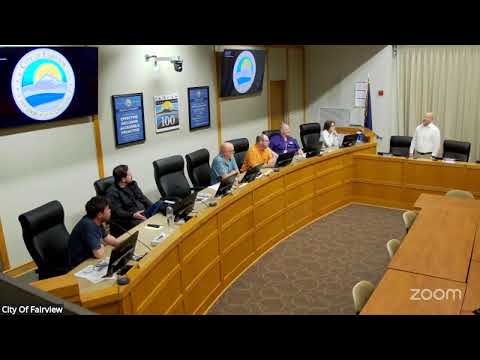
Seth, Wood Village finance director, told Fairview officials and residents at a May 21 meeting that Oregon’s property‑tax rules — particularly changes from Measure 5 and Measure 50 — have made local revenue less predictable and shifted more of the cost of public safety and schools to state funding and to some neighborhoods.
“That divorce from what’s actually happening and your actual means of ability to pay — that’s how I explain to people,” Seth said. “Assessed value … it doesn’t have a basis in reality.”
The presentation traced Oregon’s tax shifts from pre‑Measure 5 practice (where local jurisdictions estimated needs and assessors set rates) through Measure 5’s cap on taxes based on real market value and the later adjustments in Measure 50 that created a separate assessed value figure. Seth said the assessed value mechanism caps assessed‑value growth at 3% annually and was intended to stop rapidly rising tax bills, but it also disconnected taxable value from market value and from local spending needs.
Why it matters: city and county officials cannot rely on property tax growth to fund ongoing services when assessed value grows more slowly than market value. Seth and Wood Village staff illustrated the effect with examples showing two Fairview houses that sold in 2024 for similar prices but face materially different tax bills because of their assessed‑value histories.
Seth and Wood Village staff explained additional effects: after Measure 5 the state absorbed a much larger share of school funding (the presenter said roughly two‑thirds of school funding moved to the state), and local option levies now play a recurring role because they must be voter‑approved and are limited to fixed terms. “Local option levies … currently make up about 9% of all taxes imposed,” Seth said when describing how jurisdictions supplement permanent rates.
Presenters also discussed compression, the technical term for when constitutional caps mean some properties have reached the maximum they can be charged and new countywide levies shift burdens to less‑compressed properties. The finance director said that compression has concentrated tax increases eastward in Multnomah County: properties in parts of Portland with rapid market growth are often already constrained at the constitutional limit, while many East County properties still absorb new levies.
Councilors and members of the public asked about alternatives. One attendee asked whether a sales tax would help; Seth said such a change would require amending the Oregon Constitution and that past statewide attempts to enact a sales tax have failed. “You could raise the same amount of revenue from a sales tax as you do a property tax,” he said, “but it’s a big leap.”
Wood Village and the city managers coordinating the study told the council they expect parcel‑level compression analyses from consultants Tiberias and AP Triton soon; staff said those reports will show, parcel by parcel, which properties are compressed and where new revenue would fall. Greg Dirkson, Wood Village city manager, told the Fairview meeting the Tiberias parcel‑analysis work is under way and that staff asked the consultant to scrub assessor data for anomalies.
No policy change was adopted by the Fairview City Council at the meeting. Presenters and staff characterized the problems as statewide and recommended continued advocacy and study: “This is a statewide problem,” Seth said. “It impacts schools, counties and cities and the state because the state has to make schools whole.”
The presentation lasted more than a half hour with extensive public and council questions; staff said the consultant reports will be used to model revenue and compression impacts if Fairview or neighboring cities consider new levies or district changes.