
Gilbert police present e‑bike safety data as council considers helmet rules amid rise in juvenile injuries
Get AI-powered insights, summaries, and transcripts
Sign Up Free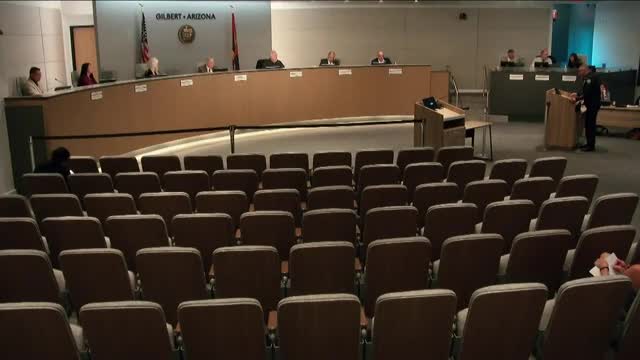
Summary
Gilbert Police presented crash and EMS data showing rising juvenile e‑bike injuries, low verified helmet use and a range of ordinance and enforcement options, including retailer education and a drone pilot to track riders.
Mayor Scott Anderson and the Town of Gilbert Council heard a police presentation on Aug. 26 on electric bicycle use, helmet use and possible ordinance options after officials reported a recent rise in juvenile e‑bike injuries.
Police presenter Mike Angstead with the Gilbert Police Department told the council the town has seen a surge in e‑bike use and a corresponding change in collision patterns, and presented crash, EMS and helmet‑use data the department collected.
Angstead said the department’s figures show verified helmet use among bicyclists in EMS responses at about 23 percent, meaning roughly 77 percent were not verified as wearing helmets. He told the council that major vehicle‑related bicycle collisions in 2024 included one adult fatality and five serious juvenile cases and that, in those major 2024 cases, only one person was wearing a helmet. “Wearing a helmet. There’s no downside to wearing a helmet,” Angstead said.
Why it matters: council members and staff said juvenile riders on higher‑speed e‑bikes are increasingly involved in serious crashes. Angstead and council members discussed multiple ways the town could respond — engineering, education and enforcement — and emphasized that no single approach is likely to be effective on its own.
Details of the presentation - Device categories: Angstead described the commonly used classifications: class 1 e‑bikes (pedal‑assist up to 20 mph), class 2 (throttle‑driven up to 20 mph), and class 3 (pedal‑assist up to 28 mph; riders must be at least 16). He distinguished these from electric motorcycles, which are treated as motor vehicles under state law and carry different helmet and licensing requirements. - Crash data: Police and fire/EMS data showed an overall decline in total vehicle‑involved bicycle crashes in recent years but a marked increase in juvenile crashes; non‑vehicular juvenile EMS responses rose from 1 in FY 2023 to 8 in FY 2024 to 12 in FY 2025 (fire department EMS counts). Angstead also cited historical examples of fatal adult bicycle collisions in 2022 and 2023. - Helmet effectiveness and compliance: Angstead cited national research (NHTSA/CDC) showing helmet use reduces head injuries and said local verified helmet use was low in major collisions. - Ordinance options: Staff presented a menu of choices — keep the status quo; require helmets for all riders; require helmets for riders under 18; require helmets for riders of all e‑bikes (class 1, 2 and 3); or require helmets only for riders of electric bicycles. The presentation also summarized measures other jurisdictions have adopted, including Scottsdale’s ordinance provisions that restrict class 3 use by those under 16 and require sellers to post educational materials and labeling (Scottsdale code referenced during the presentation). - Enforcement and outreach: Angstead said the department would start with a strong education push if the council adopted an ordinance, then transition to citation enforcement as needed. He noted the department is piloting drone first‑responder tactics to locate riders, then follow up at their homes, educate parents and, in some cases, impound equipment.
Council reaction and next steps Council members asked about enforcement logistics, retailer responsibilities and the history of Gilbert’s prior helmet ordinance (briefly adopted then repealed in 2001, according to staff). Several members said they favored targeted measures for juveniles, combined with education and retailer requirements. Vice Mayor Bobby Buckley pressed on enforceability and said education alone likely would be insufficient; Angstead replied, “the first contact is kind of educational... but there will come a point where we will have to actually write citations.”
The council gave staff direction to continue studying ordinance options, enforcement approaches and education partnerships (including with schools and retailers) and to return with more detailed recommendations.
Ending There was no vote at the Aug. 26 study session. Staff recommended a multifaceted approach — infrastructure where feasible, educational outreach, retailer notification/labeling, and an enforcement plan that would begin with education and escalate to civil citations — and will return with further analysis and specific ordinance language for council consideration.