
Chelsea commissioners advance framework for progressive-discipline policy; ask staff to circulate revised draft
Get AI-powered insights, summaries, and transcripts
Subscribe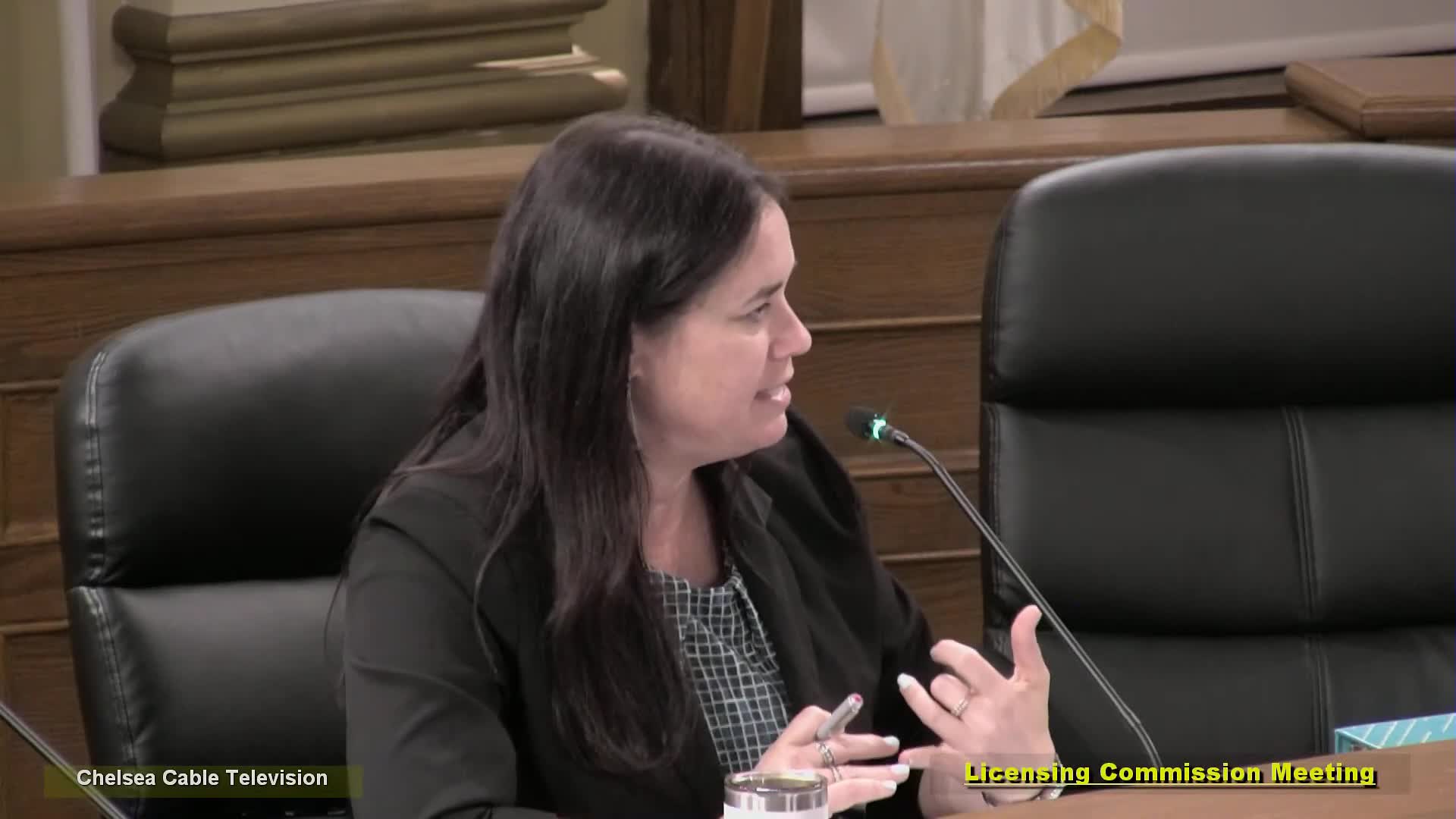
Summary
The Licensing Commission discussed a tiered progressive-discipline draft modeled in part on Framingham's policy, agreed on four violation tiers and asked staff to circulate a revised draft incorporating aggravating/mitigating factors and proposed penalty guidelines for further review.
Commissioners used the Aug. 14 meeting to advance a draft progressive-discipline policy to guide licensing enforcement decisions. Framework and tiers: Commissioners agreed in principle on a four-tier structure—Level 1 (minor), Level 2 (moderate), Level 3 (significant) and Level 4 (severe)—and reviewed example violations that should fall in each tier. Examples discussed included signage and first-time administrative errors as Level 1; unauthorized entertainment, some late-hour violations and minor noise infractions as Level 2; overserving, failure to maintain surveillance and overcapacity as Level 3; and sale to minors, drug activity, violence, wage violations or deliberate concealment of violations as Level 4. Aggravating and mitigating factors: Commissioners asked that the draft include explicit aggravating factors (refusal to cooperate with police, multiple sales in same incident, staff not trained, concealed violations) and mitigating factors (prompt acknowledgment, participation in training, voluntary corrective steps, acceptance of responsibility). They cited Framingham’s published model as a helpful example and recommended the draft allow the board to adjust penalties according to aggravating or mitigating circumstances and to consider the number of violations and the licensee’s prior record. Penalty guidelines and flexibility: Commissioners discussed a penalties chart (suspension days, fines and training requirements) as guidance rather than a mandatory formula; that chart would be paired with a section describing the purpose of penalties and the board’s ability to deviate in appropriate cases. The commission emphasized that objective guidance can reduce appeals to the state Alcoholic Beverages Control Commission (ABCC) by making the municipality’s approach transparent and consistent. Next steps: Commissioners asked staff to revise the draft to reflect tonight’s discussion, circulate a redlined version and schedule the item for follow-up at a future meeting. Several commissioners pressed for another dedicated meeting or a clear plan to complete the draft given competing schedules and the policy’s importance. Why it matters: A clear local discipline framework aims to produce consistent enforcement, clearer expectations for licensees, and fewer surprises in appeals to the ABCC.