Get Full Government Meeting Transcripts, Videos, & Alerts Forever!
Get email alerts on the Commercial Solar topic
No spam. Unsubscribe anytime.
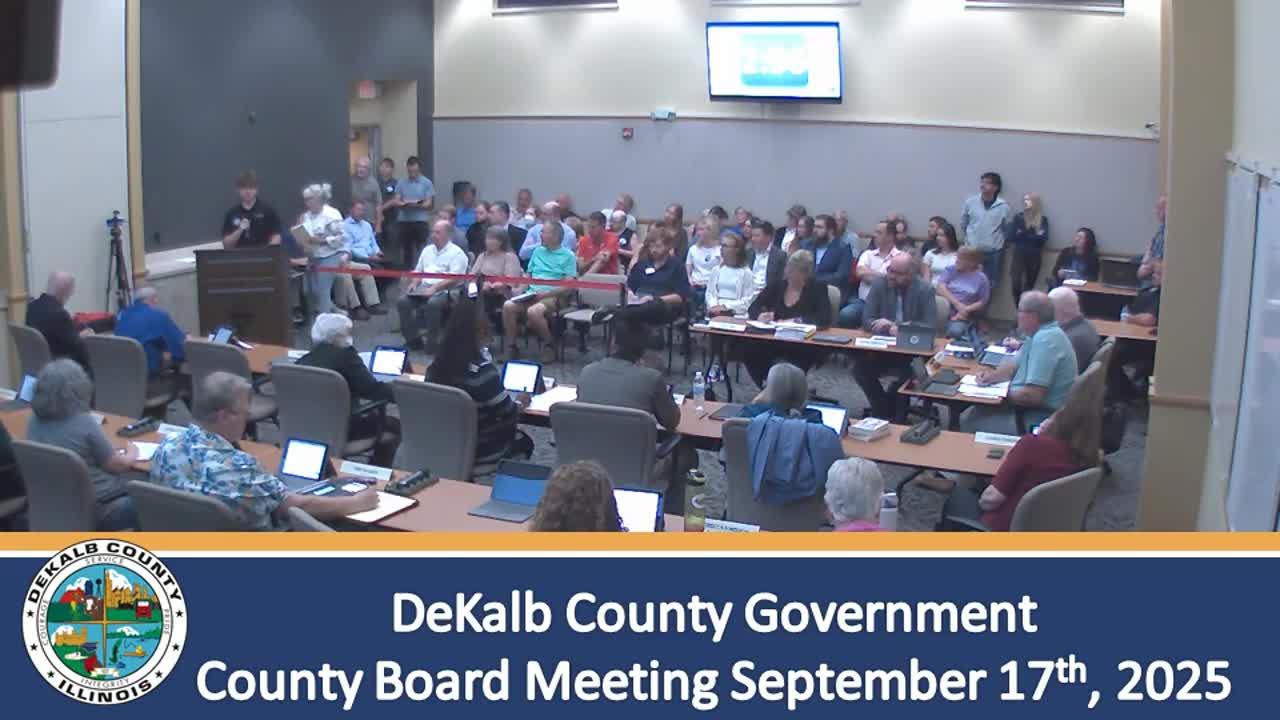
DeKalb County Board approves multiple commercial solar permits after hours of public comment
Summary
After more than an hour of public testimony both for and against utility-scale projects, the DeKalb County Board approved several special-use permits and ordinances authorizing commercial solar facilities and smaller community solar projects, while residents pressed for stronger setbacks, escrow funds and water protections.
The DeKalb County Board approved several special-use permits and related ordinances for commercial solar projects on Tuesday after extensive public comment from farmers, nearby residents, students and developers.
Supporters said the projects would bring jobs, tax revenue and clean energy; opponents warned of lost farmland, flooding risk, glare, decommissioning and inadequate protections for nonparticipating neighbors. The board approved a 4.5-megawatt special-use permit on State Route 38 and a larger multi‑parcel permit tied to Burr Oak/Burrow Solar LLC, among other projects.
The approvals followed public testimony from dozens of residents and organized groups. “This project will operate safely and does not contain any hazardous and toxic material that results in installation,” said Chase Line, identifying himself as the project developer and applicant for the Burr Oak project. Students and environmental advocates urged the board to back renewable energy; Trevor White, representing a Black Futures/Justice and Sustainability chapter, said students “unanimously decided that solar is going to be helpful for future generations.”
Opponents pressed for local conditions. Carol James of Pierce Township urged the board to require a $10,000 escrow fund for nonparticipating neighbors and cited concerns about water contamination, impaired drainage and long-term impacts for homeowners “surrounded by three sides of their homes and property by the solar panels.” Another resident asked for a minimum 200–300 foot setback and staggered tree buffers for homes facing panels.
Board members and county staff discussed what conditions the county can lawfully impose. County planning staff said state rules limit some local authority and that there is no statewide per-capita land‑dedication requirement for solar; they also noted the usual mechanisms are decommissioning fees collected at building permit time and standard setbacks in the zoning code. A board member asked whether the special-use approvals include a requirement that developers set up an escrow fund specifically for adjacent nonparticipating landowners; staff said no such condition was included in the findings and recommendations before the board and suggested private negotiations or a separate board policy if members wanted a county-mandated fund.
Speakers also raised technical and system-level questions. Several residents noted the projects will tie into the regional grid and referenced PJM and ComEd; others asked for the name of recycling facilities for end-of-life panels and for water table and FEMA flood‑zone protections. Farmers and long‑time residents argued that converting large swaths of productive farmland — speakers cited plans for projects spanning as much as 1,800 to 2,000 acres in one presentation — is irreversible and harms rural character and local food production.
Votes on the ordinances were held by roll call. The special-use permit for a 4.5-megawatt commercial solar facility on State Route 38 (ordinance O2025-16) was approved by the board (motion carried). The larger permit for Burr Oak/Burrow Solar LLC (ordinance O2025-17) passed with a recorded outcome of 15 ayes, 6 nays, 1 abstention and 2 absences as announced by the clerk. A separate 5-megawatt special-use permit (ordinance O245-19) also passed; the board recorded two opposing votes on that ordinance.
Actions attached to the approvals included the standard findings and the county’s decommissioning/permit fees collected at the building-permit stage. The board did not adopt a county‑mandated escrow fund specifically for nonparticipating neighbors as part of these special-use approvals; residents and some board members said they wanted stronger county requirements for setbacks, escrowed funds and construction workforce licensing.
Public commenters and board members asked for follow-up: clearer county guidance on decommissioning guarantees, documentation of developer recycling plans for panels, stronger visual buffers for homes, and requirements for on-site construction parking and licensed subcontractors. Developers said they would continue community engagement and pointed to application materials filed with planning staff.
The approvals mean the projects may proceed through permitting and building-permit review; several residents and township officials said they will continue monitoring construction, drainage and compliance with permit conditions.
The board’s action came amid a larger public debate across the county about how to balance renewable energy development and farmland preservation, with several speakers urging stricter local protections while others argued the projects will provide long-term fiscal and environmental benefits.