
County board debates options to address problem properties in small subdivisions
Get AI-powered insights, summaries, and transcripts
Subscribe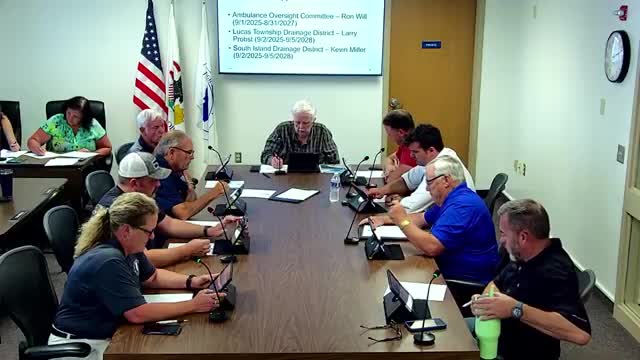
Summary
County board members spent the bulk of a legislative meeting debating whether to adopt nuisance or subdivision rules, strengthen health-department authority, or leave remedies to civil suits to address dilapidated or vacant homes creating safety and quality-of-life problems for nearby residents.
At a county legislative meeting, board members discussed long-running complaints from residents about poorly maintained or vacant houses in small subdivisions and debated possible remedies including a nuisance ordinance, subdivision rule changes, stronger health-department enforcement or civil litigation. The board did not adopt a new policy but directed staff to consult the state ttorney, the sheriff epartment and the health department and report back at a future meeting.
Board members said the recurring cases typically involve single properties near small residential pockets rather than open farm land, and that whatever remedy the county adopts must balance property-rights concerns and enforcement costs. Members repeatedly raised the risk that a broad nuisance ordinance could impose regulatory burdens on rural property owners and trigger a long county enforcement role, including potential liens and cleanup costs.
Members identified several possible legal avenues. One suggested starting with the county—ode—hapter covering subdivisions (ordinance cited as 0964 in the meeting) to add targeted standards for small residential subdivisions. Others said the health department—ode and septic regulations might be strengthened where environmental health hazards exist. The board also discussed the state—ode on noxious weeds as a parallel authority for vegetation issues. Several members said civil lawsuits are another option for neighbors but noted those suits can take years to resolve and offer no immediate remedy.
Commissioners and staff flagged practical limits to enforcement. They said the county currently lacks a dedicated enforcement officer and that pursuing liens or county-funded remediation would create new administrative responsibilities and costs. One member said the county—ould require a certified inspector or building-code official to declare a structure unsafe before more intrusive remedies are used; others emphasized excluding bona fide farm buildings from new rules.
The board asked county staff to meet with the sheriff epartment and the health department and to consult the state ttorney about what is legally permissible under state law, including whether health- or nuisance-based rules could be strengthened and whether changes could apply retroactively to existing properties. Members agreed to keep the item on a future agenda after those consultations.
Less-urgent related points included the possibility of asking neighborhoods to form homeowners associations where appropriate, exploring assessment changes to reflect dilapidation, and reviewing how other counties handle similar problems. No formal motion to adopt an ordinance or to authorize county-funded remediation was made or passed during the discussion.
The board left the item open for future action pending the staff and legal review.