
Kane County liquor commission does not reopen Blackjack’s license after heated public comment
Get AI-powered insights, summaries, and transcripts
Subscribe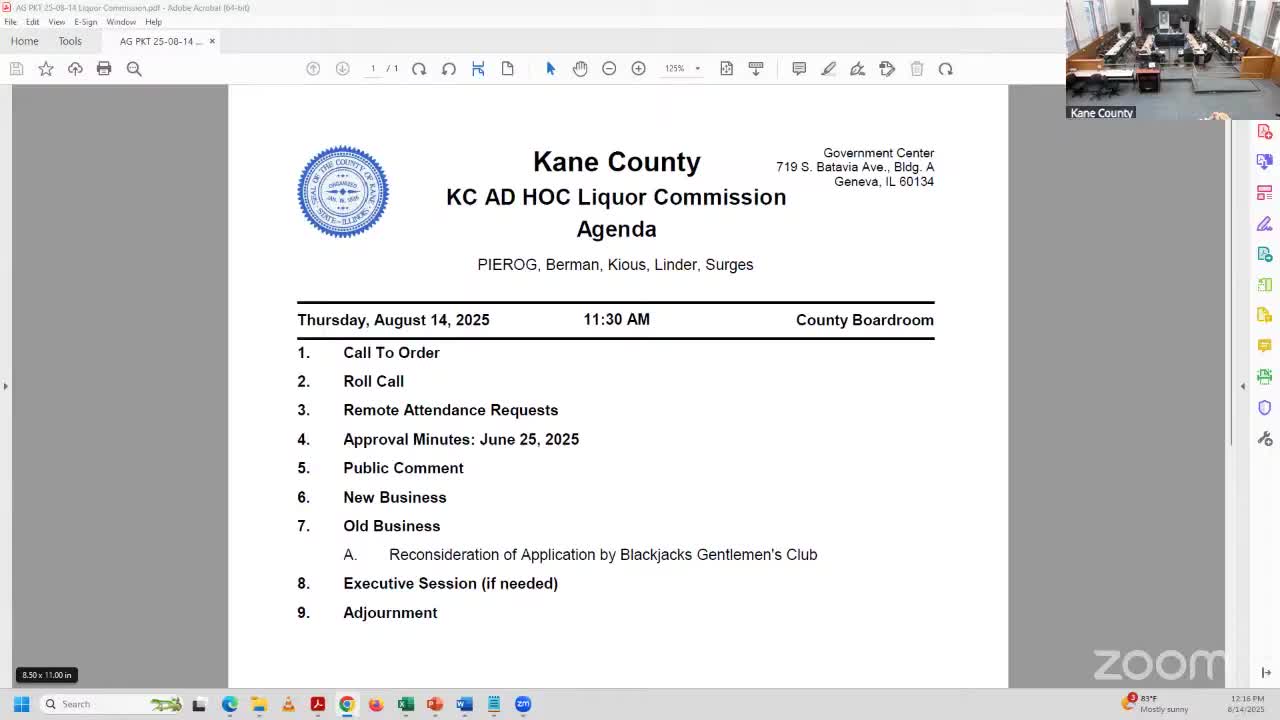
Summary
Kane County’s Liquor Commission on Aug. 14 did not take up a motion to reconsider a previously denied liquor-license application for Blackjack’s Gentleman's Club, after more than an hour of public comment that focused on campaign donations to the commission chair, public-safety concerns and the criminal history of former owners.
Kane County’s Liquor Commission on Aug. 14 did not take up a motion to reconsider a previously denied liquor-license application for Blackjack’s Gentleman's Club, after more than an hour of public comment that focused on campaign donations to the commission chair, public-safety concerns and the criminal history of former owners.
The commission’s chair convened the meeting and, after legal counsel outlined how reconsideration works within the commission’s year-long session, no commissioner moved to reopen the application; Commissioner Berman explicitly said he would not move for reconsideration. The commission then voted to go into executive session to discuss probable or imminent litigation and returned to open session without a motion to reconsider.
Why it matters: A successful motion to reconsider would have brought the club’s application back to the floor for a vote; without it the prior outcome from the June meeting remains in effect. Public speakers and several commissioners framed the matter as weighing local public-safety and community-standard concerns against the legal protections for expressive conduct and the procedural limits on denying licenses.
Legal counsel summarized the commission’s procedural position early in the meeting, saying the liquor commission functions as a “year-long session” made up of individual meetings and that a motion for reconsideration must be made according to the rules that apply to sessions. The transcript shows the attorney told the chair that “if no motion for reconsideration is made under the, terms you've generally outlined, then it's not a proper motion to reconsider at that time.”
Speakers at public comment sharply disagreed on whether the club should be allowed to hold a liquor license. Brian Anderson of Sugar Grove said the issue was public safety, arguing that establishments serving alcohol “heighten[]” disorder and calls on law enforcement; Janine Mayer invoked the Illinois Liquor Control Act and said the law allows licensing authorities to consider “public morals, community welfare, and the character of the applicant.” Mayer also referenced convictions of past owners and said approving the license “would set a dangerous precedent.”
Other speakers urged the opposite position. Denise Theobald said the law forbids denying a license on the basis of “personal beliefs,” and argued that a liquor license raises the minimum patron age to 21 and imposes additional oversight that could make the establishment safer. Several speakers — including Michelle Batag and others — raised concerns about campaign contributions to the commission chair and asked the chair to recuse herself from any vote; the chair had previously recused herself during earlier portions of this matter.
Comments during public comment also included local-impact concerns. Steve Serafin raised traffic, parking and law-enforcement capacity issues and offered to provide the county’s attorney with printed materials. Simon, who identified himself as an Elgin resident, said new housing near Route 25 made the club’s location less appropriate for the community. Speakers on both sides described the history of the business; Janine Mayer named the prior owners and the business entity that currently operates it.
The chair addressed both legal and practical points during public comment, noting that Kane County’s adult-entertainment ordinance, state law and the U.S. Constitution shape the commission’s decisions. The chair said a liquor license would impose limits on performers’ conduct and would prevent “full nudity” where a liquor license applied, and described background checks and other vetting steps that had been completed for the current applicant.
Following public comment the commission voted to go into executive session “for pending probable and/or imminent litigation.” After returning to open session, the chair asked whether any commissioner would move to bring reconsideration forward; neither Commissioner Surges (also referred to as Sergis in portions of the transcript) nor Commissioner Berman offered such a motion, and the request to reconsider therefore was not brought to a vote.
The meeting record shows an earlier attempt to adjourn before public comment failed by roll call, reported in the transcript as "failed, 2 yeses, 3 noes." The transcript further shows that the commission later took the executive-session vote and proceeded as described; no final license action was taken publicly on Aug. 14, and the record indicates the matter may be the subject of litigation.
The commission’s transcript and public comment show sharp divisions among residents over the balance between community standards, public-safety data and First Amendment considerations. The county attorney and the chair repeatedly framed the matter as constrained by state law and local ordinances; members of the public alternately urged deference to prior commission decisions and emphasized that denying a license on moral or religious grounds raises legal issues.
No further schedule for the matter was announced on the record at the close of the meeting.