
Administration committee approves multiple vendor contracts amid objections to cooperative purchasing
Get AI-powered insights, summaries, and transcripts
Subscribe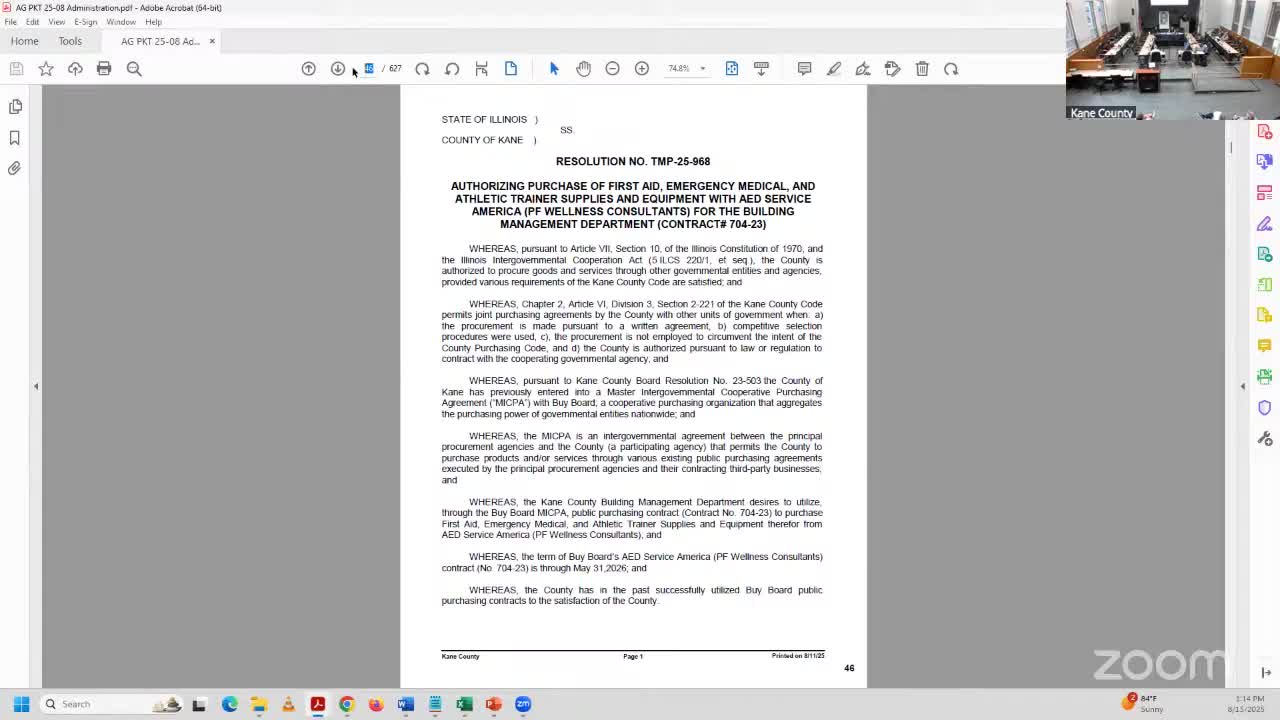
Summary
The committee approved contracts for AED maintenance, office furniture and maintenance supplies totaling several hundred thousand dollars while at least one member repeatedly objected to use of cooperative purchasing agreements instead of open bids.
The King County Administration Committee on Aug. 15 approved several vendor contracts covering automated external defibrillator (AED) maintenance, furniture for the development department and maintenance repair-and-operations supplies, while one committee member repeatedly objected to use of cooperative purchasing agreements instead of open competitive bids.
The AED contract, described by building management staff as a safety measure to keep more than 200 AEDs operable across county properties, was authorized as a not-to-exceed $50,000 purchase through a group-purchasing agreement. Kevin Harris, building management department representative, said the contract will cover batteries, naloxone and defibrillation pads so “they’re operational.”
The committee also approved a $144,985 furniture purchase for the development department from The HON Company LLC and a maintenance, repair and operations (MRO) contract with Grainger not to exceed $200,000 per year. All three measures passed after roll calls; several motions drew a recorded “no” vote from Committee Member David Young, who objected repeatedly to cooperative-purchasing vehicles.
Why it matters: Committee members said the contracts let the county move quickly on safety and time-sensitive projects. Opponents argued cooperative agreements can bypass the competitive bidding that sometimes yields lower prices.
Details and debate: Harris said urgency drove the choice for the AED contract: “This is a safety issue across the county, and so we believe that speed is important to make sure ADs are working properly.” He said the AED work was procured through Omnia Partners/BuyBoard and that the arrangement yields a discount on parts.
David Young said he opposed the county’s frequent use of co-ops: “I’m not a fan of any of these co ops. … You could save me more money,” he said, urging staff to seek alternate suppliers and competitive bids for larger purchases. Committee Member Juvy (first referenced as Juvy) told Young she would reluctantly support the furniture purchase because the development project was “time sensitive,” but asked that future large projects be spot-checked.
Committee members and staff said cooperative agreements are used when they provide convenience, speed or better pricing for specific categories; staff said they still compare prices and use alternative suppliers when they are cheaper. Harris said of Grainger: “When this is the cheapest option, we we use it. When it’s not the cheapest option, we find other places to go.”
Outcome and follow-up: All three contracts were approved by the committee. Committee records show at least one dissenting vote by David Young on each of those items; motions carried. Staff said they will continue price comparisons and, where feasible, seek competitive bids for future large purchases.
Ending: The contracts move forward to implementation under the department’s contract numbers listed in the administrative packet; committee members asked staff to provide spot checks and to document comparative pricing for future large procurements.