
Growing for Kane program launches soil‑health study and highlights drone seeding pilot
Get AI-powered insights, summaries, and transcripts
Subscribe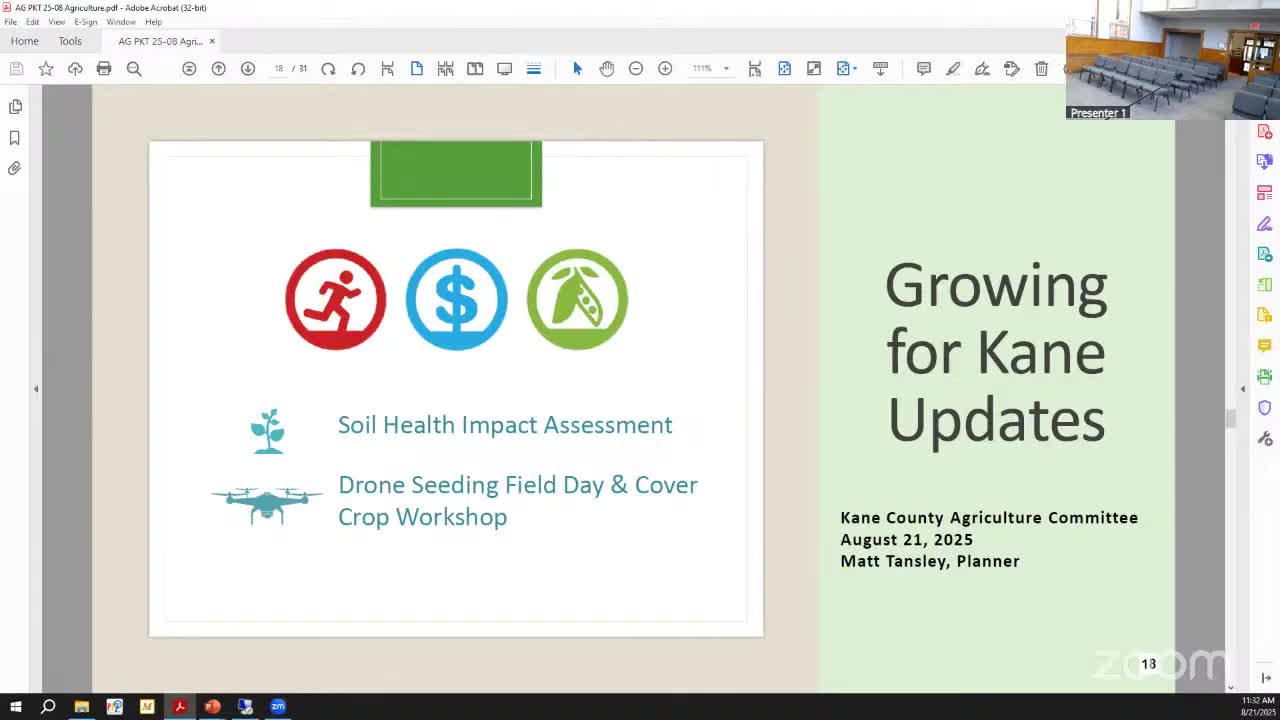
Summary
Program staff described a soil‑health impact assessment that will sample 5–10 commodity crop farms and produce a business-case report by March; the committee also heard a demonstration of drone seeding and a cover‑crop workshop and discussed limitations for specialty growers and licensing requirements for drone services.
Staff for the Growing for Kane program updated the committee on two projects: a soil‑health impact assessment that will pair soil testing with business analysis, and a recent field day demonstrating drone seeding and cover‑crop practices.
Matt Tansley, program lead, said the soil‑health project — run with consultants New Venture Advisors and the Delta Institute — will test between 5 and 10 Kane County farms using the Cornell Soil Health testing service and focus on commodity-crop producers (corn–soybean rotation) because those crops represent the majority of acreage in the county. Tansley said the project will recruit 2–3 farms willing to share business financial information so New Venture Advisors can model profitability impacts; he said any public report will protect participating farms’ anonymity. The expected final business-case narrative is planned for March of next year, and staff aim to begin outreach to recruit farms by October.
Committee members asked whether boutique or specialty growers would benefit; Tansley said the project’s small sample size would make it difficult to generalize for the diverse set of specialty producers and that the study therefore focuses on commodity growers while continuing separate outreach to specialty and urban producers.
Tansley also summarized a drone seeding field day hosted at the St. Charles Horticulture Research Center that demonstrated aerial drones for seeding and fertilizer application. He described a smaller demonstration drone with up to a 50‑pound capacity and said a larger model can carry up to 100 pounds. A company representative showed programming of flight waypoints to control spread area, speed and dispensing volume; the demonstration used roughly 10 pounds of seed on a 1–2 acre test plot. Committee members raised questions about coverage per load, the economics compared with helicopters or airplanes, and whether farmers would own drones or contract services. Tansley and others said in the near term licensed service providers will operate the drones because state and federal aviation and pesticide application certifications are required.
Extension and Farm Bureau speakers noted practical advantages: drone seeding enables cover‑crop seeding before harvest without damaging crops and can offer more precise application to reduce off‑target drift. Participants observed that drone operations may be more cost‑effective for some uses as the technology scales, but operators and vendors must still manage battery swaps, licensing and area coverage. The committee heard that three state legislators attended the field day and that the event highlighted local farmer adoption; staff are following up with outreach, education and potential pilot services.
Why it matters: the soil‑health study aims to produce farm‑level testing and business modeling that county producers can use to evaluate soil‑health practices; the drone demonstration shows emergent technology for seeding and fertilizer application that could affect timing and precision of cover‑crop and input applications.
Next steps: staff will recruit farms for the soil‑health sampling by October, proceed with testing and modeling, and distribute findings in early 2026; staff will also continue outreach on drone services and cover‑crop technical assistance.