Get Full Government Meeting Transcripts, Videos, & Alerts Forever!
Get email alerts on the Solar Development topic
No spam. Unsubscribe anytime.
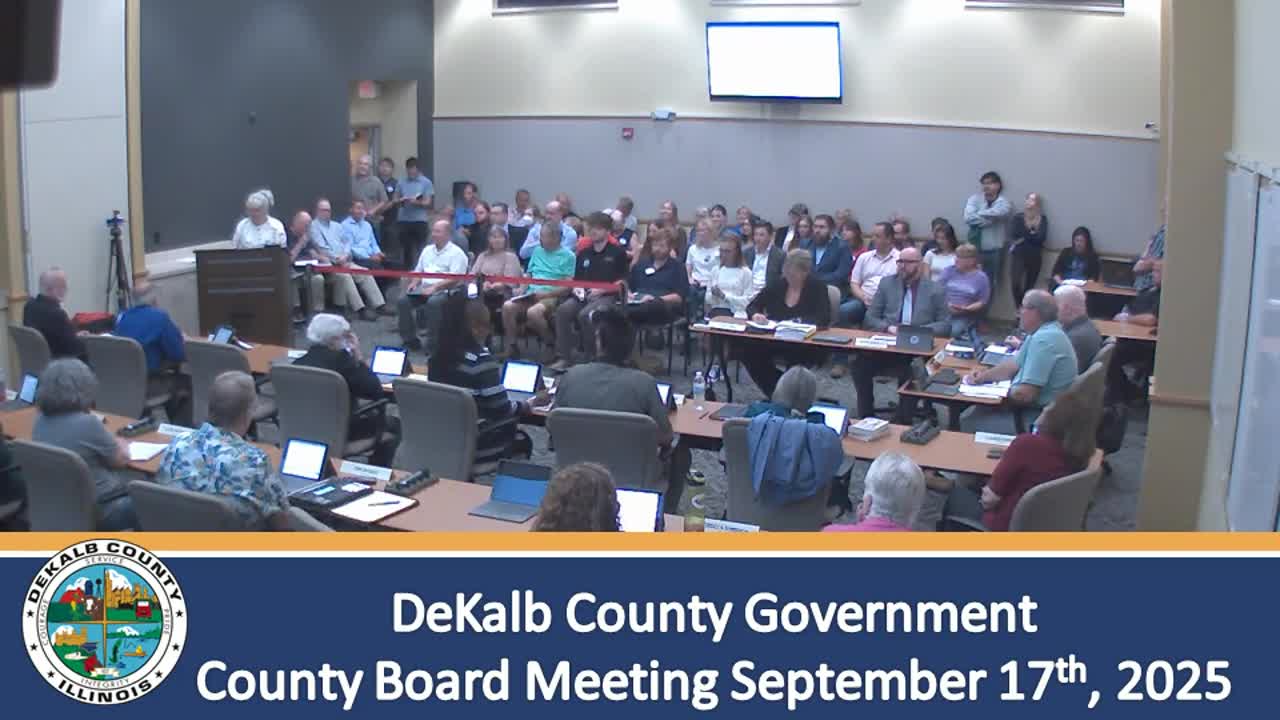
DeKalb County Board approves large commercial solar permits after hours of public comment
Summary
After extended public comment and debate over water, setbacks and neighbor protections, the DeKalb County Board approved special-use permits for multiple commercial solar projects, including the Burr Oak/Burrow Solar application covering roughly 2,000 acres.
The DeKalb County Board voted to approve special-use permits for multiple commercial solar projects, including a permit tied to Burrow (Burr Oak) Solar LLC’s roughly 2,000-acre commercial solar proposal, after lengthy public comment and a roll-call vote.
Supporters told the board the projects would bring renewable energy and tax revenue, while neighbors and local groups raised concerns about flooding, water wells, visual impacts and protections for nonparticipating residents.
The discussion mattered because the permits authorize large-scale land conversion in several townships and set the conditions under which developers must build, operate and decommission facilities. County board members said they were constrained by the county zoning code and state law when considering conditions beyond the ordinance.
Public comment ran long and included dozens of speakers from both sides. Carol James, a Pierce Township resident, urged the board to require an ‘‘enforcement fund’’ for homeowners surrounded by panels, saying it would help residents recover losses from "water contamination, flooding, watershed glare, impaired drainage systems, and repairs" she attributed to the project surroundings. Dan Beard, a Sierra Club representative, described the facility as large — "a 300-megawatt facility, large enough to power 76,000 homes" — and argued that many residents support solar as a way to advance sustainability and local school funding.
Chase Line, identifying himself as a representative of Renewable Energy and the project applicant, asked the board to follow planning committee and hearing officer recommendations and said the application ‘‘will operate safely and does not contain any hazardous and toxic material’’ that would result from installation. Isabel Gregory, a Northern Illinois University student, urged the board to consider younger residents’ interest in renewable energy and said the land could return to farming after project life.
Opponents raised several recurring concerns. Molly Eskimo, a resident near the proposed site, said the county had created "no process for compromise" and asked the board to require stronger protections: minimum 200–300-foot setbacks for homes surrounded on multiple sides, staggered tree buffers, limits on construction hours, bonding and licensing for the construction workforce, aquifer and well monitoring, and an escrow account for nonparticipating neighbors. She also noted FEMA flood-zone designations for some parcels and urged required water protections. Ron Reyes, a local farmer, warned that "you can't run a utility electric system with that kind of variability" and discussed solar output fluctuations on cloudy days.
Board members discussed the limits of local authority. A county staff member confirmed there is no state statute that requires counties to dedicate a per-capita share of land for solar, and said some requested conditions — such as private compensation funds negotiated between developers and neighbors — were not attached to the special-use findings being considered. The county will collect decommissioning or other fees at the time of building permit as required under current procedures, staff said.
After debate the board moved to approve the Burrow/Burr Oak permit along with other solar ordinances. The motion carried by roll call; the clerk recorded the vote and declared the motion carried. The board did not adopt a separate mandatory compensation fund for nonparticipating neighbors as a condition attached to the special-use permit, though multiple speakers had asked the county to require one.
Next steps identified in the meeting record: developers will proceed under the approved special-use permits and the county will collect required fees at permitting; several residents urged the board to monitor construction, require monitoring for water impacts, and ensure funds are available for decommissioning and post-construction remediation.
The board’s action came after more than an hour of public comment. Several speakers said they support renewable energy in principle but asked for stronger, enforceable measures to protect neighbors and farmland. The board indicated it would follow its current zoning code and the hearing officer’s recommendations when enforcing permit conditions.
Community members and developers may pursue private agreements beyond the special-use findings, and some speakers asked the county to consider placing neighborhood protections into future policy updates to the zoning ordinance rather than rely on case-by-case permits.