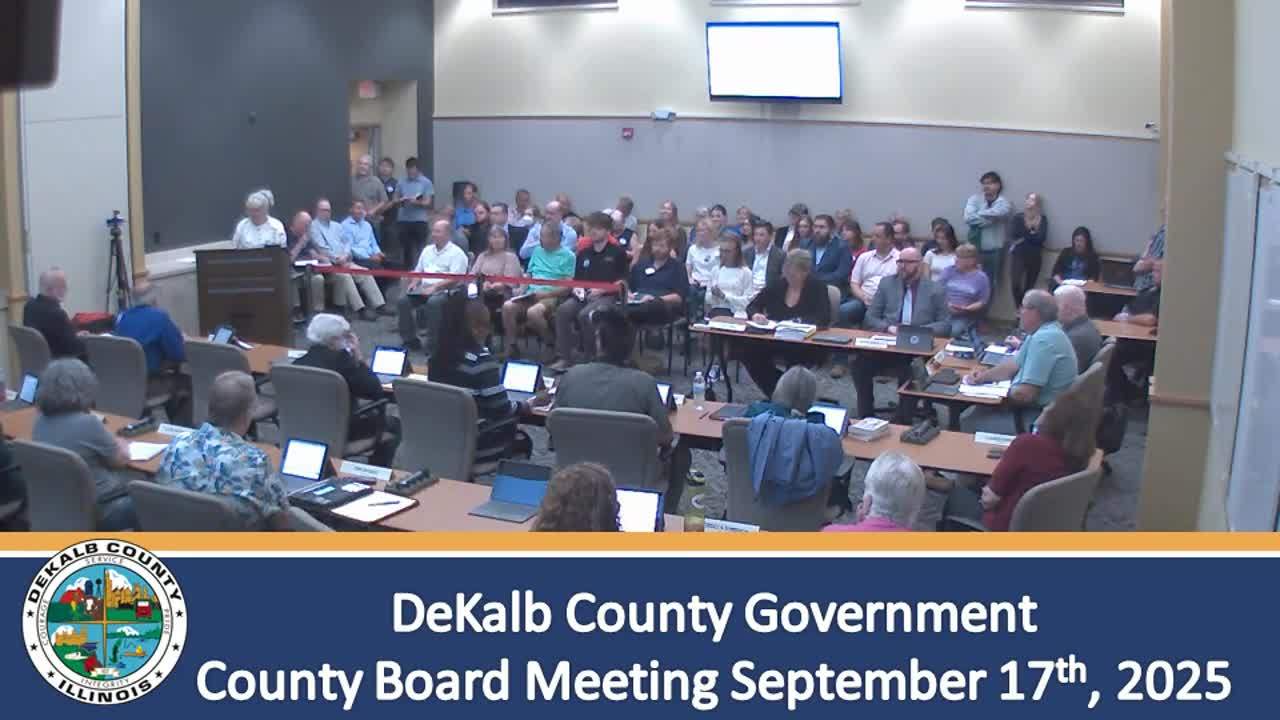
DeKalb County board approves multiple commercial solar permits amid strong public debate
Loading...
Summary
The DeKalb County Board voted to approve several special-use permits for commercial solar facilities after hours of public comment that ranged from support for renewable energy to concerns about farmland loss, local impacts and decommissioning protections.
The DeKalb County Board on Sept. 17 approved multiple special-use permits for commercial solar facilities after extended public comment from residents, students, environmental groups and project representatives.
Supporters said the projects would deliver jobs, tax revenue and renewable power, while opponents warned large-scale panels would convert prime farmland, create drainage and flood risks and leave neighboring homeowners exposed. The board adopted the permits following roll-call votes and committee recommendations.
Public speakers cited both local and regional considerations. Carol James, a Pierce Township resident, urged the board to require an escrow or remediation fund for neighbors who would be “surrounded by three sides of their homes and property” and to protect against water contamination, glare and impaired drainage. “We need an enforcement fund,” she said. Molly Eskimo, a nearby resident, asked the board to require larger setbacks, maintained visual buffers and a county‑overseen escrow for nonparticipating neighbors, proposing $10,000–$20,000 per affected household to be held by the county.
Developers and project supporters stressed community benefits. Chase Line, a representative of Renewable Energy and the applicant on one project, told the board the company had worked with local townships, that the project “will operate safely and does not contain any hazardous and toxic material,” and urged the board to follow planning‑committee and hearing‑officer recommendations. Dan Beard, representing the Sierra Club, said the largest project proposed — which he described as a 300‑megawatt facility — could produce enough energy to power tens of thousands of homes and bring tax revenue to school districts.
Opponents raised technical and policy concerns. Ron Reyes, a Pierce Township farmer, argued solar variability required thermal backup and said widespread renewables could increase utility costs; he cited examples of reliability issues in other jurisdictions. Several speakers said energy generated by the solar farms would feed into regional transmission (they named PJM and ComEd) and would not necessarily go directly to local homes.
Board members acknowledged the public concern and the constraints of state law. One board member said the county must apply its zoning ordinance and cannot exceed the limitations set by state legislation, and staff confirmed that many requirements for the special use permits were set by county code and by state rules.
Speakers on both sides urged stronger conditions: larger buffers around residences, clearer escrow and decommissioning funding, limits on construction hours, licensed and bonded construction labor, water monitoring for wells and flood‑risk mitigation. Several residents said the county should require named recycling or decommissioning plans and concrete funding guarantees before permitting long‑term leases that could last 30 years.
The board conducted separate roll calls and approved the permits and ordinances recommended by the planning committee and hearing officer. The approvals followed committee votes and public hearings; the board also noted it had no authority to impose some of the broader state policy questions raised by speakers.
The permits approved at the meeting will proceed with the conditions recorded in the county’s findings and the hearing‑officer reports. Several residents said they will continue to press for additional county policy changes and for closer enforcement of setback, water and decommissioning provisions as projects move into construction and permitting phases.