Get Full Government Meeting Transcripts, Videos, & Alerts Forever!
Get email alerts on the Driveway Variance topic
No spam. Unsubscribe anytime.
Board postpones Onondaga Drive circular driveway variance after debate over coverage and paving
Summary
The Upper Arlington Board of Zoning and Planning postponed a variance request for 2381 Onondaga Drive that would raise front-yard development coverage from 25% to 35.2% for a circular driveway; staff recommended revisions including reduced coverage and permeable paving; the applicant agreed to return Sept. 3.
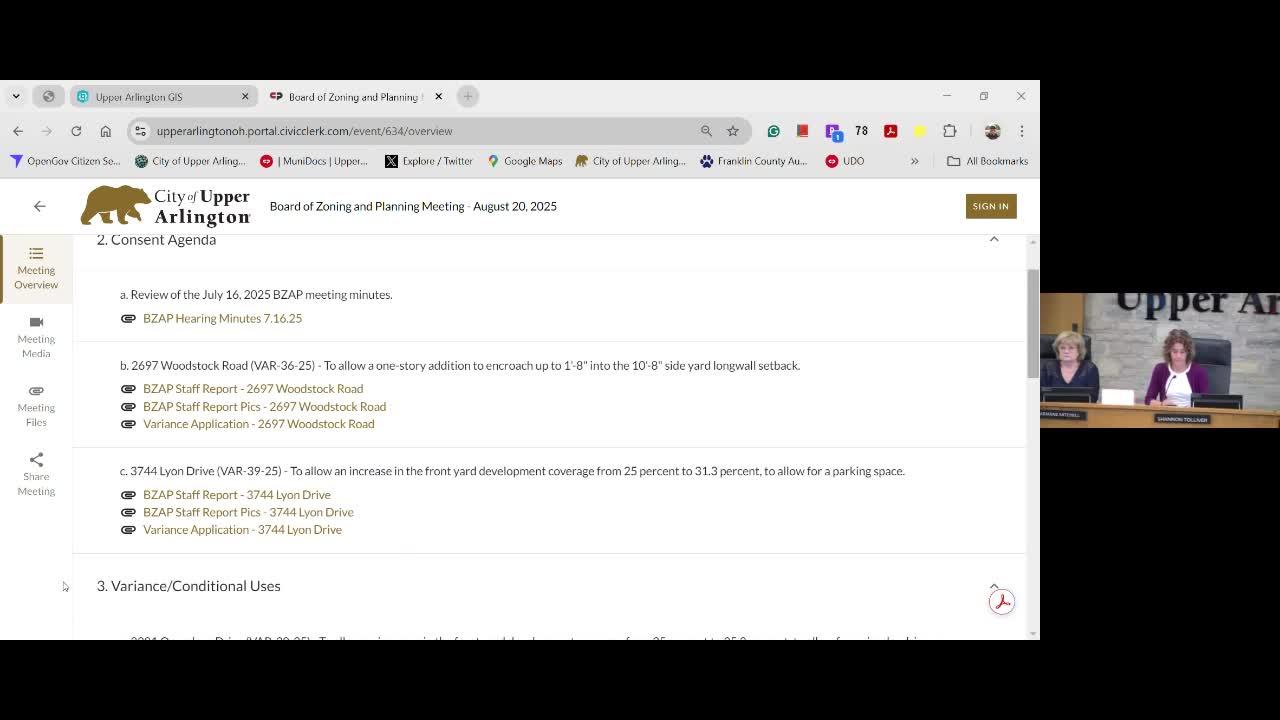
The Upper Arlington Board of Zoning and Planning on Aug. 20 postponed a variance request from the owners of 2381 Onondaga Drive that would have allowed a circular driveway increasing front-yard development coverage from the 25% limit to 35.2%.
Board members and staff debated alternatives to the applicant’s proposal, including matching a nearby granted variance of 32% that used permeable pavers, narrowing the driveway throat at the street, or otherwise reducing hard-surface area. Staff said permeable pavers still count toward the hard-surface limit under the city code unless grass pavers or gravel are used, and noted gravel driveways are prohibited. The applicant said family safety, bicycle and tricycle use, and delivery-truck maneuverability motivated the wider widths and a smoother finish than permeable pavers provide.
Staff told the board the lot is midblock on the south side of Onondaga Drive between Asbury Drive and Mountain View Road and that the applicant’s building permit for a new house is already approved. Staff recommended matching the adjacent 2021 variance (32% coverage) with permeable pavement in the inner arc as a compromise. The applicant said permeable pavers are uncomfortable for children on bikes and present long-term maintenance concerns; he said narrowing the 12-foot section would reduce coverage by roughly 2 percentage points and that he could consider revisions.
The board directed the applicants to return with revised plans and postponed the item to the Sept. 3 BZAP meeting. The board discussed acceptable alternatives: narrowing lane widths (board members suggested 10–11 feet rather than the proposed 12–13 feet), narrowing the throat near the street and flaring inward, and adding on-site stormwater measures (rain gardens or barrels) to offset increased runoff if full permeable pavement is not used.
Why it matters: front-yard development coverage limits are intended to reduce stormwater runoff and preserve neighborhood front-yard green space; board members framed the vote around precedent and neighborhood character.
Next steps: the applicant may submit revised drawings to planning staff about a week before the Sept. 3 meeting, and the board said it would prefer a design that reduces the coverage percentage significantly from the current 35.2% request.