
District leaders outline staffing levels, unfunded safety mandate and hiring pressures
Get AI-powered insights, summaries, and transcripts
Subscribe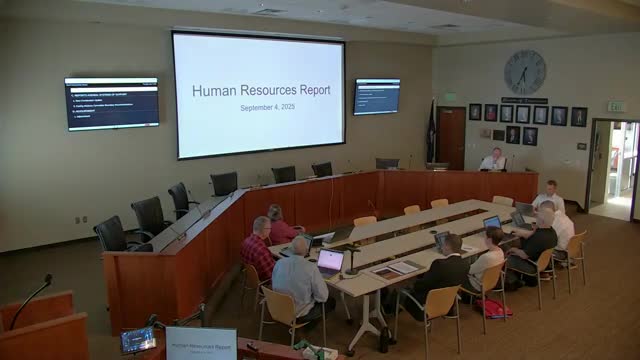
Summary
Human resources presenters told the Board of Education that the district’s workforce has grown with enrollment and that personnel costs, staffing ratios and an unfunded safety requirement will strain operations and budgets.
Tim Smith, presenting the human resources report to the Board of Education on Sept. 4, said the district is now operating systems and staffing to support 25 schools and roughly 20,000 students and that people are the district’s largest cost. “We spend the bulk of our budget on people,” Smith said. He and other staff detailed head counts, hiring challenges and several budget pressures the district faces going into a year when new buildings will add recurring personnel costs.
The overview framed several near-term fiscal and operational issues: a requirement in recent safety legislation for either a school resource officer or a school guardian at elementary schools that the district says carries no dedicated funding; persistent understaffing in nursing and special education roles; and recruitment difficulty for specialized positions such as school psychologists and special‑education teachers.
Why it matters: staffing choices determine whether new schools open fully staffed and how services such as counseling, nursing and behavior supports are delivered. Smith said the district will need to seek additional maintenance-and-operations funding to staff buildings built with bond proceeds.
Smith presented the district’s staffing “stadium” — 17 elementary schools, three middle schools, four high schools and one alternative school — and a district payroll structure that includes roughly 195 distinct job titles. He said the district had about 4,476 active employees on its roster and that average teacher salary used for a simple cost estimate is about $74,000. Using that figure, he illustrated how salary costs quickly scale at the school level: “This number is simply this 58 times 74,000. . . that represents a little over $4,000,000 in salary,” Smith said when discussing a typical high school.
Staff and board members flagged specific shortages. Smith said the district is “way behind the rest of the state on ratios for our nurses,” and added that some mental-health and behavior positions are funded by grants rather than the ongoing general fund, creating a risk if those grants end. On security staffing, Smith said the recently passed safety bill contains a provision requiring personnel that is “not funded” and gave the example that a school resource officer at about $80,000 each for 17 elementary sites would be “well over a million dollars” in additional recurring salary, a sum not in the current budget.
Board members asked about custodial coverage for rented facilities, and Smith said rentals rely on custodians volunteering overtime but that staffing pressures have made those overtime assignments harder to fill. He described custodial staffing and scheduling as square-footage–based and said sweepers are part-time night staff while general custodians are full‑time daytime employees.
On recruitment, Smith said some elementary openings attract 50–60 applicants while other specialized roles — school psychologists and special-education teachers — required out‑of‑state recruitment. He summarized exit and stay interviews as pointing to student behavior as the top retention pressure: “It’s all around behavior. Student behavior,” he said.
Discussion versus direction versus decision: the session was a staff report and question-and-answer; the board did not take formal votes. Board members asked staff to continue tracking specific risk areas and Smith said the district will add an employee satisfaction survey and an exit survey this year to gather more actionable data.
What’s next: staff and the superintendent plan to continue work on salary schedules, position control and recruitment strategies; the board asked for follow-up information on nursing ratios and on how grant-funded positions would be sustained if grant dollars end.
Ending: The board thanked Smith for the detail and for the level of analysis. Several board members emphasized support for teachers’ work hours and said the district will need to balance staffing capacity as new schools open.