
Plan commission sends Epcon’s 55+ Courtyards at Heritage Trail PUD to town council with conditions
Get AI-powered insights, summaries, and transcripts
Sign Up Free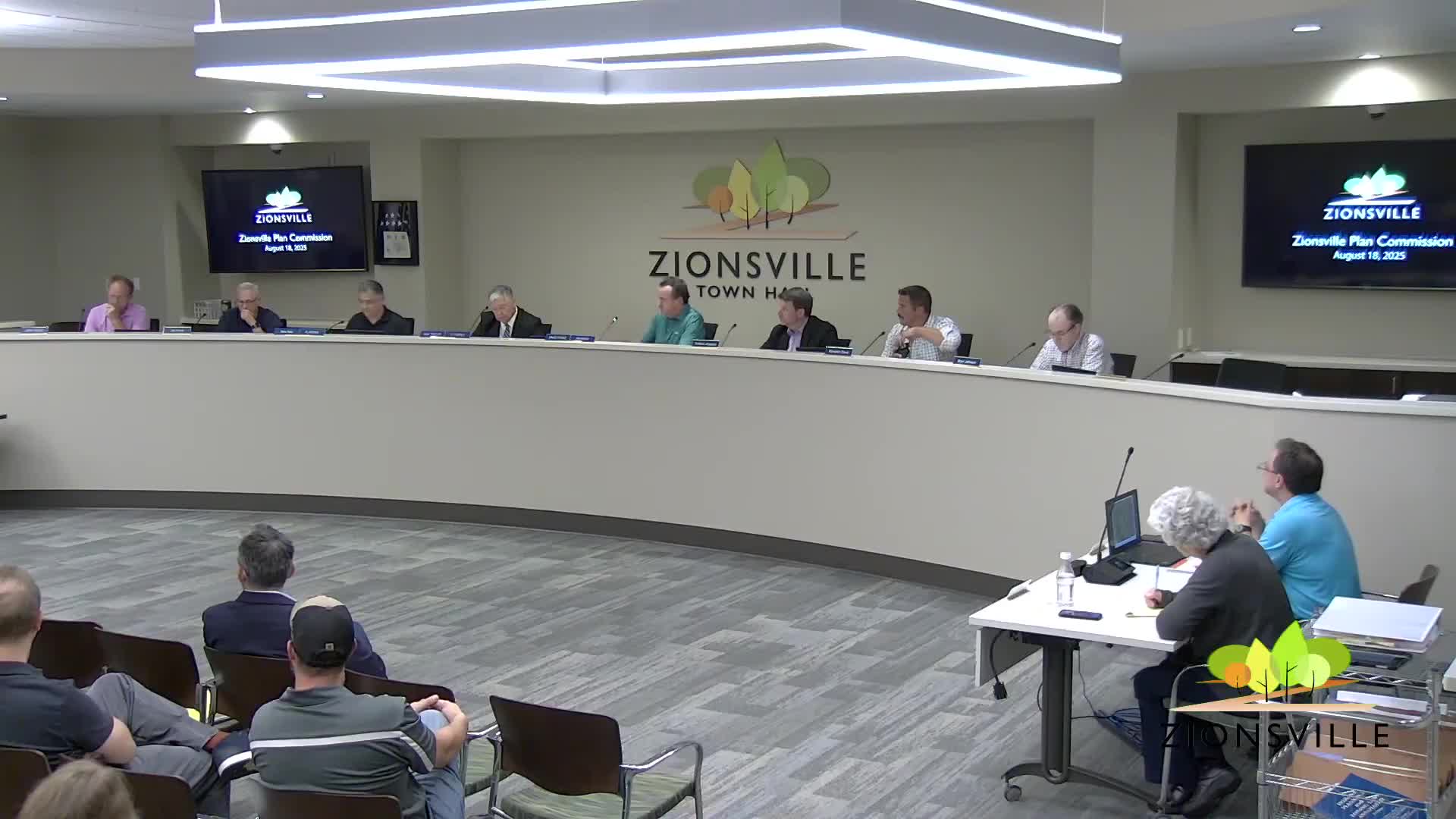
Summary
Zionsville Plan Commission voted 6-0 to recommend the Epcon Communities Courtyards at Heritage Trail planned unit development (PUD), attaching staff conditions including resolving public-works and Boone County highway comments and implementing a traffic-impact study.
ZIONSVILLE, Ind. — The Zionsville Plan Commission voted 6-0 on Aug. 18 to forward a recommended approval of Epcon Communities’ Courtyards at Heritage Trail PUD rezoning to the town council, subject to technical conditions including resolution of Department of Public Works and Boone County Highway comments and implementation of the project’s traffic-impact study.
The PUD would rezone roughly 180.75 acres from a rural single-family residential district (R-1) to a planned unit development to allow an age-restricted neighborhood of up to 362 homes targeted to the 55-and-over market. The commission’s recommendation required the petitioner to satisfy technical advisory committee items and follow any traffic mitigation that the Department of Public Works requires.
Why it matters: Commissioners and staff framed the project as an alternative to conventional subdivisions that could add municipal revenue and housing options for older adults, while neighbors pressed for protections against traffic and visual impacts. The conditions attached to the commission’s favorable recommendation are intended to ensure engineering, right-of-way and traffic issues are resolved before the town council acts.
Epcon’s representatives described changes made after prior meetings to tighten setbacks, clarify courtyard easements, add architectural and landscaping standards for perimeter lots, require that driveways be concrete, and explicitly require compliance with the federal Housing for Older Persons Act (HOPA) for 55+ communities. “Our goal was to create a document that was solely and uniquely tailored to the Epcon development,” attorney Mike Andreoli said. Land acquisition director Dale Pifer said the ordinance text was revised “mainly for clarity and for alignment with the drawings,” and emphasized that the concept plan itself did not change.
Neighbors and commissioners pressed two recurring issues: traffic impacts on County Road 800, and the town’s future use of a park parcel included in the PUD. Tom Dirks, a Hampshire resident who backs the project, said he still worries that traffic could be greater than predicted if ball fields or other public uses are sited at the park parcel. “I think traffic will be more of a problem than what people might think,” Dirks said.
Epcon said the buildout is expected to be incremental—roughly a seven-year build out in three stages—and that dedication of right-of-way and park parcels will be handled through a dedication agreement approved by the town council and mayor. Epcon also raised a separate concern about a recent Boone County Highway Department position that might require the developer to convey parcels in fee rather than only dedicate right-of-way; town staff said Boone County’s letter referenced dedication but did not explicitly require conveying fee simple title.
Action: Commissioner Brad Johnson moved for a favorable recommendation to the town council “based on the findings in the staff report subject to resolution of the technical advisory committee comments submitted by the Department of Public Works (Exhibit 5) and Boone County Highway Department (Exhibit 6), and the traffic impact study to the satisfaction of the Department of Public Works followed by implementation of the study’s recommendations.” The motion was seconded and passed in a 6-0 roll call vote.
Next steps: The PUD will go to the town council for final consideration. The park parcel’s final use would be determined through separate town processes and any dedication agreement required by the council.
Ending: Commissioners and staff noted they would continue to scrutinize engineering and right-of-way details during the development-plan review stage. The commission’s recommendation does not itself authorize construction or change parcel ownership.