Get Full Government Meeting Transcripts, Videos, & Alerts Forever!
Get email alerts on the County Budget topic
No spam. Unsubscribe anytime.
Brazos County presents lean FY2026 budget; tax-rate posting and capital projects draw public concern
Summary
County staff presented a proposed FY2026 general fund budget of $192.4242 million at a Sept. 9 public hearing. Officials said the proposal is a cautious 1% increase over last year but must be posted against the no-new-revenue rate; residents urged delaying capital projects and questioned staffing and tax impacts.
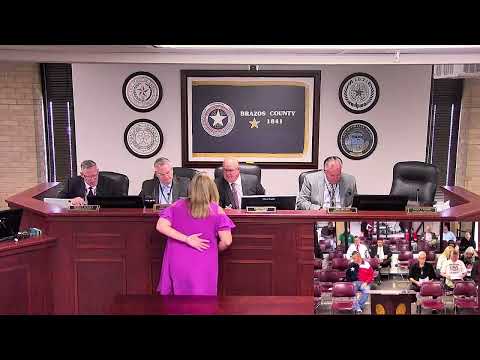
Nina Payne, a Brazos County staff member, presented the proposed fiscal year 2026 general fund budget at a public hearing Tuesday, Sept. 9, 2025, in the Commissioner's Courtroom at the Brazos County Administrative Building. Payne said the FY2026 general fund (excluding transfers) is proposed at $192,424,200, an increase she described as "lean and cautious." The county scheduled a separate tax-rate discussion at 9:15 a.m. and a Commissioners Court session at 10 a.m.
The proposal aims to protect core services while absorbing cost pressures, Payne said, noting slower revenue growth and rising demand on public safety, courts, roads and emergency services. "This is a lean and cautious budget," Payne said. She told the court the FY2025 adopted general fund was $190,350,000 (excluding transfers) and that staff identified about $8,150,000 in decreases during departmental budget meetings to free resources for priorities.
Why it matters: county officials said state rules on how budgets are posted affect public perception of the increase and that changes in property valuations and potential state actions are complicating a year of tight choices. Judge Cassell (identified in the meeting as the county judge) explained that "by statute by the Texas legislature, we have to post our budget, which is a 1% increase over last year, but we have to post it as an increase over the NNR [no-new-revenue rate]," a practice the judge said creates higher public-facing percentage figures.
Key details from the presentation: Payne identified targeted nonrecurring investments of about $4.7 million for one-time noncapital projects (she cited items such as HVAC replacements, armored vests and furniture), and about $1,050,000 for position reclassifications and seven new positions. She said departments were asked to reassess priorities and that certain capital projects were delayed to limit discretionary spending. Payne summarized overall reductions of roughly $8.15 million from departmental requests to balance priorities.
Public commenters and concerns: Precinct 2 resident Chris Barnes urged delaying or eliminating two items—an office building project on Texas Avenue and an unspecified budget item linked to the medical examiner's office—saying those capital expenses could wait given current pressures. Barnes said, in part, that such spending "is not something we need right now." Precinct 3 resident Ronald Rhodes, speaking about personal financial strain and taxes, called a reported 12% tax increase "completely unacceptable" and asked elected officials to find cuts. Precinct 4 resident Kathy Viens questioned assumptions about office-space expansion and asked whether the county had accounted for potential job losses or role changes from artificial intelligence; Commissioner Nettles and others said AI is being considered as a cost and efficiency tool.
Commissioners' framing and context: Commissioners and the judge repeatedly credited staff for identifying savings and stressed the complexity of preparing the budget amid shifting property valuations and pending state-level changes. One commissioner said the court had found $8,150,000 in reductions and noted the budget contains "significant investments" in public safety. Commissioners discussed whether deferring the proposed $10 million 101 Texas Avenue project (across from the courthouse) could lower the immediate tax-rate impact; Commissioner Brown suggested bonding in a later cycle as one option to reduce pressure on the current tax rate.
Fiscal context and uncertainties: Officials warned of uncertainty tied to appraisal-roll adjustments and state policy changes. During discussion a commissioner said the court had just learned that about $120 million in valuations had been removed from the roll shortly before staff and the court finalized proposal assumptions; that change complicates revenue forecasting. Staff also told the court the county's maintenance-and-operations (M&O) position for the fiscal year could be a deficit in a range roughly between $5 million and $15 million depending on the eventual tax rate.
Next steps: The court recessed the budget workshop at 9:04 a.m. and reconvened for a tax-rate discussion at 9:15 a.m., with the formal Commissioners Court beginning at 10 a.m. Officials invited further public comment during the upcoming sessions and said details from workshops and supporting documents remain posted online.
Ending: The court emphasized that the posted percentage change reflects statutory posting rules rather than the county’s internal 1% planning increase, and officials repeatedly asked for public input as they refine the proposal ahead of the tax-rate decision later that morning.