
Committee advances district cell-phone rule to full board; administrators will set enforcement procedures
Get AI-powered insights, summaries, and transcripts
Subscribe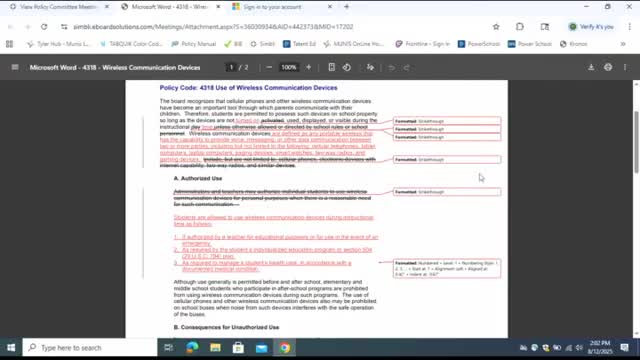
Summary
The committee voted 3-0 to send an updated wireless-communication policy to the full board after agreeing teachers and other responsible adults may confiscate visible devices and that exceptions exist for IEP/504 and health needs; principals will finalize building-level procedures and messaging.
The policy committee voted unanimously to forward an updated wireless-communication policy to the full school board after staff and administrators discussed enforcement details including confiscation and authorized exceptions.
Key decisions: The committee approved sending the revised wireless-communication policy to the board. The policy uses statutory-aligned definitions of “turned on”/“activated” devices and explicitly lists device types such as cellular phones, tablets, laptops, gaming devices and smartwatches. The policy specifies authorized use only when permitted by a teacher, required by an IEP or Section 504 plan, or needed for student health reasons.
Enforcement discussion: Staff asked whether teachers as well as administrators should be empowered to confiscate devices that are visible and used in violation; administrators recommended that any responsible supervising adult be allowed to intervene, with confiscated devices routed to a consistent central location. Doctor Clark, speaking as a school administrator, said he preferred that a responsible adult be able to confiscate but that devices be turned in to a central office to avoid inconsistent enforcement.
Principals and messaging: Committee members said building principals should be allowed to determine the practical protocol and that district staff will meet with middle- and high-school principals to coordinate messaging to families. The policy leaves a range of disciplinary responses to the student code of conduct, enabling administrators to apply developmentally appropriate, graduated consequences.
Outcome and next steps: The motion to send the wireless-communication policy to the full board passed 3-0; staff will meet principals and prepare parent messaging prior to implementation.