
CRA approves rebate of city tax increment for Gaines Street development after debate over student housing
Get AI-powered insights, summaries, and transcripts
Subscribe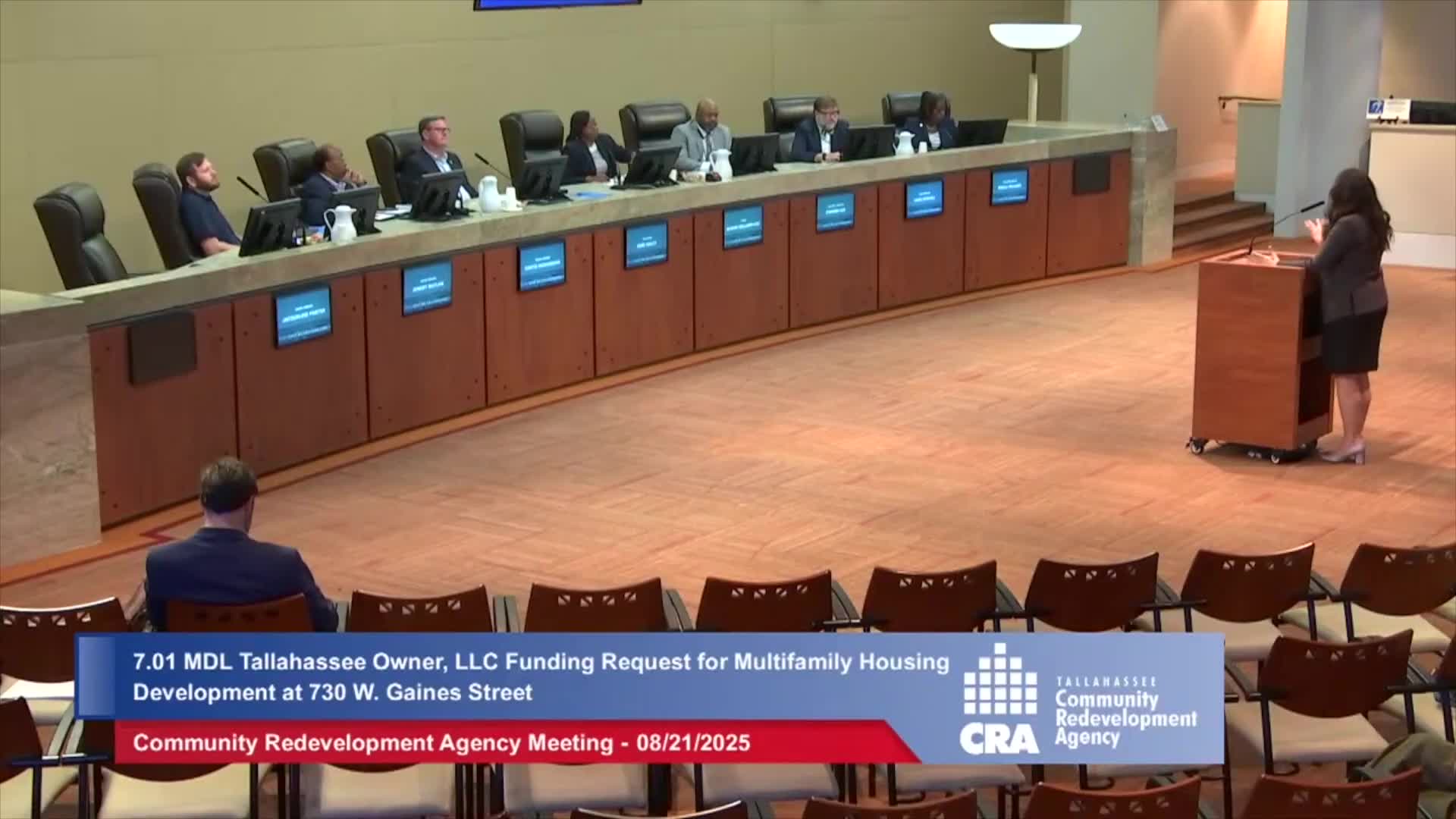
Summary
The Tallahassee CRA approved a request from MDL Tallahassee (Park 7 affiliate) to rebate the city portion of future ad-valorem taxes from a planned 187‑unit Gaines Street development, with board members and nearby developers pressing for community-benefit conditions and limits on student‑housing metrics.
The Community Redevelopment Agency voted to approve a city tax-increment reimbursement for a proposed 187-unit housing development at 730 West Gaines Street. The developer requested 100% of the city portion of the increased ad-valorem tax revenue for about six years (through the CRA’s remaining life) to offset extraordinary site costs; board members approved the request by a 4–1 vote.
The applicant told the agency the project requires demolition, deep soil remediation and two levels of subterranean parking because about half the parcel is encumbered by easements and contamination; the applicant said construction costs are about $253 per square foot and estimated the city portion of incremental taxes at roughly $238,000 per year. “The city will collect exactly what it’s collecting today, and the increase based on the project's completion will be reimbursed annually just for the city's portion,” attorney Aaron Tilton said.
Why it matters: The CRA will forgo the city share of new property tax revenue from the site during the reimbursement period; staff and the applicant presented estimates showing the fully built project would still generate substantially higher net tax revenue for all taxing jurisdictions once reimbursements end. Staff said the developer would invest roughly $150 million up front and that reimbursed funds would be directed to on-site public‑benefit elements such as streetscape, demolition/abatement and mobility upgrades.
The debate: Nearby developers and counsel told the board the proposed incentive appears to break an earlier CRA practice of excluding student housing from these incentives. Maribel Nicholson Choice, attorney for a neighboring owner, said extending an abatement to a single developer “without conditions that clearly reflect and are concrete reflections of the CRA’s goals” is unfair to other private investors who helped redevelop Gaines Street. Developer Brad Wolf said the project appears to be student housing and urged the agency not to fund student housing projects that can proceed without public assistance. Robert Volpe, representing another College Town developer, suggested conditions such as limiting average beds per unit to encourage smaller‑unit multifamily living or requiring an affordable‑housing component.
Board response and conditions: Board members pressed the applicant on build costs, remediation and the unique site constraints. The applicant described site contamination, permanent easements that reduce buildable area and the need for concrete construction at nine stories. The applicant also committed on the record to community benefit items discussed during the meeting — local vendor participation, outreach to the university communities, and to investigate a modest contribution to the city affordable‑housing fund during the reimbursement years; after the chair’s follow‑up, Aaron Tilton said, “Yes, ma’am. You have a yes on all three.”
Outcome and next steps: The CRA approved the staff recommendation (option 1) to grant the rebate; commissioners instructed staff to incorporate negotiated conditions into the development agreement and to work with the developer on community engagement with neighboring property owners. The applicant told the board that, if approved, it intends to mobilize in early 2026 and to open in summer 2028.
Discussion vs. decision: The article separates board discussion (site costs, student‑housing policy, possible conditions) from the formal action (adoption of a tax‑increment reimbursement agreement, 4–1 vote). The board directed staff to negotiate contract conditions and community outreach plans but did not adopt a separate new policy defining student housing eligibility.
Ending: The agreement will be memorialized in a development contract and incorporated into the CRA’s remaining TIF schedule; staff said the reimbursement ends when the CRA sunsets.