
Catoosa County holds community engagement meeting on proposed E‑SPLOST 7 renewal ahead of Nov. 4 vote
Get AI-powered insights, summaries, and transcripts
Subscribe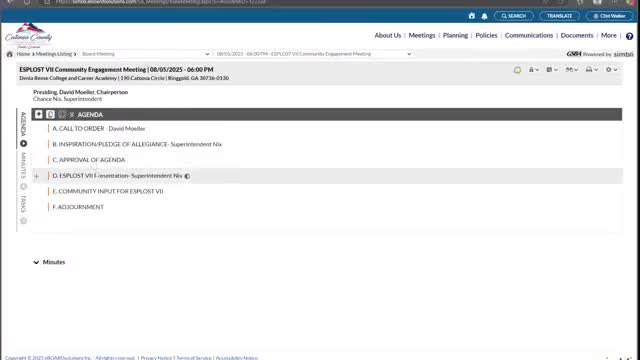
Summary
Catoosa County Public Schools outlined projects funded by the Education Special Purpose Local Option Sales Tax and sought public input on priorities for an upcoming Nov. 4, 2025 vote; residents urged turf fields, Boynton Elementary upgrades and sustained investments in safety, technology and facility equitability.
Catoosa County Public Schools officials presented proposed projects for a proposed continuation of the Education Special Purpose Local Option Sales Tax (E‑SPLOST) and sought public comment at a community engagement meeting Aug. 5, outlining priorities ahead of a Nov. 4, 2025, referendum on continuing the 1¢ sales tax. Superintendent Nicks told attendees the district and its consultants received 1,700 survey responses and that safety, secure and well‑maintained classrooms were the top priority for respondents.
Why it matters: The E‑SPLOST is a locally imposed one‑cent sales tax voters in the county must approve every five years; the district says proceeds have funded new schools, safety upgrades, classroom technology, and capital maintenance since voters first approved the tax in 1997.
School officials showed a district video detailing previous E‑SPLOST phases and projects and listed the priorities the board proposes for “E‑SPLOST 7”: continued investments in school safety (surveillance, access control and crisis alert systems), facility equitability across older campuses, instructional technology for classrooms, and capital maintenance (roofs, HVAC and other structural work). The district noted eight of 18 schools are more than 50 years old and five are more than 65 years old; the facilities inventory covers about 2 million square feet, and the bus fleet is roughly 150 vehicles.
Speakers from the community urged that specific projects be included in the E‑SPLOST plan. Matt Phillips, speaking for Heritage High School, asked the board to consider converting the school’s natural grass football field to synthetic turf, saying it would reduce weather‑related cancellations and heavy maintenance by staff. “It’s all about the kids,” Phillips said. He told the board his campus nearly had to move its homecoming game last year because Ringgold High School — which has turf — could host the event when Heritage could not.
LFO High School Principal Brad Langford also urged a turf conversion at Tommy Cash Stadium, saying a turf field would benefit multiple sports, band and community events and would increase the venue’s availability for feeder schools and external groups. “This project would lead to equitability, accessibility, and sustainability,” Langford said.
Boynton Elementary Principal Jennifer Scott asked the board to prioritize phase‑two work at her campus, describing repeated leaks, aging plumbing and insufficient cafeteria and gym capacity as enrollment grows. “This represents a critical opportunity to enhance the learning environment at Boynton,” Scott said, asking that phase‑two plans include additional classrooms, a new media center, expanded cafeteria and safer traffic flow on Boynton Drive.
District staff highlighted how past E‑SPLOST investments were used: earlier phases supported five new schools; later phases funded classroom technology (interactive boards, teacher laptops, student devices during the pandemic), upgraded security systems, athletic facility improvements and a career and technical education academy that provided college credit and industry credentials to students. The district said in the 2024–25 school year 76 students earned more than 1,000 college credit hours through Georgia Northwestern Technical College and 103 students earned industry‑recognized credentials.
Officials reiterated E‑SPLOST restrictions mentioned in the presentation: proceeds may be used for capital projects such as construction, renovation, equipment and technology but not for salaries, health care or general operating costs; voters must approve continuation every five years. The district encouraged continued public input through the forms and QR code provided at the meeting and via the web form or email listed by the district for E‑SPLOST 7 input.
Discussion versus decision: The meeting was a listening session and no binding action to place projects on the ballot was recorded during the engagement segment. Board members and staff asked for community feedback; several residents and school principals presented requests the board could consider when finalizing its project list.
What’s next: The board asked citizens to continue submitting input as staff prepares a final project list for any formal board action and for materials the district will circulate ahead of the Nov. 4 referendum. The district emphasized community feedback will inform final project priorities.
Sources: District presentation and video shown at the Aug. 5 community engagement meeting; public commenters Matt Phillips, Brad Langford and Jennifer Scott.