
Beatrice council approves HDR study to evaluate local power plant ahead of 2031 capacity changes
Get AI-powered insights, summaries, and transcripts
Subscribe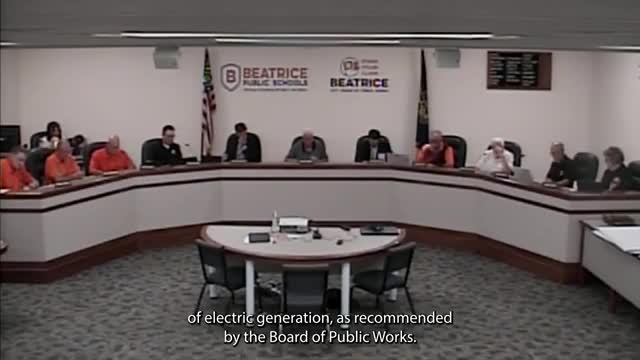
Summary
The Beatrice City Council approved a not-to-exceed $134,406 agreement with HDR Inc. to study the feasibility, procurement, permitting and timeline for a local generation facility to meet increased capacity requirements that take effect after existing contracts expire at the end of 2030.
The Beatrice City Council voted to retain HDR Incorporated to study options for a local electric generation facility and a procurement and permitting timeline ahead of 2031, when the city’s current energy and capacity contracts expire.
The study will evaluate several generation options, including gas-fired units, and produce cost estimates and a procurement and permitting schedule. City staff described the agreement as a due-diligence step and said the not-to-exceed price is $134,406. “This does not in any way obligate the City to actually go forward building … a power plant,” a city staff member told the council.
Council members framed the study as a response to two trends: the city’s contracts for energy and capacity expire Dec. 31, 2030, and the Southwest Power Pool is raising reserve requirements. City staff said current rules require roughly 15% reserve capacity but are increasing to about 35% in some winter months, effectively raising the city’s needed spare capacity by roughly 25 percent. Staff also reported longer lead times for procurement of key equipment—on the order of five years—meaning planning must start promptly to meet a 2031 timeline.
During debate, council members and staff discussed the plant’s intended use as capacity backup rather than a full-time baseload generator. A council member asked whether the plant would “just be sitting there” until dispatched; staff answered that if the Southwest Power Pool dispatches the facility it would run, otherwise it would provide stand-by capacity.
Council discussion also covered potential regional partnerships to spread costs and the city’s efforts to contact neighboring communities for interest in partnering. Staff said the city’s planning team will reach out to other local utilities to explore economies of scale and potential joint ownership or dispatch arrangements.
The resolution to retain HDR carried 7–1. The council and staff emphasized that the study is a step in due diligence and does not commit the city to construction.
Tying the work to local priorities, council members framed capacity planning as part of long-term community infrastructure alongside water and landfill planning, saying securing reliable power helps economic development over decades.