
Cary ZPA continues hearing on 360-unit Damish Farm mixed-use proposal amid New Haven Drive traffic dispute
Get AI-powered insights, summaries, and transcripts
Subscribe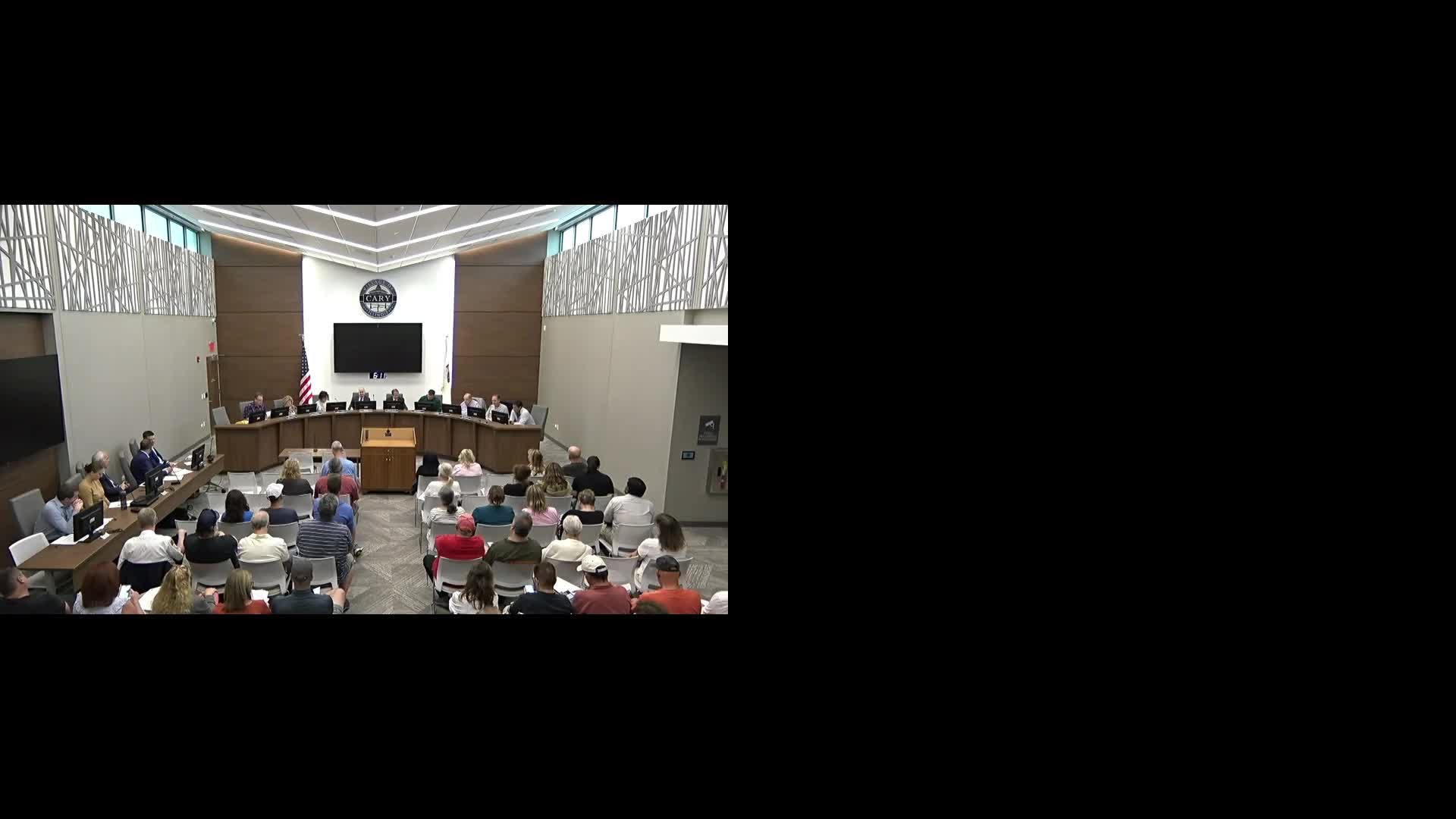
Summary
Fiduciary Real Estate Development presented a 360-unit mixed-use plan for the Damish Farm site along Route 31. The Zoning, Planning and Appeals (ZPA) board continued the hearing to Aug. 21 after extended public comment focused on the proposed New Haven Drive extension, traffic impacts and a requested stormwater variance.
The Village of Cary Zoning, Planning and Appeals board on July 17 continued public hearings on a proposal to redevelop the Damish Farm property on Route 31 into a mixed-use project that would combine about 4.7 acres of commercial frontage with 360 apartment homes behind it.
The petitioner, Fiduciary Real Estate Development, asked the ZPA for five actions: an amendment to the village comprehensive plan to change the site’s future land use from commercial to commercial plus multifamily; a zoning map amendment to rezone most of the site to R-3 multifamily; approval of a final plat of subdivision; approval of a planned-unit development with five zoning departures; and a variance to the McHenry County stormwater ordinance allowing longer detention drawdown times. The board continued the hearing to Aug. 21, 2025, to allow time for additional analysis and review.
Why it matters: Residents of the adjacent Cambria subdivision said the proposal — and specifically the developer’s request to extend New Haven Drive to Route 31 — could change traffic patterns, safety and neighborhood character. The board and staff repeatedly framed the dispute as a balance among the village’s comprehensive-plan guidance, developers’ market assumptions, public-safety access and traffic-calming options.
What the proposal would do: Tony DeRosa, vice president of Fiduciary Real Estate Development, said the firm proposes two phases: 234 apartments in phase one and 126 in phase two, for 360 units total; a retail pad area of about 4.7 acres that could accommodate roughly 32,000 square feet of retail; and a townhouse-style apartment design with private entries and attached garages. DeRosa said average asking rents are currently projected between $1,600 and $2,900 per month. He said the developer reduced unit count since a neighborhood meeting in April and moved stormwater ponds and buildings to increase buffers for adjacent single-family yards.
Zoning departures and technical requests: Staff summarized the departures the petitioner seeks: reduced building setbacks along the New Haven extension (code minimum 30 feet; requested as low as 15 feet at limited building faces), reduced internal setbacks in limited locations (30 to 24 feet), a reduction in required parking (petitioner proposes 784 spaces vs. the code-calculated 810), an increase in density from 9 to 13 units per acre, and additional monument signage beyond code limits. The petitioner is also requesting a variance to extend stormwater basin drawdown time beyond the McHenry County standard, which is currently 72 hours.
Stormwater design and variance request: Jared Plasic, civil engineer for Manhart Consulting, described five on-site infiltration basins and said the site’s soils and a large existing depressional storage area give the property “higher infiltration rates than you get pretty much anywhere else in most of the Chicagoland area.” Plasic said the design provides roughly 130% of typical detention volume for a project of this size and that the developer originally sought up to 108 hours but revised the variance to request 90 hours (the McHenry County standard is 72 hours). “We’re essentially doubling the amount of a typical stormwater,” Plasic said, and requested a slightly longer drawdown to match the site’s infiltration-based approach. Several neighbors raised concerns about mosquitoes and standing water.
Traffic, New Haven Drive and public safety: The most contested element in public comment was the New Haven Drive extension. Brian Simmons, Cary’s director of community development, said the extension is shown in village planning documents and the Route 31 subarea plan as a potential future connection that would preserve commercial frontage on 31 while permitting housing behind it. The petitioner said the village requested the New Haven connection during prior planning stages and that an IDOT-reviewed signal at Route 31 may be workable only if the connection is provided; developer testimony said lack of a signal would reduce the marketability of the retail frontage.
Louay Abuna, traffic engineer for KLOA, described the traffic study methodology: weekday AM and PM peak counts and a Saturday midday count taken in February, and modeling that followed Illinois/IDOT practice. He said the study evaluated intersections on Route 31 and in the adjacent neighborhood and modeled redistribution of local trips if New Haven were extended. Abuna acknowledged the study was submitted for village and IDOT review and had received comments from the village’s consultant; he said a revised version incorporating those comments was under preparation.
Board and public concerns prompted the ZPA to request a broader and clearer traffic presentation. Chairman Patrick Corey said commissioners lacked enough information on possible “substitution” traffic — drivers who would divert from other arterial routes through the neighborhood if New Haven is connected to 31 — and asked the petitioner to provide additional analysis and clear graphics showing current and projected volumes. Several speakers and commissioners urged independent review or clearer disclosure of assumptions, particularly about traffic east of Cary Algonquin Road and the cumulative effect of other planned projects in the area.
Public comment and neighborhood impact: More than two dozen residents spoke, many describing New Haven as a long-established cul-de-sac with daily pedestrian, bicycle and school activity. Speakers cited recent speeding, children walking to parks, and worry that a new through connection would invite cut-through traffic, trucks and higher speeds. “You open up New Haven Drive to Route 31, and you’re gonna have Route 31 going right down New Haven Drive,” said Tom Gillis, a New Haven resident. Several residents asked for independent study of property-value effects and requested protections such as one-way access or traffic-calming designs if a connection is approved.
Public-safety response: A fire representative said pre‑submittal coordination showed the extension could shorten emergency response times by about one to one and a half minutes in some scenarios; the representative said apparatus access and hydrant placement were part of ongoing review. Commissioners noted public-safety benefits alongside quality-of-life concerns.
Economics and mitigation: The developer provided projections and local-impact estimates: an estimated $1.4 million annual tax increment at full buildout, an estimated $2.7 million in village impact fees across phases, and more than 300 construction jobs during buildout plus about 100 permanent commercial jobs if retail is leased. The petitioner said the development would create rooftops that could support future retail along Route 31.
Board action: After nearly three hours of testimony and public comment, the ZPA did not take a final vote on any land-use change and instead continued the hearing to allow the petitioner to supplement the record. The ZPA set a continued hearing for Aug. 21, 2025, at 6 p.m. at Cary Village Hall. Commissioners instructed staff and the petitioner to provide a clearer, revised traffic analysis that graphically compares existing and projected volumes on New Haven and on nearby corridors and to provide supporting material on the stormwater design and the asserted non-diminution of adjacent property values.
Next steps: The petitioner said it will revise the traffic and stormwater materials with input from the village’s consultants and IDOT, and the ZPA asked that revised materials be filed in time for village and third-party review before the Aug. 21 meeting. The ZPA will make a recommendation to the Village Board; the Board of Trustees will make the final decision on any map amendment, rezoning, PUD or stormwater variance.