
Planning commission tables proposal to rezone County Road A parcels to heavy industrial after public concern
Get AI-powered insights, summaries, and transcripts
Subscribe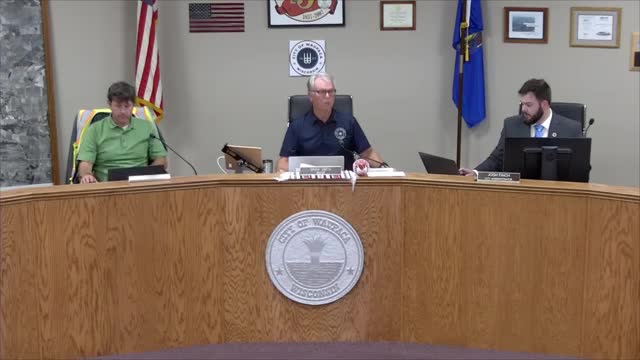
Summary
The Waupaca City Planning Commission on Sept. 3 tabled a request to rezone three parcels on County Road A and Eastgate Drive from B-4 Strip Commercial to I-2 Heavy Industrial, after residents and environmental advocates pressed for more information and commissioners debated whether a heavy‑industrial designation is premature without a defined project.
The Waupaca City Planning Commission on Sept. 3 tabled a request to rezone three parcels at County Road A and Eastgate Drive from B-4 Strip Commercial to I-2 Heavy Industrial, saying the commission wanted more information and time before recommending the ordinance to the City Council. The motion to table the request to the next planning-commission meeting carried after a motion by Commissioner Velacher and a second by Commissioner Olson.
Why it matters: the applicant, the Doddridge L. Brooks Living Trust (applicant Ron Brooks), told the commission a potential investor has conditioned interest on the heavy‑industrial zoning. Several residents and civic groups urged caution, saying heavy-industrial zoning could allow future uses with traffic, air, odor and environmental impacts and that a recent feasibility report recommended light industrial along highway-adjacent parcels.
At the public hearing, Ron Brooks identified himself as the applicant and landowner and said the family has held the parcels for decades and had little development traction under the strip-commercial designation. “We’ve sat on this property trying to develop it as strip commercial for over 20 years,” Brooks said. He told the commission an interested group would not proceed unless the heavy-industrial zoning was in place.
Multiple neighbors and local group leaders spoke in opposition. Cathy Dimple, a lifelong Waupaca resident and landowner along the bypass, said she chose light-industrial zoning for her parcels and that heavy-industrial zoning would permit a broader set of uses without conditional-review safeguards: “I completely disagree with changing this to heavy industrial. I think that opens the doors to so many options that we would be blindly allowing to fall under a permitted status,” she said. Other speakers raised concerns about heavy truck traffic on Eastgate Drive, fire-access and water-supply needs for heavy operations, and potential impacts on the Waupaca River and nearby wetlands.
Robert Van Epps, president of the Waiwiga Lake Restoration Group, described long-term sampling on the Waupaca River and said he was not opposed to development but asked for more environmental information and safeguards protecting the river. Louis Ebeling said the area contains extensive wetlands and warned heavy industrial uses could harm that resource. Several speakers also cautioned that energy facilities could be tax-exempt and therefore not deliver the anticipated municipal revenue.
City planning staff and commissioners cited a city-commissioned future-development and land-use feasibility report (New Day Planning) that recommended designating highway-adjacent parcels for light industrial, while reserving non‑highway-adjacent sites for heavier uses. Planning staff summarized parcel sizes as approximately 4 acres, 5 acres and roughly 20 acres (one commissioner suggested the largest parcel might be about 33 acres), and said the applicant’s rezoning request would be conditioned on a pending comprehensive-plan amendment if approved by council.
Commission discussion focused on whether a rezone to heavy industrial should be granted without a specific project. Several commissioners said the feasibility study recommended light industrial for highway-fronting parcels and that rezoning to heavy industrial without a defined project felt premature. Others argued that rezoning could help attract investment to an area the city has been trying to develop for years. Planning staff clarified that even after rezoning, a future project would require site-plan review and might require conditional-use approval and other permits.
Outcome and next steps: the commission voted to table the ordinance to the next planning‑commission meeting (one month) to allow additional review and to avoid prematurely jeopardizing a confidential prospective project. The tabling preserves the applicant’s ability to reapply and preserves staff and commission time to gather any requested environmental, traffic and infrastructure impact information.
Context: the parcels lie south of U.S. Highway 10 near the city’s eastern interchange and within an area subject to a TIF (tax increment financing) district and recent city-funded feasibility analysis. The commission’s action was procedural (tabled) and not a denial; the applicant can return with additional materials or the council can consider the application after subsequent planning-commission recommendation.