Get Full Government Meeting Transcripts, Videos, & Alerts Forever!
Get email alerts on the Utilities Sewer topic
No spam. Unsubscribe anytime.
Council work session advances plan to raise sewer rates, target high-strength dischargers to close $283,000 shortfall
Summary
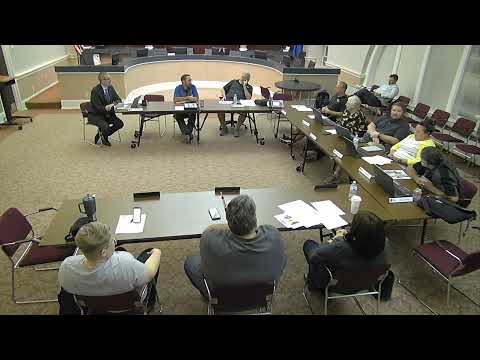
At a Aug. 25 council work session, Town and Country Engineering and city public works staff outlined a four-part rate plan to close a projected $283,000 funding shortfall in the sanitary sewer utility for fiscal 2025–26.
At a Aug. 25 council work session, Town and Country Engineering and city public works staff outlined a four-part rate plan to close a projected $283,000 funding shortfall in the sanitary sewer utility for fiscal 2025–26. The plan would raise a $1 monthly fixed fee, add $0.20 per 100 cubic feet to volumetric charges, revise fixed fees by equivalent meter size and begin enforcement of local "category B" surcharges on high-strength industrial dischargers such as Riverside Foods.
The changes are intended to meet state and lender expectations and to ensure the utility can cover ongoing operations, major capital projects and debt service. Greg Dressler, vice president of Town and Country Engineering, told the council the city faces an estimated $118,486 shortfall on 2025 project funding and $165,000 for 2026 projects — a combined shortfall of about $283,000 under the current rates. Dressler said the city also must meet Department of Natural Resources requirements on coverage and that operating costs such as energy and chemicals have risen faster than revenues.
The rate study presented four revenue components and the approximate annual revenue each would generate: a $1 fixed monthly fee (about $67,800); a $0.20 per 100 cubic feet volumetric increase (about $60,000); moving to an equivalent-meter fixed-fee table to charge larger meters proportionately (about $132,000); and enforcing category B surcharges on high-strength dischargers (Dressler’s conservative estimate: about $131,000). "That $100,000 a year is not gonna go far on plant improvements, but I put something in there as a I wanna call it, placeholder," Dressler said of a proposed set‑aside for long‑term plant reinvestment.
Dressler and public works staff said the combined changes intentionally overshoot the immediate shortfall to create reserves for an aging wastewater plant and 17 lift stations. The plant dates largely to the early 1970s and is rated for roughly 3,000,000 gallons per day; engineers said portions of the plant and many lift-station control systems are showing age. Dressler said a full replacement plant of larger capacity would be orders of magnitude more expensive: "If I were to build a...4,000,000 gallon a day plant, that is about a $150,000,000 investment," he said.
For a typical household using about 3,500 gallons of sewage a month, the combined fixed-fee and volumetric increases would amount to roughly $2 per month under the proposal, staff said. The equivalent-meter revisions would shift more of debt-service costs to larger water users by multiplying the current fixed fee by an equivalent‑meter factor; Dressler said a 6‑inch meter (at the hospital) carries a 50‑unit equivalent charge on the water side and would see a similar multiplier applied on the sewer side, raising the hospital’s fixed fee by “nearly a $900” monthly amount under the draft table.
The council and staff discussed outreach and direct notification. Dressler said the city typically publishes rate changes on its website and does targeted direct outreach to large customers that would face major increases. Public works staff said they will refine the customer list and confirm which meters are already subject to unit charges or deduct/irrigation meters.
A major element of the proposal is enforcing category B (high‑strength) surcharges on industrial customers that discharge elevated biochemical oxygen demand (BOD), total suspended solids (TSS) and phosphorus. Staff said limited sampling from Riverside Foods showed extreme concentrations at times — Dressler cited a highest reading near 6,700 milligrams per liter — and that weekly or more frequent sampling would be needed to bill accurately. Dressler estimated category B bills could add "a $10,000 to $20,000 additional sewer charge to this business every month" until the facility reduces its loadings. Public works staff said DNR staff have attended recent progress meetings with Riverside and warned that failure to reduce loadings could lead to DNR enforcement actions and that DNR could require corrective upgrades that the city could pass through to the discharger.
Councilmembers asked about impacts on small businesses, multifamily properties and irrigation/deduct meters. Staff said many larger meters are already discounted for multifamily unit charges and that some outliers could see small decreases under the table. The winter‑averaging water billing policy also drew questions; staff said that policy affects a different revenue calculation on the water side and that changes could be discussed separately.
No ordinance vote was taken at the work session. Councilmembers gave direction to staff to finalize ordinance text, prepare customer notification materials and return with formal ordinance revisions for adoption in time to show the funding stream to lenders. Staff said the earliest effective date proposed would be Jan. 1, 2026; the timing is intended to allow the city to demonstrate the revenue stream needed to close on clean-water loans in early 2026. Councilmembers asked staff to return with a refined list of affected meters and to begin targeted outreach to large commercial customers.
Evidence presented at the session included the rate study, sampling results for industrial discharges and the city’s capital improvement needs. Staff and the engineering consultant emphasized that the proposal spreads costs across fixed and volumetric components, and that enforcement of category B surcharges is intended both to recover treatment costs and to provide incentives for industrial dischargers to reduce high-strength waste inputs.
Outlook: Staff will finalize ordinance revisions, prepare communications for customers and return to council — staff suggested mid‑September for a formal ordinance submittal — with an effective date proposed as Jan. 1, 2026, contingent on council adoption and lender acceptance.