
UCPS reports statewide top ranking, steady gains in student proficiency and graduation rate
Get AI-powered insights, summaries, and transcripts
Subscribe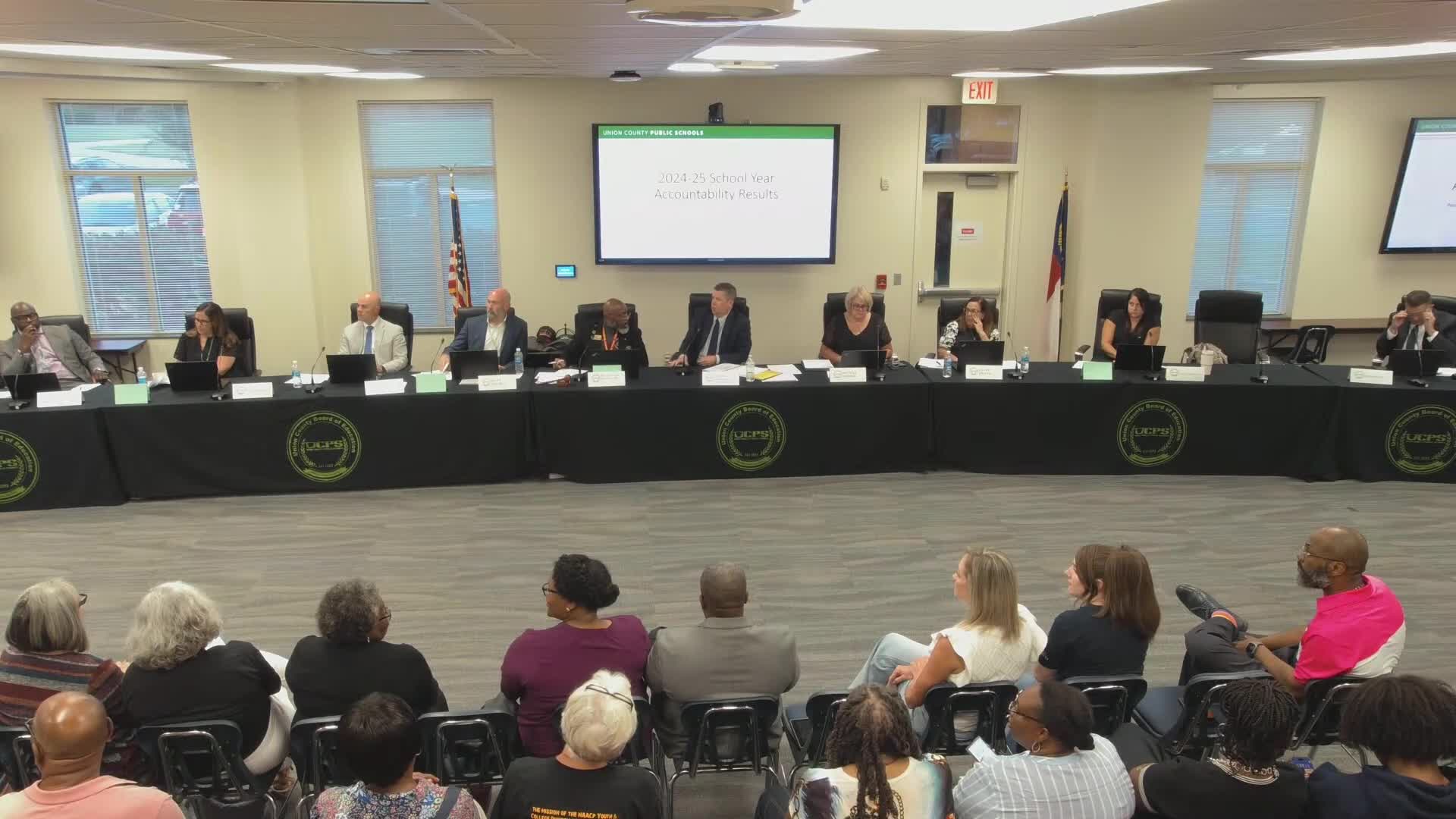
Summary
Union County Public Schools officials presented 2024–25 accountability results showing districtwide proficiency gains, 90% of schools earning A–C performance grades, and a 93.2% four‑year graduation rate, while staff outlined next steps for focus schools and tutoring programs.
Union County Public Schools officials on Tuesday presented the district’s 2024–25 accountability results to the Union County Board of Education, reporting gains in statewide proficiency, strong growth measures and higher participation in career and college readiness programs. Dr. Jonathan Tyson, UCPS chief of school performance, and Dr. Matt Schlider, director of research and evaluation, led the presentation.
The district’s overall grade‑level proficiency (GLP) on End‑of‑Grade and End‑of‑Course tests was 70.7 percent for 2024–25, a 1.2 percentage‑point increase from the prior year and a 7.7 point increase since 2021, Dr. Schlider said. "That number is number 1 in the state of North Carolina," he said, referring to the combined EOG/EOC indicator.
The data matter for families and schools because they inform state school performance grades, funding conversations and district interventions. Dr. Schlider said the state’s accountability figures will be certified in October and that UCPS will provide a full board briefing at that time.
Key findings from the presentation: - Overall EOG/EOC GLP: 70.7 percent (up 1.2 points year over year). - School performance grades: 45 of 50 schools (90 percent) received A, B or C grades; five schools received a D; none received an F. - Growth: 43 of 50 schools (86 percent) met or exceeded expected growth as calculated by the state’s EVAAS (Education Value‑Added Assessment System). - Cohort graduation rate (four‑year): 93.2 percent. - CTE credentials earned: 13,259 (reported as 32 percent higher than 2021). - AP exams taken: 8,083 exams with an 80 percent pass rate reported for the year. - New re‑normed science assessments: UCPS fifth graders scored 78.8 percent proficiency on the new fifth‑grade science EOG, and eighth graders scored 72.5 percent on the new eighth‑grade science EOG.
Dr. Tyson and Dr. Schlider highlighted intensive tutoring programs as contributing factors in specific gains. Schlider presented comparative growth for schools with and without second‑grade intensive reading tutoring, saying schools with the program showed a 12.1 percentage‑point gain versus a 6 point gain at comparable schools without it. For middle‑school math tutoring, he cited double‑digit gains for participating grades.
Board members asked questions about low‑performing schools and supports for staff and students. Dr. Tyson said district leaders are focused on culture building, staffing stability and the district’s turnaround plan for focus schools: "When we have a strong culture in our schools, our students do better," he said. Board member discussion emphasized community support and the additional noninstructional responsibilities teachers often shoulder in higher‑need schools.
District leaders said next steps include continuing tutoring and turnaround efforts, reducing the count of low‑performing schools and publishing the full, certified report in October. The presentation referenced data posted by the North Carolina Department of Public Instruction and noted certification timelines for state accountability figures.
The board publicly recognized several principals whose schools exited low‑performing status, including Amanda Stinchcomb of Benton Heights Elementary and Brian Patience of Sun Valley Middle School. Dr. Schlider said Sun Valley recorded the highest growth index in the state.
District staff repeatedly noted that the state accountability model weights proficiency at 80 percent and growth at 20 percent for school performance grades; EVAAS calculations for growth are performed by the vendor SAS.