
City seeks alternatives analysis for Business Park lift station after hospital expansion would exceed capacity
Get AI-powered insights, summaries, and transcripts
Subscribe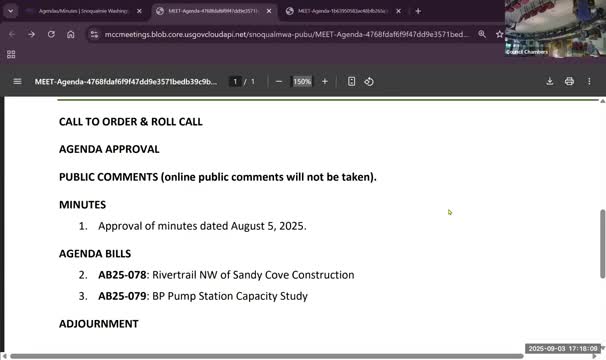
Summary
Patrick Fry, project engineer with City of Snoqualmie Parks and Public Works, told the council the Business Park lift station has a firm capacity of 750 gallons per minute and that Snoqualmie Valley Health’s planned expansion would add about 49 gpm, exceeding that firm capacity under current estimates.
Patrick Fry, project engineer with City of Snoqualmie Parks and Public Works, told the council that the Business Park (BP) lift station is approaching its firm capacity and that an alternatives analysis is needed because a planned Snoqualmie Valley Health expansion would add flow beyond the station’s firm rating.
"it has a firm capacity of... 750 gallons per minute. As it stands, it's receiving estimated 711 gallons per minute," Fry said. He added that the hospital’s planned additional flow is 49 gallons per minute, which would put the pump station roughly 10 gpm over the firm capacity as estimated in the analysis.
Why it matters: Fry said the BP pump station collects upstream gravity flows from a large portion of town and that exceeding its firm capacity risks higher cycling and potential performance issues. Fry presented monitoring data showing the station’s pumps cycle between about seven and 12 times per hour during wet months; the pump manufacturer’s recommended maximum is 13 cycles per hour.
What staff proposed: the city recommended contracting RH2 to perform an alternatives analysis and preliminary (about 25–30 percent) design for up to three alternatives. Fry said the RH2 contract is hourly and not to exceed $98,850 (which staff summarized for council as "about $100,000"). The alternatives analysis would investigate options such as adding storage (an adjacent wet well), upsizing pumps, adding additional pumps (including a jockey pump), or upsizing force mains, and would examine electrical capacity, site constraints and lead times for equipment.
Funding and cost allocation: Fry told council the BP upgrade was not included in the current CIP because the general sewer plan treats BP as a developer-funded improvement; however, because the hospital project is proceeding now, the council has indicated the hospital should provide a deposit before the city begins the study. Hospital representatives at the meeting said they had provided data earlier and asked the city to share responsibility for the cost. A hospital representative who identified himself as the hospital’s owner representative said, "we're asked to spend money that we don't have, that we would like to buy a CT scanner," and asked for a shared approach to the study cost. Renee Jensen, the hospital chief executive, said the expansion is a public hospital district project that serves the community and emphasized the project’s urgency given planned occupancy and bond timing.
Schedule and estimated construction cost: Fry said he expects the alternatives analysis to be complete by November, with final design and construction anticipated in 2026 depending on funding. He and RH2 estimated final construction costs in the range of $1 million to $1.5 million, but Fry emphasized that is a rough initial estimate. Fry also said construction could be delayed if long-lead equipment (electrical switchgear, pumps) is required; those items can have multi-month lead times.
Council concerns and next step: council members said they were sympathetic to the hospital’s timeline but also concerned about asking city ratepayers to absorb added cost after a recent utility rate increase. Council discussion did not record a final vote to award the alternatives-analysis contract; instead, the council moved the agenda bill forward to the council agenda for further discussion and noted the hospital is to deposit funds before work begins.
Ending: the city will return with a formal agenda bill for contract approval once deposit/funding and scope questions are resolved; the alternatives analysis would then inform a later design and construction agenda bill.