
Opa-locka CRA weighs demolition, redevelopment and short-term activations for downtown properties
Get AI-powered insights, summaries, and transcripts
Subscribe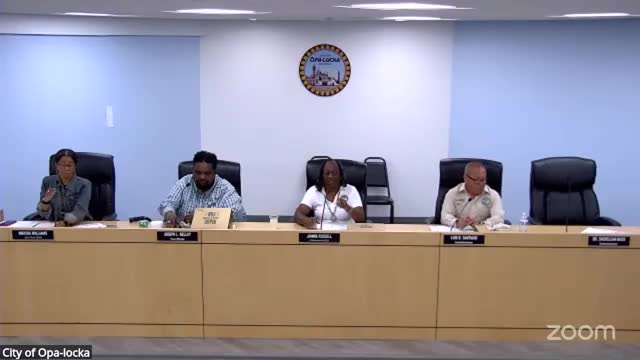
Summary
At a workshop, the City of Opa-locka Community Redevelopment Agency reviewed a portfolio of recently acquired downtown properties and directed staff to pursue cost estimates, draft RFPs and short-term activations (food trucks, events) while convening partners for larger redevelopment options.
The City of Opa-locka Community Redevelopment Agency (CRA) spent a workshop on options for six downtown properties it now controls, focusing on whether to repair and retain existing buildings, demolish and redevelop with mixed-use housing, or pursue short-term activations such as food trucks and event rentals.
The CRA director, Jason (director), told board members the agency paid $1,675,000 for the corner property at 391 Opelika Boulevard and about $650,000 for the former Chinese restaurant at 14401 Northwest 20 Seventh Avenue. He said contractors estimated more than $500,000 to build out a single bay inside 391, and that bringing the whole building up to market standards would likely exceed $1 million. "That property was $1,675,000," Jason said, and for the corner bay he added, "the estimate ... was over $500,000."
Why it matters: Board members framed the choices around two goals the vice chair set at the start: deciding future uses for acquired parcels and making fiscally sound, community-conscious decisions. Members repeatedly emphasized that redeveloping downtown ought to increase the local tax base and create foot traffic that supports businesses, and they pressed staff for concrete cost and revenue estimates before committing to a path.
Discussion and options: Staff reviewed each parcel in turn and laid out near- and long-term options. - 391 Opelika Boulevard: six commercial bays, three occupied on month-to-month terms and three vacant; currently collecting about $500 in rent from some occupants. Staff presented options to (1) repair and re-tenant, (2) sell, (3) issue an RFP for redevelopment or (4) demolish and create interim uses (park, food trucks) while pursuing an RFP for a larger mixed-use project. Several board members favored demolition and an RFP to attract a developer to build multi-story mixed-use housing with ground-floor retail; staff estimated an eventual project could support dozens of housing units and significantly increase tax revenue. - 240 Baumann Avenue (the church compound): comprises multiple folios under the CRA’s control. Staff said the structure is in good condition and can be used in the near term as a community event/performing-arts space with light improvements (paint, landscaping). A formal tenant or manager could operate rentals for weddings, funerals and performances while long-term options are studied. A full lease on some church-adjacent parcels runs through 2027; breaking that lease now could trigger a contractual payout (staff cited a figure of about $250,000 if the lease were ended prematurely). - 14401 NW 20 Seventh Avenue (former Chinese restaurant): the building has been largely gutted, needs cosmetic and some structural work and has seen local interest, including a standing unsolicited offer from a local operator. Staff recommended holding the parcel and using an RFP to select a preferred commercial use and tenant, and flagged parking as a constraint to be resolved with adjacent parcels. - 2145 Alibaba Avenue and other small lots: staff described these as infill parcels that make joint-development more feasible if adjacent owners and the Opa-locka CDC join a single plan; staff proposed convening those parties and piloting a community garden or temporary uses while negotiating a larger joint development.
Short-term activations and property management: A community member and several board members urged immediate measures to improve public perception of downtown. Staff reported a proposal to host rotating food trucks (2–3 trucks) on weekends; the offeror would handle lighting and trash removal and would pay the city or coordinate through a property manager. Board members asked staff to draft the vendor agreements and to include the city attorney and selected property manager in structuring those permits and rotations.
Finance and timing: Board members and staff reviewed the agency’s recent spending and budget constraints. Staff reported the CRA spent roughly $5.7 million on property acquisitions in the last 18 months and noted the agency’s annual operating budget is roughly $3.0 million (covering programs and transfers). Directors said those constraints make large rehab investments expensive; several members recommended demolition-and-rebuild with ground-floor retail and upper-floor housing to maximize tax base growth.
Next steps and direction to staff: The board asked staff to supply specific information before the next workshop: contractor estimates to fully rehab 391 (and per-bay pro forma revenue), firm cost estimates to demolish 391, draft RFP language options for both commercial (restaurant/retail) and mixed-use redevelopment, summaries of the three serious developer inquiries the agency has received, and a draft vendor agreement and public-permitting checklist for rotating food trucks and event rentals at the Chinese-restaurant parcel and at a proposed temporary park at 391. Staff said they have already engaged a firm to help produce RFP drafts and expect to have RFP materials ready by September/early October; the board asked for one more workshop within 2–4 weeks and signaled an intent to vote on formal resolutions by the October meeting.
What didn’t change: There were no binding votes at the workshop. Board members expressed a range of preferences—some favoring short-term activation and holding the properties, others pushing for demolition and large-scale mixed-use redevelopment—so staff was directed to return with detailed costs and draft procurement documents to enable formal decisions.
Looking ahead: The CRA will convene property owners and the Opa-locka CDC to explore joint development on the small infill block around 2145 Alibaba Avenue; staff will also circulate RFP drafts and cost estimates for 391 and the Chinese-restaurant site and prepare vendor agreements for temporary activations. The board sought proposals and legal drafts that would let the agency remove month-to-month tenants in an orderly way if redevelopment is approved, and requested projected revenue and tax-impact estimates so members can weigh trade-offs at the October vote.