Get Full Government Meeting Transcripts, Videos, & Alerts Forever!
Get email alerts on the Irrigated Lands Panel topic
No spam. Unsubscribe anytime.
State Water Board convenes second agricultural expert panel to review irrigated‑lands program
Summary
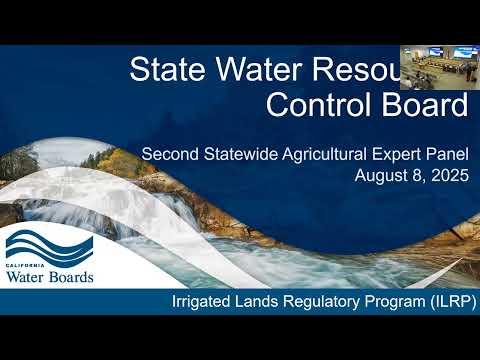
The State Water Resources Control Board convened the first meeting of its second agricultural expert panel on Aug. 8 to review irrigated‑lands reporting and advise whether nitrogen tracking metrics should be used in statewide regulation.
The State Water Resources Control Board convened the first meeting of its second agricultural expert panel on Aug. 8 in Sacramento to review five years of irrigated‑lands reporting and to advise the board on whether and how to use “nitrogen applied” and “nitrogen removed” metrics in statewide regulation.
The panel was formed after the board’s 2023 petition order remanded portions of the Central Coast’s 2021 general waste discharge requirements and directed staff to convene another expert panel before the board considers new statewide regulatory approaches. “Our board’s charge is to have a long‑term irrigated lands regulatory program that both protects water quality as well as provides for a sustainable agricultural industry in California,” Chief Deputy Director Karen Mogus said at the meeting.
Why it matters: The panel will assess whether data collected by regional coalitions and other parties supports new tools such as multiyear A/R (applied divided by removed) targets or A–R (applied minus removed) limits intended to reduce nitrate loading to groundwater. The central question is whether the state now has enough reliable, regionally relevant data and practical methods to translate those numbers into enforceable regulation that will protect drinking water without unduly disrupting farming operations.
State staff framed the issue with a brief history. Darren Palamas of the State Water Board reviewed the first 2014 expert panel’s major conclusions — that nitrogen in groundwater is a real and statewide problem, that farm practices contribute to nitrate leaching, and that a regulatory program should emphasize continuous improvement and practical measures rather than complex, high‑cost field‑by‑field modeling. Palamas described the panel’s recommendation to track applied (fertilizer, organic amendments and irrigation water) versus removed (harvest, sequestration in permanent wood) and to evaluate a multiyear performance ratio.
Eric Gilman, an attorney in the board’s Office of Chief Counsel, summarized the 2023 petition order that remanded parts of the Central Coast irrigated‑lands requirements. The petition order reiterated the East San Joaquin (ESJ) order’s direction that growers or their representatives collect and report nitrogen applied and removed and calculate A/R and A–R as measures of potential groundwater risk, but it said it is premature to specify how those metrics should be used as regulatory tools until more data and expert review are available.
Board staff described the panel’s charge questions, which span monitoring and reporting, metrics and practices, science and technical considerations, and program implementation. Laleh Rastegozard (State Water Board staff) said the nine charge questions and subquestions are posted to the board’s web site and will guide the panel’s work.
Panel business: The panel elected UC Davis nutrient‑management specialist Daniel Geisler as chair by unanimous roll‑call vote and approved the panel charter. Both actions were taken by simple majorities of members present; all votes recorded at the meeting were affirmative. The panel’s next meetings were scheduled: a data‑focused meeting Aug. 14, a full meeting Oct. 31 and a final session Jan. 14, 2026. Staff said two public listening sessions are planned for Oct. 1 and late November and that small working groups will be convened as needed.
At the meeting, panelists, regional staff and third‑party presenters emphasized that the irrigated‑lands program varies substantially across regions. Several presenters noted that most of the existing A/R data come from the Central Valley coalitions and that other regions — notably the Central Coast — have only recently begun comprehensive reporting. “The Central Coast’s first A/R dataset was submitted in 2024,” Abby Taylor Silva, a Central Coast coalition consultant, told the panel, and she urged the panel to allow time for further data collection and outreach before recommending limits. Agricultural representatives also urged “flexibility” for small and diversified farms and additional technical assistance.
Nonprofit and community presenters pressed for stronger, enforceable protections. Community Water Center policy advocate Kaya Rivers and Environmental Law Foundation Executive Director Nat Cain said nitrate contamination now affects thousands of domestic wells and public systems and that continued delay would increase public‑health burdens. Cain said an expert panel that advises against limits could result in “another decade or more” of delay.
What the panel will do next: Staff told the panel they expect recommendations to be science‑based and to inform the state and regional boards if rule changes or other regulatory tools are warranted. Staff emphasized the board’s legal framework — including the nonpoint source policy and the Porter‑Cologne Water Quality Control Act — that requires plans and timelines to protect beneficial uses such as safe drinking water.
The panel will consider the technical merits of A/R and A–R approaches, regional variability, management practices, privacy concerns about grower data, and how the board should use any recommended numeric values. The board’s staff and regional partners will continue to supply datasets, modeling support and program reports as the panel requests them.
Ending: Panel members will reconvene Aug. 14 for a data‑focused session before the group begins drafting recommendations. The board’s staff said they will publish materials and panel summaries online and that the panel chair will present the final report to the State Water Resources Control Board.