
Pinellas County to begin large emergency beach nourishment; missing easements could block $103 million in federal funds
Get AI-powered insights, summaries, and transcripts
Subscribe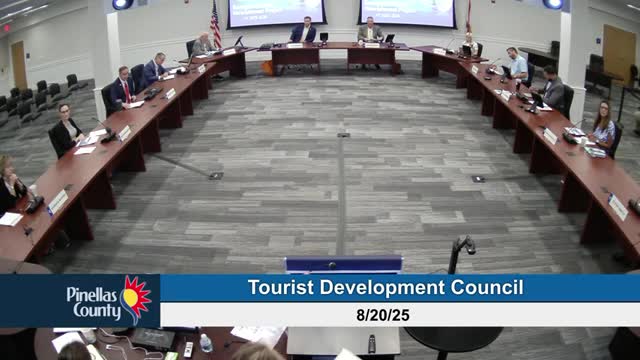
Summary
Pinellas County public works officials described plans this week to start a large, county-funded beach nourishment project for Sand Key, Treasure Island and Upham Beach and warned that missing property easements and federal permitting limits could delay construction or block $103 million in emergency federal funds.
Pinellas County public works officials described plans this week to start a large, county-funded beach nourishment project for Sand Key, Treasure Island and Upham Beach and warned that missing property easements and federal permitting limits could delay construction or block $103 million in emergency federal funds. "The storm damage reduction benefits from this project are in excess of $10,000,000,000," Kelly Hammer Levy, public works director for Pinellas County, said during the Tourist Development Council meeting.
County officials said the project will reconstruct a wide beach and dune profile modeled on previously authorized U.S. Army Corps of Engineers work and will place sand both above and below the mean high water line to re-create the Corps design. The Board of County Commissioners has authorized a one-time emergency nourishment project for Sand Key, Treasure Island and Upham; county staff are proceeding without full Corps cost-share support and are using tourist development tax revenue for the majority of the work.
Levy said the program will place more than 2,000,000 cubic yards of sand on the Sand Key segment alone, a workscope she described as among the largest ever for that shoreline. Sand sources will include Egmont Shoal (a Port of Tampa borrow area) and local borrow areas at Pass-a-Grille and Blind Pass; Weeks Marine is the prime contractor for Sand Key and Gator Dredging will work on the southern segments. "This is one of the largest, if not the largest project ever constructed on Sand Key with over 2,000,000 cubic yards of sand being placed on this beach," Levy said.
Levy laid out the permitting and property-access challenges the county faces. The county is seeking temporary construction easements that would run to 2029 for some properties; staff said the state permits require ongoing monitoring and maintenance that extend the needed term. Where owners do not grant easements, the plan calls for the county to fill from the erosion-control line to the Gulf (a lower private-property profile may leave a depression and temporarily trapped water behind the public fill), and there will be active construction zones and intermittent beach closures. "The heartburn, we're missing out on a $103,000,000 in federal emergency funds, because of the easement issue," Levy said.
Officials provided counts of remaining gaps in three municipalities: 48 missing easements in Indian Rocks Beach, 47 in Indian Shores and 30 in Redington Shores, and said the county was still short about 125 temporary construction easements overall for the Sand Key segment. Levy described ongoing outreach to property owners, including certified mail and in-person offers, and said some owners have refused either temporary or permanent easements.
County staff described the construction approach: pipeline corridors used in past Army Corps work will be re-used, wet sand will be pumped as a sand-water slurry into diked settling areas, decant water will be returned to the Gulf under turbidity-monitoring restrictions, and heavy earth-moving equipment will shape the beach and dune. Levy said the dune on Sand Key will be roughly 3 feet above the post-fill beach profile; Treasure Island's dune will be about 5 feet above the beach profile. Where owners accept no easement, the private landward area may remain lower than the constructed public beach elevation (Levy cited a constructed elevation of 5.3 feet for part of the template) and could form a gully that holds water until graded.
Schedule and logistics: staff said mobilization of dredge pipe on Sand Key is tentatively set to begin Aug. 22, with land-equipment mobilization near Tiki Gardens and water-based assets appearing at Sand Key Park; Gator Dredging is expected to start on Upham Beach after Labor Day to avoid the holiday period, and Weeks Marine will finish Treasure Island after sourcing additional sand. Levy cautioned that the project must be finished within a six-month construction window tied to the county's emergency permit and that the Army Corps emergency permit expires March 6. She also said the plan includes sea turtle and seabird monitoring and relocation requirements and that a contractor (identified in the meeting as Bruno) will handle nest relocations.
Questions from council members focused on pipeline corridors, turbidity and whether local accretion at inlets (John's Pass) could be used as a borrow source. Levy said Corps project limits and existing permitted pipeline corridors constrain the county's ability to use some accretion areas for the Corps-modeled design. She said the county sought to keep the design consistent with previous Corps construction to accelerate permitting under the Corps' emergency authority and avoid returning to the standard, longer review process.
County staff stressed the limits of local authority and the need for cooperation from property owners and federal partners. Levy said the tourist development tax is funding about 89% of the local project costs while roughly 11% is coming from grants; she said the county has received about $10.4 million from state emergency funding for one segment and about $3.8 million from the Florida Department of Environmental Protection for Treasure Island and Upham. "We really need the Corps. We really need our partner back," she said.
The presentation closed with an outreach plea: staff are still accepting temporary easements and warned that once the contractor has surveyed and staged a segment, it may be too late for owners to join. Levy urged property owners to contact the county via sign4sandpinellas.gov if they were rethinking easements.
Ending: County officials asked residents and water users to expect visible staging at Sand Key Park and other access points, intermittent beach closures during work, pipeline corridors offshore and considerable dredge and land-equipment activity. Officials said they will continue to coordinate with the Corps, DEP and local municipalities and to report schedule changes publicly.