Get Full Government Meeting Transcripts, Videos, & Alerts Forever!
Get email alerts on the Government Transparency topic
No spam. Unsubscribe anytime.
Idaho controller previews Transparent Idaho portal, urges local data submissions
Summary
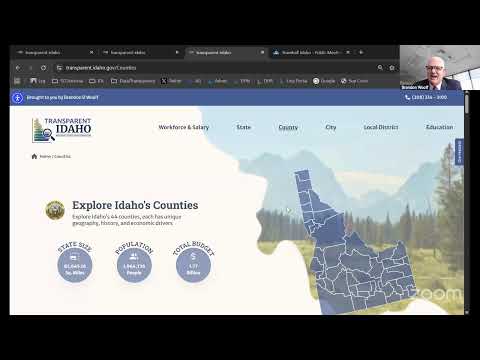
Idaho State Controller Brandon Woolf on Wednesday walked Bonner County commissioners through Transparent Idaho and the state's Town Hall meeting portal, demonstrating how the sites display state and local payrolls, vendor payments, budgets and meeting notices and urging local governments and school districts to submit standardized data so residents can compare spending across jurisdictions.
Idaho State Controller Brandon Woolf on Wednesday walked Bonner County commissioners through Transparent Idaho and the state's Town Hall meeting portal, demonstrating how the sites display state and local payrolls, vendor payments, budgets and meeting notices and urging local governments and school districts to submit standardized data so residents can compare spending across jurisdictions.
Why it matters: The sites are intended to increase public access to government financial records and meeting information. Woolf said better, standardized data online reduces public‑records requests and helps citizens, elected officials and agencies identify spending patterns and possible savings.
Woolf, who described launching the first version of Transparent Idaho in January 2013 and expanding it afterward, showed commissioners how users can search statewide payrolls, export vendor payment rows (export limit: 50,000 rows), and view county and city budget visualizations that normalize spending for apples‑to‑apples comparisons. "One of the biggest things... is just the lack of trust in government is at an all time low," Woolf said, arguing that accessible data can help rebuild trust.
Woolf demonstrated county pages that break down expenditures and revenues by category and fiscal year, and he used Bonner County as an example of the site's county-level displays. He said state payroll and agency data are updated nightly; county and local submissions are currently posted quarterly, and education transactional data is provided to the controller's office by the Idaho State Department of Education on a quarterly pipeline. Woolf said the education uploads were newly loaded in April and that additional years of data ("23, 24, 25") were still needed.
Woolf described a compliance mechanism built into the system: "If a local government entity does not send their information, then we can mark them as noncompliant, and then they will not get their sales tax distribution from the state tax commission," he said. He attributed the push to add local governments to the portal to legislation passed in 2021 and credited Representative Heather Scott for sponsoring a bill that required state agreements and contracts to be posted.
Commissioners and other participants asked several operational questions that Woolf said his office would take back as development requests: adding a visible timestamp showing when a dataset was last received or updated, more granular building‑level maintenance and asset reporting (not currently available), and geo‑specific subscription options for Town Hall notifications (for example, alerts for meetings within a set radius or for a named highway). Woolf said the state team will consider those features as next steps.
Woolf also described sample uses of the data for internal analysis: he said state vendor and travel records could be exported and analyzed to identify potential enterprise contract savings for travel and lodging. He demonstrated how users may filter vendor payments, view audit and budget documents for special districts (fire, ambulance, cemetery, etc.), and subscribe to meeting notices at townhall.idaho.gov.
No formal county action was taken during the briefing; Woolf's presentation was informational and generated requests for enhancements and follow‑up from his office. Commissioners said they would promote the portals to local residents to improve awareness and reduce ad‑hoc public‑records requests.
Woolf closed by urging local officials and school districts to deliver their financial files through the state reporting pipelines so the portal can present current, comparable data. "We have some teeth to it," he said of the compliance rule that links reporting to sales‑tax distributions.
The controller's office said it posts the state agency payroll nightly, allows CSV exports up to 50,000 rows, updates county data quarterly (with a separate legislative history pushing for annual filing), and receives school district transactional data through the Department of Education on a quarterly cadence; more detailed building‑level maintenance data and full historical personnel transfers for local governments are not currently available.