Get Full Government Meeting Transcripts, Videos, & Alerts Forever!
Get email alerts on the Overlay Zoning topic
No spam. Unsubscribe anytime.
Planning commission recommends 10 Mile community overlay after multi-year outreach; commissioners split on rural upzoning
Summary
Charleston County planning staff presented a draft 10 Mile community overlay zoning district after more than two years of outreach; the Planning Commission voted to forward the overlay to County Council by a 6-2-3 vote.
Charleston County planning staff presented a draft 10 Mile community overlay zoning district and recommended approval of parallel amendments to the Charleston County Comprehensive Plan and the Zoning and Land Development Regulations (ZLDR).
Staff said the overlay responds to community meetings held since 2023 and to a 24-month moratorium County Council enacted in July 2024 on major subdivisions inside historic districts. The overlay would apply customized standards across the 10 Mile historic district east of the Cooper River, including rules for residential density, building form, signage, stormwater protections, and traffic-impact thresholds.
Emily Pigott, a county planner who presented the item, said the overlay is intended “to protect and promote the culture of the historic 10 Mile community” and to preserve low-density residential patterns while allowing limited commercial uses in community-identified locations. Pigott noted the overlay would control uses, dimensional standards and provide special conditions such as a maximum 35-foot building height and a width-to-depth ratio for single-family homes not to exceed 1:1.25.
Key numeric standards discussed by staff include: in the residential urban/suburban area a proposed density of 3 principal dwelling units per acre with a 12,500-square-foot minimum lot area (if water and sewer are both available); in the residential rural area a proposed density of 1 principal dwelling unit per acre with a minimum lot area of 38,500 square feet; and in proposed commercial/mixed-use areas a cap of 2 principal dwelling units per acre for mixed-use occupancy and a 5,000-square-foot per-building cap for single buildings on commercial parcels. Staff also proposed that new single-family homes be elevated up to 8 feet as a maximum lowest floor when required by the county flood ordinance (with Board of Zoning Appeals exceptions possible).
Public commenters and community representatives described the process as multi-year and urged protecting the community's cultural character. Pearl Askew, a 10 Mile resident, thanked “staff working with the 10 Mile community and the 10 Mile community committee members who worked tirelessly for more than 2 years.” Fran White, representing the 10 Mile Neighborhood Association, said developers had built “uncharacteristic homes on uncharacteristic sized lots” and warned that continued subdivision activity had the potential to cause gentrification.
Preservation and historic groups also weighed in. Sam Spence of the Preservation Society of Charleston supported the overlay but cautioned about increasing densities outside the urban growth boundary and suggested folding subdivision protections into the overlay to avoid repeated moratoriums. Lisa Jones of the Historic Charleston Foundation said she supported the urban/suburban regulations but opposed the blanket rural upzoning to 1 unit per acre, calling that “a significant change” that many residents opposed.
Commissioner Luke Morris said he could not support an upzoning outside the urban growth boundary: “If somebody came to us…outside the urban growth boundary that was currently 1 unit per 3 acres, I could not find myself, in general, supporting an upzoning of 1 dwelling unit per acre.” Other commissioners likewise expressed concern that a county-wide precedent for blanket upzoning outside the urban growth boundary could undermine the purpose of the boundary.
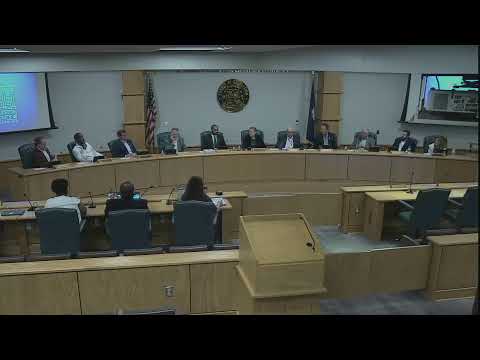
After public comment and deliberation, the Planning Commission voted to recommend approval of the comprehensive plan and ZLDR text amendments and to forward the overlay to County Council. The motion carried by a vote the chair announced as 6 ayes, 2 nays and 3 abstentions. County Council will hold a public hearing on Oct. 14, 2025 and a Planning and Public Works Committee review on Oct. 23, 2025; final action will require Council readings.
Staff told the commission they had received written input that included five general comments, two comments in opposition, five conditional-support comments requesting edits, and two additional comments submitted after the public input deadline, including one from the Coastal Conservation League recommending more community engagement.
The commission closed the hearing and forwarded the package to County Council for public hearings and final consideration.