Get Full Government Meeting Transcripts, Videos, & Alerts Forever!
Get email alerts on the Municipal Budget Millage topic
No spam. Unsubscribe anytime.
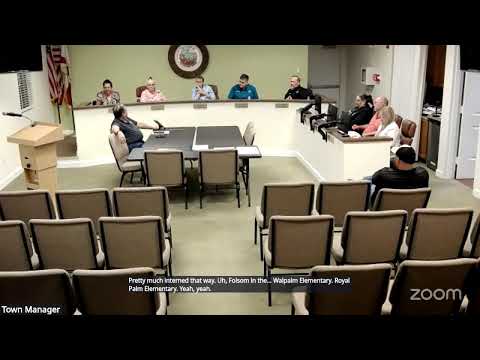
Council OKs higher tentative millage in first reading as debate over budget, crew cuts and $400 rebate idea intensifies
Summary
On first reading the council set a tentative millage rate of 3.2564 mills (vote 4–1) and continued budget work. Debate centered on whether raising millage to generate about $180,000 could be used to subsidize residents' solid-waste costs and provide a one-time rebate, and whether staffing cuts would endanger a road project.
The Town Council of Loxahatchee Groves set a tentative millage rate on first reading of 3.2564 mills at its Sept. 3 meeting, a measure that passed 4–1. The millage decision was part of the council’s larger FY2025–26 budget discussion, in which councilors and members of the public argued over revenue options, staff raises and the risk that cutting public-works labor would halt a road and drainage capital project.
Town Manager Francine Romagna read the manager’s statutorily required notice about the tentative millage and the rolled-back rate. Council members and the town attorney described the arithmetic: raising the millage by a half-mill would produce roughly $365,000 in revenue; the specific increase to 3.2564 mills was estimated to yield approximately $180,000. Councilors discussed a proposal, advanced by Council member McClendon, to use the additional revenue to partially subsidize residential solid-waste service and return money to assessed households as a rebate. He characterized the scheme as a way to collect more from commercial properties while rebating a net amount to residents.
Proponents said the millage increase could, in a single year, generate funds to cover shortfalls (the council heard that the town’s roads-and-drainage budget faces a $625,000 shortfall tied to a lower county assessment), sustain an in-house crew and still allow a rebate for residents. Opponents said raising the millage shifts costs to property owners who do not receive rebates (nonprofits, schools, vacant land) and could create a recurring expectation of rebates by residents. One council member said she did not support a millage increase even if it would generate a rebate because not everyone pays millage equally.
Public commenters repeatedly urged the council to manage general spending before increasing taxes. Tracy Raffelowitz criticized the budget structure and noted administration and consultant costs; another resident urged limits on raises and hiring. Multiple commenters argued against lobbying and grant-writing expenses that they said could obligate the town to debt or zoning concessions.
Town Attorney Kurtz and staff warned the council about the knock-on effects of recent decisions. Staff reported that if the board sustained a prior decision to reduce an assessment rate from $300 to $220 per acre among one revenue source, the roads-and-drainage operating fund would show a $625,000 gap. Staff said cutting a public-works crew would likely stop an active road bank-stabilization and drainage prep project because the town would not have the workforce to complete it; staff estimated the labor component at roughly $350,000 and said the general fund currently has about $613,000 designated for capital.
Councilors asked staff to run detailed, by-property examples showing how the millage change and rebate options would affect individual taxpayers and commercial entities. Councilor McClendon and others asked staff to model scenarios for the next meeting; the council voted in favor of the tentative millage on first reading (4–1) and approved budget direction to incorporate the millage change and contingency placements. Staff said they would return with spreadsheets showing household and commercial impacts and options for implementing a rebate or placing additional revenue in contingency.
Next steps: the tentative millage and tentative budget were adopted for advertising and will return for final reading and adoption at subsequent public hearings. Staff will present detailed revenue and distribution modeling before the final vote.