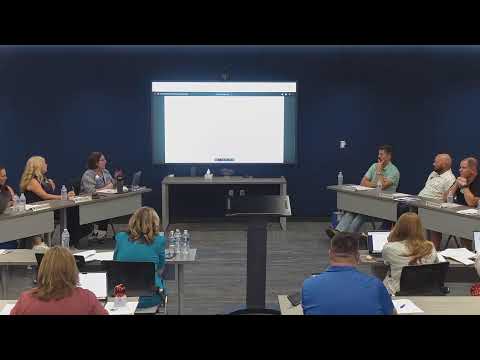
External review identifies gaps in Bixby special-education services; consultant offers 60-plus recommendations
Loading...
Summary
Consultant Dr. Francis Stetson told the Bixby Public Schools board that the district has strengths but needs clearer district-wide standards, more targeted professional development and improved parent engagement; the presentation was discussion-only and produced a recommended action plan.
Dr. Francis Stetson, an external consultant, presented the findings of a spring 2025 evaluation of Bixby Public Schools' special-education services to the school board, telling trustees the district has strengths but also ‘‘a lack of clarity’’ about districtwide quality standards and a set of concrete steps to improve services. The presentation was a discussion item; the board took no formal action at the meeting.
Stetson said his team produced a full report and a shorter summary of findings and that the draft contains more than 60 recommendations for the district to consider. ‘‘Districts not many districts request an evaluation of services,’’ Stetson said, and that the district’s willingness to evaluate ‘‘creates a huge expectation that we’re going to do something.’’
The consultant told the board the evaluation found agreement across parents, special-education staff and general-education staff about where services are working and where they are not — a foundation Stetson said can help the district move to fix problems. ‘‘There was such agreement between what the parents said in their meetings and when you talk to the leadership team and the educators,’’ he said.
Key findings and context
- Identification and outcomes: Stetson reported Bixby identifies about 12.9% of its student population as requiring special education, higher than the Oklahoma average he cited (9.2%) but below the most recent national averages he referenced (about 14–15%). He noted the district’s graduation rate for students with disabilities is 92%, above the state target cited in the report (87%).
- Definitions and alignment: The review flagged confusion about what ‘‘inclusive education’’ and ‘‘least restrictive environment’’ (LRE) mean in practice. Stetson emphasized three related reference points — neighborhood school, general-education classroom and curriculum — and warned that state guidance that relies on a subjective ‘‘diploma-track’’ checklist can push students off the general curriculum prematurely. ‘‘One of the reasons I’m excited to deliver this report is that there are concrete strategies for correcting everything that’s in here,’’ he said.
- Service delivery language: The report recommends moving away from describing supports as ‘‘places’’ (for example, ‘‘resource’’ or ‘‘self-contained’’) toward describing them as ‘‘services’’ and supports aligned to specific learner needs. Diana, a district special‑services staff member who spoke during discussion, told the board: ‘‘Special education is a service and not a place.’’
- Instruction and professional development: Stetson found variability in general-education and special-education instruction and recommended more targeted, coordinated professional development that brings curriculum leaders, special-education leaders and PD staff into the same planning room. He recommended an objective, child-centered decision process that begins with the general-education standard and then documents what supports, accommodations or modifications each child needs.
- Use of paraeducators and staffing: Observations showed many classrooms had multiple adults but unclear roles. Stetson urged clarity of paraeducator roles and systematic coaching: ‘‘Paraeducators ask for their direction, coaching, and training in their role.’’
- Positive Behavioral Interventions and Supports (PBIS): The report highlighted rising behavioral incidents and recommended districtwide, consistent PBIS implementation with data monitoring and clearer training for staff on de-escalation and function-based supports.
- Family engagement and parent advisory group: The consultant noted a low response rate to the district parent survey (about 80 survey responses for a population of roughly 1,100 students with disabilities), and recommended reissuing the survey during the school year and creating a parent advisory council. Diana said the district intends to form a parent advisory council and will recruit volunteers once school is underway.
What the board heard about metrics and targets
Stetson discussed LRE metrics and federal guidance, noting the Office of Special Education Programs (OSEP) has aimed at an 80% benchmark for time spent in the general-education classroom, while Oklahoma’s state standard at the time of the presentation was lower. He said Bixby’s current LRE rate was roughly 77.31% and that, by that measure, the district met the existing Oklahoma standard but could work toward the higher federal benchmark.
Recommendations and next steps conveyed to the board
Stetson recommended that the district and its schools: adopt a short list (8–10) of district quality standards for special education; establish an objective, student‑need-centered decision process that starts with general-curriculum objectives; schedule and deliver coordinated professional development that includes general-education and special-education staff; clarify paraeducator roles and provide coaching; strengthen PBIS and behavioral intervention planning; and reissue the parent survey and form a parent advisory council that will help set priorities and monitor progress. The consultant suggested the district convert the 60-plus recommendations into an action plan with start and end dates, owners and measurable success indicators.
District staff and board comments
District special‑services staff said they had begun several steps referenced in the report — a standards‑based report card, cross‑training of special-education and general‑education teachers, and local ‘‘boot camps’’ for paraprofessionals — but described further work as ‘‘logistical’’ and planned once the school year started. Diana said the district will ‘‘set some schedules, get some things rolling, get some organization’’ for the parent group and implementation tasks.
Legal and compliance notes
Stetson flagged state policy language that may allow subjective decisions about diploma-track placement and recommended the district seek clarification where Oklahoma’s checklist appears to substitute a separate or alternative curriculum that is not aligned with the general curriculum. He urged the board to ensure decisions are made ‘‘on the basis of what the child needs, not what adults want.’’
What was not decided
The presentation was a discussion item; the board did not vote on the report or any of Stetson’s recommendations at the meeting. Several board members asked clarifying questions about parent engagement, technology, middle-school transitions and the feasibility of implementing recommended changes over several years.
Why it matters
The consultant framed the review as groundwork for systemic change: consistent definitions, clearer processes and measurable standards that would affect staffing, professional development, IEP decision-making and parent partnerships. Those operational changes, if implemented, would directly affect instruction and support for students with disabilities across the district.
Looking ahead
District leaders said they will reissue the parent survey during the school year, begin recruiting for the parent advisory council soon after school starts, and convert the consultant’s recommendations into a prioritized action plan with owners and timelines. Stetson said some recommendations will be quick wins and others will require multi-year work to shift vocabulary, scheduling and staffing practices.