
Mississippi School for Mathematics and Science asks board for capital and funding path after presentation on aging campus
Get AI-powered insights, summaries, and transcripts
Subscribe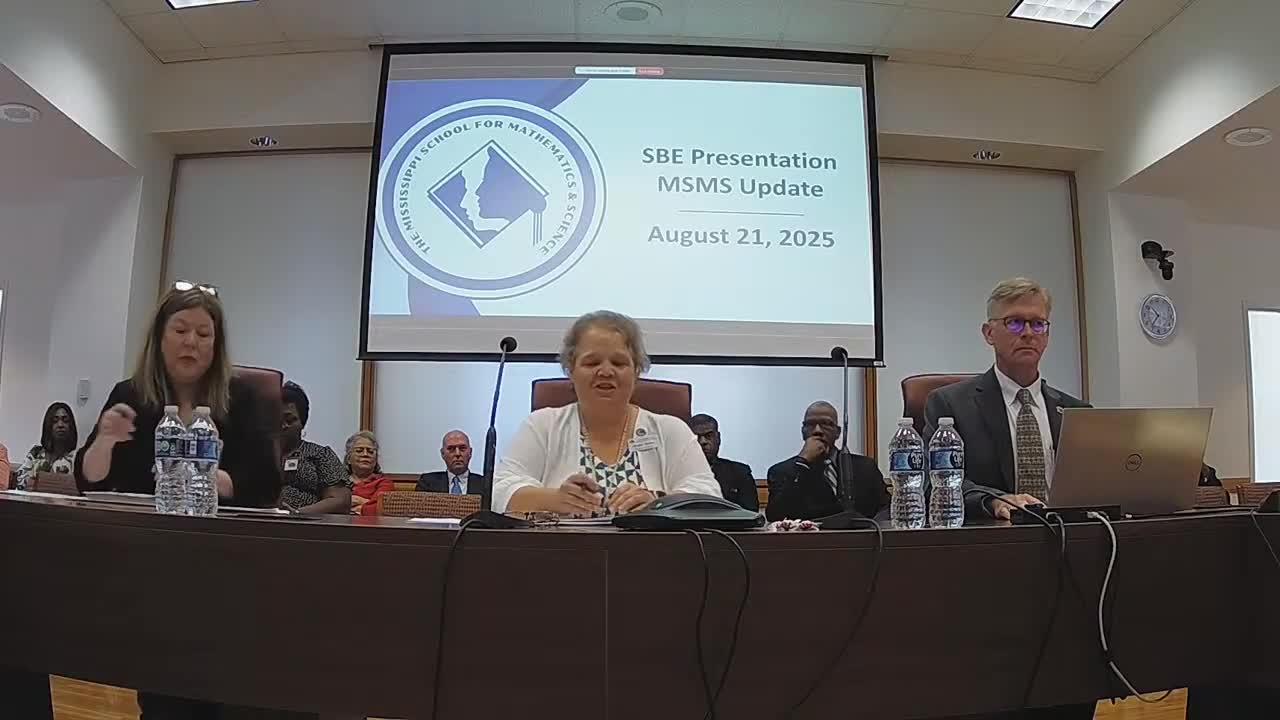
Summary
MSMS officials detailed HVAC and mechanical needs, a $7.83 million list of past facility investments, rising support fees paid to Mississippi University for Women and asked the State Board of Education and legislature to consider funding pathways and scholarship partnerships.
Leaders from the Mississippi School for Mathematics and Science told the State Board of Education on Aug. 21 that the residential school is operating on an aging campus, faces rising operating costs and needs a clearer funding path for maintenance and capital projects.
Ginger Tedder, executive director of MSMS, and Thomas East Rolling, director for academic affairs, told the board that MSMS currently houses about 232 residential students and occupies roughly 154,000 square feet across multiple buildings on the Mississippi University for Women campus. Tedder said MSMS pays $113,000 per year in support fees to MUW and estimated the effective maintenance-fee rate the school pays now as about $0.73 per square foot; she said the goal to cover recommended facility stewardship would be closer to $4.00 per square foot.
Tedder presented a compiled inventory of facilities investments dating back to 1994 and said the department27s best estimate of total past facility improvements is $7,827,715.60. The presentation highlighted imminent HVAC work scheduled to begin over Labor Day weekend and described work that has improved dorm restrooms and other student-facing spaces.
Why it matters: MSMS is a state residential school that serves students from across Mississippi. Tedder and East Rolling said the school's facility and fiscal model differs from other state schools because MSMS operates on a university campus and pays support fees to MUW; they asked the board for help clarifying long-term stewardship, MOA/MOU terms and potential legislative fixes for how state school funding follows students.
Key budget and program details presented: - Current student body: about 232 residential students. - Facilities footprint: roughly 154,000 square feet across multiple residence halls and academic buildings. - Historic facility investment total presented: $7,827,715.60. - Current maintenance/support fee paid to MUW: $113,000 annually (presenter cited this as 73 cents per square foot vs. MUW27s $4 target). - Planned year-to-year increases in MUW support fees the school anticipates; MSMS projected a 10% year-to-year approach for future fee increases and showed a multi-year budget projection that included a new human-resources position budgeted at $65,000 (MUW-employed and subsidized).
Tedder also asked the board to consider policy changes and partnerships to improve recruitment and retention, including pursuing LEA-status waivers (to expand federal grant eligibility), establishing scholarship agreements with in-state higher-education institutions to increase the share of graduates who remain in-state, and considering MSMS as its own fiscal agent in the future.
Board Q&A: board members asked whether MUW does the contracted work funded by the support fee (Tedder said the fee currently goes to MUW for facilities support) and whether MSMS could fully self-manage facilities (Tedder said MSMS is building toward greater self-sufficiency but still relies on MUW for large capital work and certain campus services such as cafeteria and student health center).
Financial context: a board member noted that local district dollars do not currently follow students who attend MSMS and that changing that funding flow would require legislative action. Tedder said the issue of local funding not transferring with a student currently limits MSMS revenue and asked for further legislative consideration.
Outcome: informational presentation only; the board did not take action on Aug. 21. MSMS requested follow-up discussions with the board and MDE staff and provided materials for the board27s legislative planning ahead of the next session.