
Nantucket Select Board urges more time for short-term rental bylaw talks amid commerce-clause concerns
Get AI-powered insights, summaries, and transcripts
Subscribe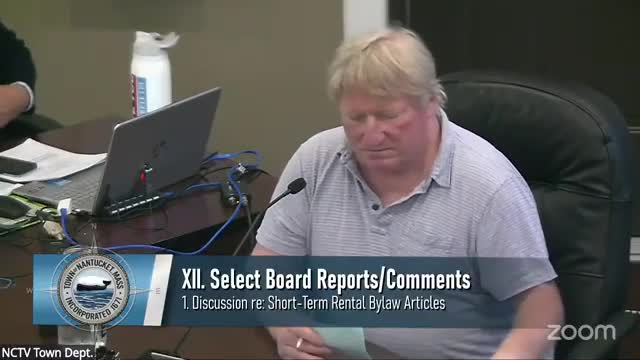
Summary
Town counsel and Select Board members said proposals to regulate short‑term rentals remain a work in progress and urged stakeholders to coalesce before citizen warrant deadlines, citing legal risk under the dormant commerce clause and an ongoing appeal in the Land Court.
Town Counsel John Giorgio told the Select Board on Aug. 6 that stakeholders are still refining proposals to regulate short‑term rentals and that no one had told him they intend to file a citizen petition for a special town meeting "at this time." He recommended delaying a special meeting until proposals coalesce and, where possible, are developed through the Planning Board.
Why it matters: Select Board members said the issue divides the community and that zoning and general bylaw approaches carry different legal and voting consequences. Giorgio warned that some zoning approaches could face legal challenges under the dormant commerce clause and highlighted the town’s existing enforcement tools in Chapter 123 of the general bylaw.
Giorgio said the Planning Board is the most appropriate body to consider zoning amendments and urged any draft to be ready before the citizen-warrant deadline for the 2025 annual town meeting, typically in mid-November, so the town can avoid multiple petitioned articles. "Nobody has indicated to me that they have a present intention of filing a petition for a special town meeting," Giorgio said. He added that a Planning Board proposal would allow public hearings and a more orderly path to town meeting.
Giorgio described three broad approaches under discussion: (1) zoning amendments that reshape when and where short‑term rentals are allowed; (2) changes to the zoning definition of principal use to explicitly address rentals, including short‑term rentals; and (3) using Chapter 123 (the general bylaw) to place operational guardrails—such as limits on days rented or contract counts—while leaving use determinations to zoning. He cautioned that civil-penalty enforcement (up to $5,000) is available under the general bylaw but that zoning enforcement is limited to lower noncriminal disposition fines.
Select Board members said they support continuing the community and stakeholder dialogues already underway. Planning Board Chair Dave Iverson and Select Board members Tom and Malcolm described multiple meetings with varied stakeholders and urged more time for fact‑finding and compromise. Tom said working groups and further meetings have not yet produced a "silver bullet" and praised the Planning Board’s efforts to lead a consensus article that could reach the two‑thirds vote required for zoning changes.
Board members also weighed legal timing risks tied to on‑going litigation. Giorgio and consulting counsel noted an appeal from prior land court decisions remains pending; he and outside counsel do not expect the appeal to be finally resolved before next May’s annual town meeting because of the time required to assemble records and appellate briefing.
The board did not take a formal vote on any regulatory text. Instead members agreed to continue stakeholder meetings, encourage the Planning Board to craft a proposal, and discourage an immediate special town meeting while options are still coalescing.
Looking ahead: Town counsel asked interested parties to bring draft language early enough to be considered before the citizen-warrant deadline so the town can pursue a single, coherent approach rather than multiple petitioned articles.