Get Full Government Meeting Transcripts, Videos, & Alerts Forever!
Get email alerts on the Parks Splashpad topic
No spam. Unsubscribe anytime.
Council weighs higher bid, health rules and grant timing for proposed splash pad at pool
Summary
Designers and staff told the council a recirculating splash pad is more costly than the initially planned pass-through system; state grants total $650,000 but bids came in at roughly $1.25 million, leaving the council to choose between a referendum or value‑engineering.
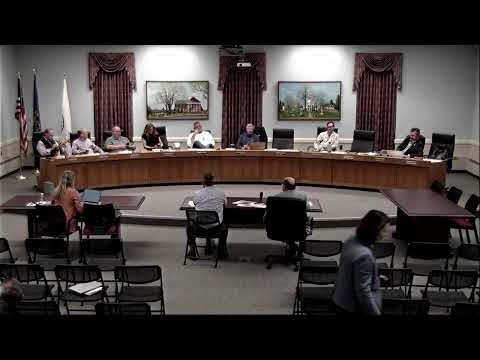
Town staff and the design team updated the Council on the proposed outdoor splash pad at the municipal pool, outlining technical options, grant funding and recent bidder pricing. Sean Kimball, the town manager, said the project originally moved forward on a plan that combined $365,000 of town funds with a $500,000 state STEAP grant for a $865,000 preliminary budget. Subsequent design work and regulatory review identified two water‑treatment approaches: a lower‑cost pass‑through system (tap water routed directly to sewer) and a higher‑cost recirculating system that treats and reuses water.
Engineers and staff reported that state and public‑health regulators (DEEP and the Connecticut Department of Public Health) were not comfortable with proposed discharges or reuse schemes that would avoid treatment. As a result, the design team recommended a recirculating system. Bids returned at about $1.25 million, plus two alternates that bring the total to about $1.30 million. Kimball said the state budget later added $150,000 in support, bringing total state funding to roughly $650,000, but that gap remains large.
Staff presented two paths for the council: 1) accept bids and put a larger project (staff showed an option at $1.45 million to include contingency) on a November referendum; or 2) value‑engineer the plan to reduce scope and lower costs to about $1.15 million so the project could proceed without a referendum (the town would still need to cover the remaining local share). Engineers described likely value‑engineering measures as simplifying the rubberized floor pattern, reducing concrete thickness and trimming some features; council members expressed reluctance to “dumb down” the project’s quality.
Public‑health and operational concerns were central to the debate. Councilors and staff discussed potential bacteriological risks of recirculation, prior DPH advisories in other Connecticut communities, and lifecycle costs: a recirculating system reduces potable water use but requires treatment equipment, maintenance and monitoring. Councilors asked about the indoor kiddie pool: staff said initial hopes for an indoor splash feature were out of budget; the kiddie pool still in the facility would require a separate rehab or replacement in future years.
On schedule, the bidder stated an early‑2026 start with completion by June 15, 2026, if the council moved forward. Several council members said they preferred to delay a final decision to gather further health, cost and design information rather than accept a reduced product; others said the town’s STEAP grant remains available for several years and that delaying up to one year to refine the plan was acceptable. The council did not approve construction funding or place the splash pad on the ballot at the meeting; staff were asked to pursue additional information and report back.