Get Full Government Meeting Transcripts, Videos, & Alerts Forever!
Get email alerts on the Land Use Development topic
No spam. Unsubscribe anytime.
Cheshire council unanimously rejects sale of 58-acre state parcel after residents oppose cold‑storage plan
Summary
After hours of public comment at a Sept. 9 hearing, the Cheshire Town Council voted unanimously to reject selling roughly 58 acres conveyed by the state to a private developer proposing a 119,000‑square‑foot cold‑storage facility, citing sustained resident concerns about noise, traffic, wetlands and groundwater.
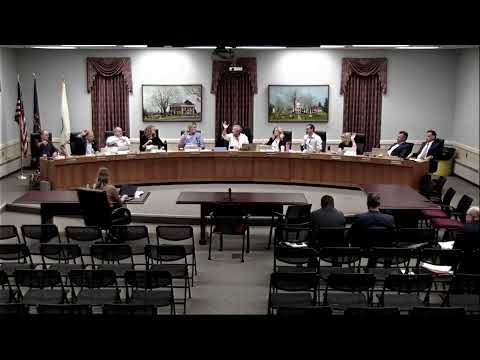
Cheshire, Conn. — The Cheshire Town Council on Sept. 9 rejected a proposal to sell approximately 58 acres of state‑conveyed land along Route 10 to a private developer after hours of public comment and a heated debate among councilors.
The motion before the council would have approved a term sheet to sell the property to 3 Squared LLC; the council moved and seconded the sale but ultimately voted to deny it unanimously. The vote followed a packed public hearing in which dozens of residents from nearby Birch Drive and the Castle Heights community urged the council to block the transaction, saying a 119,000‑square‑foot cold‑storage warehouse proposed in the developer’s response to the town’s RFP is incompatible with the neighborhood and risks public‑health, safety and environmental harms.
Why it matters: The parcel was conveyed from the state to Cheshire in 2017 with the goal of economic development. Developer 3 Squared’s submission to the town proposes a large cold‑storage building, additional space for light industrial or supportive housing, and other supporting uses. Opponents said the project would create round‑the‑clock truck traffic and refrigeration equipment noise, risk aquifer contamination, erode property values and strain emergency‑response resources.
The developer’s team said the council’s vote would not approve a project plan; attorney Dennis Sanneviva, representing the applicant, told the council that “a positive vote tonight to sell the property to my client is not a vote on this proposal. It's a vote to allow the process to continue.” The applicant presented a noise analysis prepared by GZA GeoEnvironmental and a traffic memorandum by Scott Hesketh to address neighbors’ worries. GZA modeling showed steady‑state sound at the nearest Birch Drive property line of about 53.1 dB daytime and about 51 dB at night, levels the consultant said meet Connecticut’s noise standard cited in his presentation: “Section 22a‑69‑2.5 noise zone standards are 61 decibels in a residential area during the day and 51 decibels at night.”
Resident concerns and evidence: State Representative Liz Linehan, who said she mediated the state’s original conveyance to the town in 2017, told the council she “no longer support[s] the sale of that land and specifically do not support the cold storage building because of its negative impact on the neighbors and the environment.” Land‑use attorney Carrie Olson, speaking for Castle Heights Condominium Association and Birch Drive neighbors, said the zoning history is unclear to residents and argued the property “is not in an industrial zone. It never has been.” Olson cited conflicting sections of the town zoning regulations (identified in public comments as regulation section 48 and 48.2(h)) and said the RFP lacked the master‑plan detail the town’s 2016 Plan of Conservation and Development recommends for the interchange focus area.
Residents offered quantitative and documentary evidence: a petition with roughly 1,800 signatures, more than 50 emailed comments to the council, local realtor letters about likely property‑value impacts, citations of a 2023 EPA fine against another cold‑storage operator for ammonia discharge, and field noise measurements from Castle Heights that speakers said already exceed Connecticut nighttime guidelines. Speakers also highlighted wetlands, vernal pools and state Natural Diversity Database (NDDB) map locations for the eastern box turtle and wood turtle on or near the site and raised groundwater and stormwater‑runoff concerns. Several neighborhood speakers asked the council to ask the state to amend the conveyance or secure an extension so the town can pursue open‑space protection rather than a sale to the developer.
Developer response and technical reports: The applicant assembled a technical team to respond. GZA’s consultant said the firm deployed a 24‑hour background noise survey and CadnaA modeling using conservative assumptions (three rooftop compressors, truck refrigeration units and a worst‑case eight peak trucks). Phil Doyle, the developer’s land planner, said the current response preserved roughly 25 acres of the eastern portion of the site as undisturbed buffer and that the cold‑storage building would sit roughly 800 feet from the nearest property line — farther than some speakers had suggested.
Council discussion and next steps: Council debate emphasized two themes: (1) the council’s unique role in the sale (the town council can approve or reject the transfer of town‑held land acquired for economic development) and (2) the limits of local regulatory boards once a project reaches inland wetlands and planning and zoning review. Several councilors said they would support working with the state delegation to seek a modified conveyance preserving the bulk of the parcel as conservation/open space while keeping a small Route 10 frontage area available for development.
Motion and outcome: Councilor Fiona Pearson made the motion to approve the sale on the terms presented in the applicant’s July 10 term sheet; Councilor Don Walsh seconded. After extended discussion and public testimony, the final tally was 0 yes, 9 no; the motion failed. The council’s decision was procedural — it rejected the proposed disposition under the terms before it but did not prevent the developer from pursuing land‑use approvals should the state later modify the conveyance or the council reconsider.
What to watch next: Several councilors said they would work with Representative Linehan to ask the state for an amendment or extension of the conveyance to preserve open space and explore alternative uses such as active‑adult housing or other lower‑impact development at the Route 10 frontage. If a different disposition or a new RFP emerges, the town will publish formal solicitations and the project would return to public review at planning and zoning and inland wetlands hearings.
Discussion vs. decision: The public hearing provided testimony and evidence. The council’s vote was a formal decision on the specific term sheet presented; the denial does not by itself prohibit future proposals or a different sale term negotiated with the state.
Context and numbers cited at the hearing: roughly 58 acres; 119,000 sq. ft. cold‑storage building in the developer’s submission; roughly 86,000 sq. ft. of additional supportive housing/light industrial described in the response; developer‑proposed 25‑acre undisturbed buffer; petition of ~1,800 signatures; more than 50 emailed comments to the council; Connecticut noise standard cited as 61 dB day/51 dB night (Section 22a‑69‑2.5).