Get Full Government Meeting Transcripts, Videos, & Alerts Forever!
Get email alerts on the School Solar topic
No spam. Unsubscribe anytime.
Simsbury sustainability group pushes school solar ahead of state, federal deadlines
Summary
The Simsbury Sustainability Committee plans to present an updated sustainability plan to the Board of Selectmen on Oct. 15 and urged quick action to pursue school solar projects using Connecticut Green Bank programs and other financing options, noting time-sensitive federal tax-credit rules.
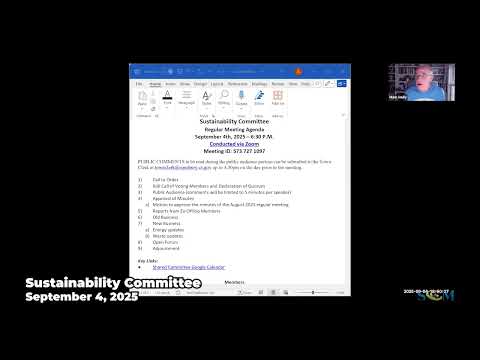
Members of the Simsbury Sustainability Committee said they will bring an updated sustainability plan before the Board of Selectmen on Oct. 15 and urged committee members to show support in the audience as schools and the town explore solar installations funded through the Connecticut Green Bank.
Committee members described the Green Bank approach as a power-purchase agreement (PPA) model that can put solar on district roofs with little or no upfront cost to the town while the bank manages procurement, installation and ongoing operations. Committee members said alternative financing — including issuing municipal bonds so the town owns panels and captures tax credits — is also possible but may take more time to arrange.
The committee highlighted several district buildings as near-term candidates: Latimer Lane Elementary and other elementary sites, Touton/Tara-area schools (as referenced in committee discussion) and Henry James Middle School, which committee members said will require roof replacement in stages before a full solar install. Members emphasized they would only move forward “if the finances made sense” and that projects would proceed only with staff and district approval.
Timing was a central concern. During the discussion a committee member said federal incentives require a project to start construction by July and be in service by 2027 to secure the current tax-credit structure; the member described that timetable as “very, very tight.” The committee noted state-level school incentives are distributed on a first-come, first-funded basis and that Connecticut’s incremental municipal programs for school solar could be fully allocated by February, creating additional urgency.
Committee members reviewed differences between a Green Bank PPA and bond funding. They described the PPA as requiring less day-to-day town staff management because the Green Bank acts as project manager and owner, while bond financing could let the town directly capture tax credits and any long‑term financial upside but may involve borrowing costs and a longer procurement process.
The committee also discussed a prior request-for-proposals that included Simsbury’s closed landfill in Wolcott as a potential site but said technical issues and an objection from the nearby airport had removed the landfill option from that earlier RFP. Committee members encouraged staff follow-up to confirm whether recent statutory changes and megawatt caps that have since expanded might reopen that possibility.
Next steps recorded in the meeting included presenting the sustainability plan to the Board of Selectmen on Oct. 15 for endorsement and staff follow-up to investigate bond-vs.-PPA financing paths, Green Bank program options and timing constraints related to federal safe-harbor and in-service rules. Committee members said they would relay findings back to the committee and the schools before any formal commitment.
For now, the committee’s plan is to seek the Board of Selectmen’s endorsement and to continue technical and financial due diligence; no town appropriation or binding contract was approved during the meeting.