Get Full Government Meeting Transcripts, Videos, & Alerts Forever!
Get email alerts on the Outdoor Lighting topic
No spam. Unsubscribe anytime.
Simsbury planning commission approves draft comments on dark‑sky outdoor lighting amendment
Summary
The commission voted unanimously to approve a draft motion on a proposed zoning text amendment that would centralize outdoor lighting rules, require photometric plans for site plans, and incorporate dark‑sky principles; the zoning commission will hold a public hearing Oct. 20.
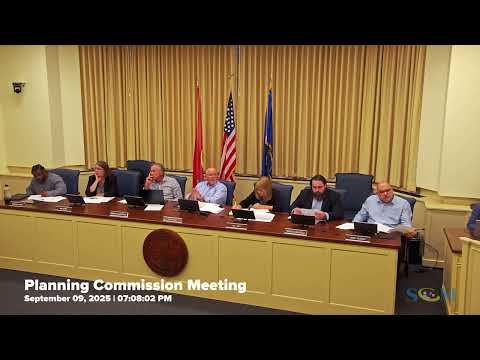
On Sept. 9, 2025, the Simsbury Planning Commission voted unanimously to adopt a draft motion regarding ZC‑25‑7, a proposed zoning text amendment to establish a centralized outdoor lighting chapter and incorporate dark‑sky principles into the town's zoning regulations. The zoning commission has scheduled a public hearing on the amendment for Oct. 20, 2025.
The amendment, presented to the planning commission by Britney McAlpin, the applicant, would add a new Section 11 titled "Outdoor Lighting Standards," update the definitions in Section 17.4 and amend the Simsbury Center code and the Hartford‑Simsbury form‑based code to reference the single standard. "This is gonna ensure that all outdoor lighting is facing downward with no up light," McAlpin said during her presentation.
The proposed rules would apply to new site plan applications and to site plan amendments that change outdoor lighting fixtures. The draft requires applicants to submit a photometric plan showing foot‑candle readings at property lines and a specification of luminaires and lamp color temperature. The draft sets color temperature guidance at 3,000 K or less, with 2,700 K preferred, and limits light trespass and glare. Certain lighting is listed as exempt, including public safety lighting for police and fire, short‑term or temporary lighting, and specified flagpole or seasonal lighting. The regulation also separates "essential" and "nonessential" lighting with different control requirements and encourages automatic shutoffs.
Staff told the commission that when a site plan application changes fewer than 25% of fixtures the change may be handled administratively without a photometric plan but still must comply with the standards. The draft sets a numerical target on light trespass: at the property line, commercial properties abutting residential properties should measure essentially 0.0 foot‑candles, while commercial adjacent to commercial would be limited to 0.5 foot‑candles, according to examples cited during the meeting.
The draft regulation centralizes existing lighting references scattered through the codes and draws from other Connecticut municipalities and model guidance. McAlpin said staff reviewed several town codes and the model outdoor lighting regulations from the Light Down CT initiative; the draft also incorporated feedback from Leo Smith of the Connecticut chapter of the International Dark‑Sky Association.
Commissioners asked implementation questions, including whether the rules would require retrofits. McAlpin and staff clarified that the amendment would not force retrofits of existing commercial properties but would apply if a site plan or an applicable site plan amendment were submitted; individual residential house lights would not be covered. Staff noted the draft includes a street lighting provision that requires full cutoff fixtures but does not apply to Department of Transportation fixtures located in state right‑of‑way.
The planning commission approved a motion "to adopt the draft motion shown on the screen" and carried it unanimously. Bill Rice, secretary (filling in for Chairman Aaron Levitt Smith), closed the item by saying, "Motion carries unanimously. Very nice, Britney." The next formal step is the zoning commission public hearing on Oct. 20, 2025.
Why this matters: The change would create a single, referenced chapter governing outdoor lighting for nonresidential site plans in Simsbury, implement guidance identified in the town's 2024 Plan of Conservation and Development, and require documentation (photometrics) that planners can use to assess light spill and visual impact during site plan review.