Get Full Government Meeting Transcripts, Videos, & Alerts Forever!
Get email alerts on the Child Warning Signs topic
No spam. Unsubscribe anytime.
Coldwater council agrees to revisit policy on child-warning signs after parents and teachers speak
Summary
After public comments from parents and a teacher, the Coldwater City Council voted Aug. 25 to ask staff to return with formal recommendations to revisit the municipal policy on child-warning signs, a topic the council previously decided not to reopen on July 28, 2025.
Coldwater City Council members voted Aug. 25 to bring back for discussion a municipal policy on child-warning signs after two residents urged the council to reconsider allowing signs that alert motorists to children with disabilities.
Jane Nastali, a parent and representative of a group of teachers and parents, told the council the group had researched more recent studies than those previously cited by staff and asked the council to “consider revisiting the municipal services policy regarding child warning signs in the city of Coldwater.”
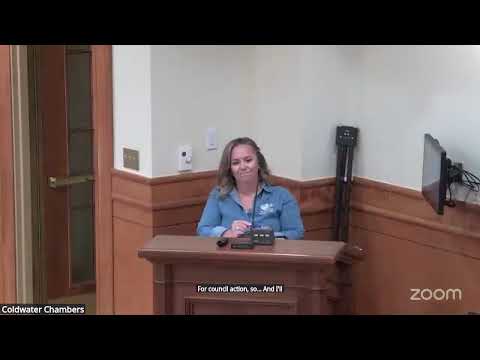
Katie Jewell, a neighbor and 18-year teacher who said she lives next door to the family that raised the request, told the council the signs function as “a quick IEP for any driver” and argued that “if they help even one time, the signs are very necessary.”
The issue first came before the council on July 28, 2025, when members collectively decided not to reopen the municipal services policy restricting child-warning signs. Council members and staff also noted the city removed existing signs about two years ago. During the Aug. 25 discussion, one council member compared the request to deer-crossing signs, asking, “Why does the state of Michigan and why do the counties in Michigan offer up deer signs?” and arguing that similar caution signage could be appropriate for children with special needs.
Council members noted practical questions and past problems that led to the policy stance: how to limit proliferation of signs, who would monitor whether a sign remains needed, whether signs should be placed in the public right-of-way (which the city controls) or on private property, and how to set a duration or renewal requirement so obsolete signs are removed. Staff said private yard signs remain an option but that city-installed signs raise questions about location, duration and enforcement.
By motion, the council instructed staff to prepare recommendations for council consideration at the next meeting. Those recommendations should include proposed eligibility criteria, duration/renewal procedures, placement rules (public right-of-way versus private property), and an outline of any administrative or publication costs. The motion to place the item on the next council agenda carried; the meeting record shows one council member voted no but does not identify who cast that vote.
Background and context: Council members and staff referenced a prior discussion and vote on July 28, 2025, and the city manager confirmed that previously installed signs were removed roughly two years ago. Commenters cited examples from other jurisdictions and a statement attributed to the American Association on Intellectual and Developmental Disabilities about difficulties researching the topic ethically. No change to policy was adopted on Aug. 25; the council only directed staff to return with a structured recommendation for formal consideration.
What happens next: Staff will draft specific criteria and return the item to the council at the next meeting for further council action. The council did not adopt specific placement standards, fee schedules, or enforcement mechanisms on Aug. 25.
Sources: Public commenters Jane Nastali and Katie Jewell during the Aug. 25, 2025 council meeting; council discussion and motion recorded Aug. 25, 2025.