Get Full Government Meeting Transcripts, Videos, & Alerts Forever!
Get email alerts on the Disability Signage topic
No spam. Unsubscribe anytime.
Coldwater council adopts policy allowing blind, deaf and autistic child warning signs after public testimony
Summary
After extensive public comment from parents and caregivers, the Coldwater City Council on Sept. 8 adopted Resolution 25-99 and Policy P-25-03 to allow installation of disability-specific warning signs on local streets and set a process for requests, placement and annual renewal.
The City Council of Coldwater on Sept. 8 adopted Resolution 25-99 and Policy P-25-03 to create a citywide process for installing blind, deaf, autistic and other disabled-child warning signs on local streets following extended public comment from families and caregivers. The policy permits signs on local rights-of-way placed between 100 and 150 feet from the requesting property, requires a signed application from a medical professional, and calls for an annual confirmation each January that the sign is still needed.
City Manager Keith (City Manager) told the council staff prepared a revised policy after the council's prior discussion and that the policy would create a governance process for accepting applications, managing installation and removal, and monitoring placement. "Based on your discussions, we're bringing forward to you resolution 25 99, which would adopt this revised policy p-25-03 and establish a process by which we would accept applications," Keith said.
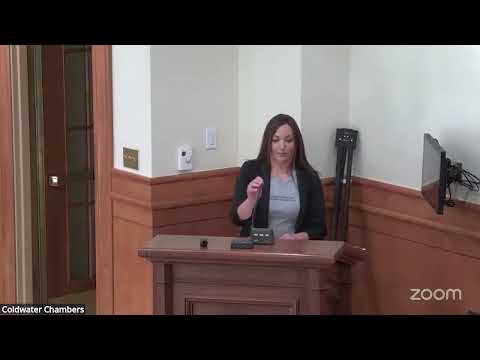
The council heard more than a dozen public commenters during the meeting's public-comment period. Dominique Prater, committee chair of the Branch County Parent Advisory Committee, described elopement as a common and fast-moving danger for some children with autism and said signs "are silent, but they are a powerful reminder to slow down, stay alert, and consider that a vulnerable child may be nearby." Eric Cozart, identified as "a parent of a child with special needs," urged the council to consider the limits of published studies that focus on crash data and said the signs also provide neighborhood awareness and parental peace of mind: "What they don't measure is the countless near misses avoided because a driver eased off the gas when they saw a sign," he said.
Other speakers recounted personal incidents and urged the council to restore signs that had previously been installed in parts of the area. Jennifer Garner said she previously requested signs and had them installed after contacting the city, then later saw requests dismissed after a staffing change; she cited national statistics that she said show about seven U.S. children with autism die each month after eloping and called the issue "a matter of safety, dignity, and proactive inclusiveness." Katrina Hamlin and Heath Garn described near-miss incidents involving their children and neighborhood responses that a sign might help prevent similar events in the future.
Council members discussed visibility and placement logistics. One council member suggested using fluorescent high-visibility yellow comparable to recently replaced pedestrian crossing signs; Public Works staff (Bob, Staff member) confirmed the city uses high-visibility yellow for those signs and that similar materials would be used. Council discussion also addressed concerns that signage could inadvertently identify vulnerable households to malicious actors; one member asked whether placement could be shifted a short distance if a resident near the planned location objected. Public Works staff said in practice the city has on rare occasions moved signs at residents' requests and that the policy did not yet include a standardized relocation procedure.
The policy specifies that Michigan Department of Transportation (MDOT) rights-of-way are excluded when MDOT will not permit signs and that the city will place signs no closer than 100 feet and no farther than 150 feet from the requesting property to give motorists advance notice. The city will ask applicants to reaffirm annually in January that the sign is still needed; if applicants do not respond after outreach, the city may remove the sign. The city also will survey the area, procure and install signs (lead time estimated at a few weeks), and coordinate placement to avoid blocking regulatory signage.
Council member Jim (Council member) moved to adopt Resolution 25-99 and Policy P-25-03; Council member Mike (Council member) supported the motion. The motion passed on a voice vote with no recorded opposition. The council directed staff to implement the application and annual-confirmation procedures described in the policy.
The decision follows weeks of community outreach and echoes ordinances and policies other municipalities have adopted; the council and staff noted they relied on examples from other cities while drafting the Coldwater policy. Staff said applicants will submit a form with a physician's acknowledgement, the Public Works department will survey placement, and the Deputy Treasurer will track any administrative details related to the sign program.