
Coldwater authority backs Carriage Circle housing plan, recommends city hearing
Get AI-powered insights, summaries, and transcripts
Subscribe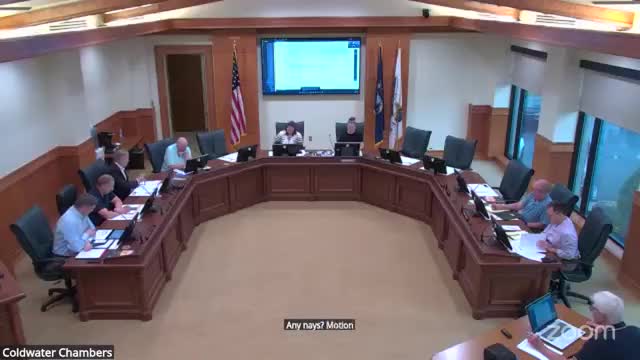
Summary
The Coldwater Brownfield Redevelopment Authority voted unanimously June 30 to recommend a Brownfield plan for the Carriage Circle housing redevelopment and asked city council to set a public hearing.
The Coldwater Brownfield Redevelopment Authority voted unanimously June 30 to recommend a Brownfield plan for the Carriage Circle housing redevelopment and asked city council to set a public hearing.
The plan presented by developer Redstone Group and consultant Michigan Growth Advisors proposes 228 rental units, a mix of two- and three-bedroom apartments, and requests use of Brownfield tax increment financing (TIF) to reimburse roughly $19,000,000 in eligible activities — including about $1.6 million of infrastructure work and a roughly $14.5 million “gap subsidy” the developer said is needed to support affordable rents. Joe Gastinelli, managing director of Michigan Growth Advisors, told the board the plan proposes that about 30% of units (about 68 units) be income-restricted to an average of 90% of area median income (AMI).
The recommendation approved by the Brownfield authority forwards the plan to Coldwater city council for the statutorily required public hearing and notice to taxing jurisdictions. If council approves, the developer must execute a reimbursement agreement with the authority and submit an Act 381 work plan to the Michigan State Housing Development Authority (MSHDA) to obtain state approval for capturing school millages.
Brian Papke of Redstone Group described the proposed project as a collection of smaller, architecturally residential‑scale buildings with heavy landscaping, carports, a dog park, playground and a community building. He said the design aims for 100% two- and three-bedroom units to provide more family‑sized housing than nearby projects: “We have all 2 and 3 bedrooms, 100% in this project,” Papke said. He estimated construction could start in mid-to-late fall depending on approvals, with early occupancies possible in spring 2027.
Gastinelli summarized how the statutory Brownfield changes that created a “housing property” category allow TIF to reimburse additional activities beyond traditional environmental cleanup — notably private infrastructure and a financing gap for affordable units. He said the program’s flexibility and predictability make it easier to attract investors: “It provides certainty to investors to make it much more attractive to want to spend more money more quickly,” Gastinelli said.
Board members asked for details about local tax impacts. The plan’s tax-capture table (table 2 in the Brownfield packet) models capture of 4.6 mills of county millage and estimates total county capture of about $1,600,000 over the 16‑year capture period. A board member who identified the county perspective warned that $1.6 million is significant for the county budget. Keith Baker, Coldwater city manager, confirmed the site is currently zoned for multifamily and that the plan’s modeled duration is 16 years, after which capture would stop unless amended.
Board and staff discussed program administration. The developer’s financial model includes a 10% administrative capture for the Brownfield Authority; the presentation noted about $65,000 per year at full build-out for authority administration, and Gastinelli said administering housing TIFs requires more annual reporting — including income monitoring and reports to MSHDA — than a typical Brownfield plan.
Gastinelli described the next procedural steps: the authority’s recommendation to city council, city council’s public hearing and vote, execution of a reimbursement agreement, then submission of an Act 381 work plan to MSHDA for school millage capture; MSHDA review typically takes 30–60 days, he said. The developer said eligible costs are reimbursed only after they are incurred and approved by the authority.
The board approved Resolution 2502 recommending the plan and requesting that city council set the required public hearing and notify taxing jurisdictions. The authority’s action does not directly levy taxes or obligate taxing jurisdictions; it forwards the plan for the statutory municipal and state review steps that follow.
If the city and state approvals proceed, the developer said construction would likely occur in phases and the modeled TIF capture would be used primarily to subsidize affordability and some infrastructure costs, not to create a permanent local capture past the stated 16‑year term.
Board members said they supported the project’s goal of adding family‑sized housing but acknowledged trade-offs for local taxing jurisdictions.
The Brownfield authority’s packet and presentation materials list the plan’s eligible-cost tables and capture estimates; the authority will forward those exhibits to city council as part of the required notice and hearing process.