
Coldwater staff seeks city ordinance to require grease-trap inspections, annual fee
Get AI-powered insights, summaries, and transcripts
Subscribe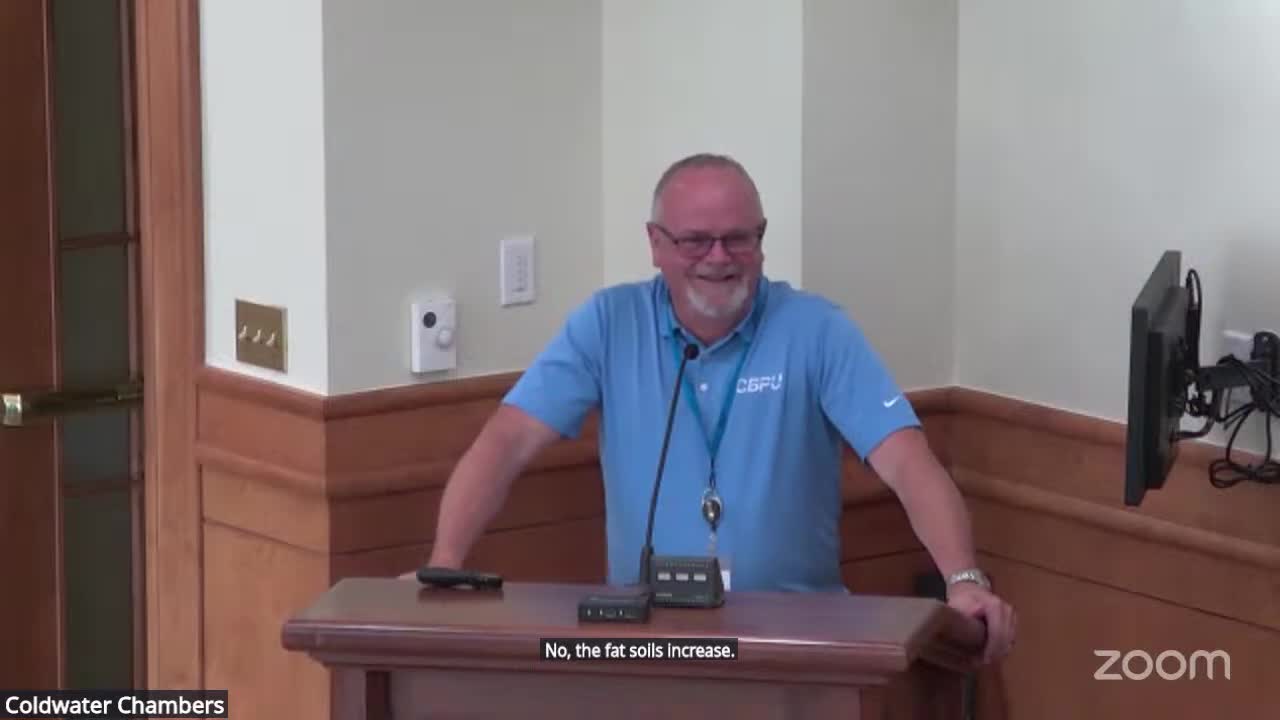
Summary
Utility staff requested the City Council adopt an ordinance requiring inspection and an annual $50 fee for grease traps, oil separators and similar devices to reduce sewer backups and protect the collection system.
The Coldwater Board of Public Utilities voted to send a proposed ordinance amendment to the City Council that would add inspection requirements and an annual $50 inspection fee for fats, oils and grease (FOG) control devices such as grease traps and oil separators.
Brian (last name not provided), who addressed the board as the staff presenter on collection-system maintenance, said FOG is a primary cause of sewer backups and wastewater-collection problems and that current county guidance is limited. “We want to change the ordinance to include an inspection of the grease traps, sand traps, all this stuff with a $50 fee annual inspection with a fine structure,” Brian said, adding that the intent is to work with businesses to become proactive before failures occur.
He told the board the Water Department will perform inspections rather than the wastewater treatment staff; staff will create an initial inspection list because county records are incomplete. Brian said the treatment plant does not accept grease-trap cleanings and that generators currently must travel to Three Rivers to dispose of collected waste, which adds cost. He said the proposed program would require businesses to keep cleaning logs (recommended retention three years) and that the city could require more frequent cleaning when an initial inspection shows heavy grease accumulation.
The board moved to approve forwarding the proposed ordinance language and implementation plan to the City Council; the motion passed. Utility staff described the measure as a proactive program to reduce backups and long-term maintenance costs and as beneficial to both the utility and local food-service businesses that would otherwise face emergency repairs.