
Coldwater BPU approves rate adjustments, cites MISO auction and state renewable mandates
Get AI-powered insights, summaries, and transcripts
Subscribe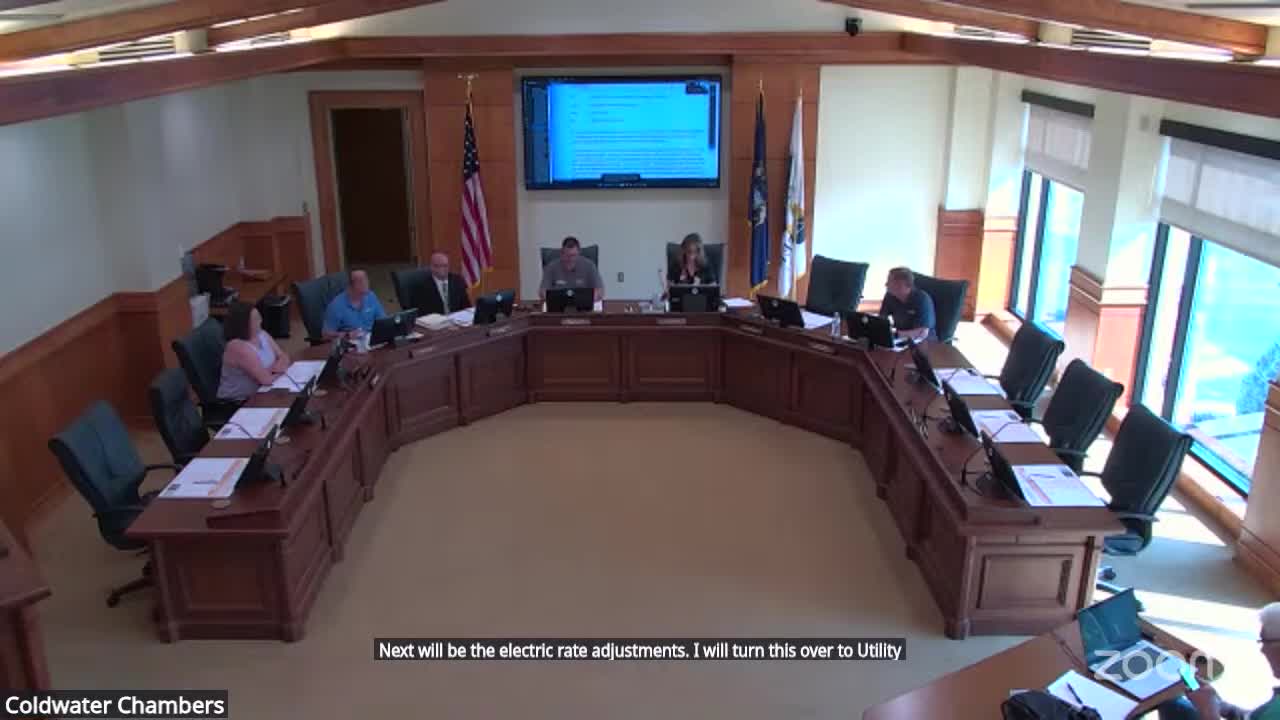
Summary
The Coldwater Board of Public Utilities approved a resolution to adjust its electric base rate and power cost adjustment mechanism, citing recent MISO auction results and upcoming state renewable-energy requirements that will influence future supply costs.
The Coldwater Board of Public Utilities on July 2 approved a resolution to adjust the electric base rate and the power cost adjustment (PCA), with the change to be forwarded to the City Council for final approval.
Utility Director Jakubzak told the board the proposed change raises the base energy component from 6.7¢ per kilowatt-hour to 7¢ per kilowatt-hour and would reduce the variable PCA customers see. “By doing that, our PCA is going to drop,” Jakubzak said, and the board discussed the measure as intended to shift a portion of variable supply cost into a more fixed base rate to reduce month-to-month volatility for customers.
The board packet included recent MISO (Midcontinent Independent System Operator) auction results that Jakubzak said show substantially higher clearing prices this year than in recent seasons; the most recent auction cleared at about $6.61 per megawatt-hour on average, with seasonal variation. Jakubzak said the state’s renewable-energy mandates — including incremental renewable percentages and clean-energy targets referenced in the materials — will add pressure on supply costs and renewables/renewable-energy-credit procurement in coming years.
Board members moved to approve the rate adjustments and associated Resolution 25-68 for submission to the city council; the board voted in favor and will present the matter to city council at its July 14 meeting. If approved by council, the electric change would take effect Sept. 1, the board packet states.
Jakubzak described the board’s goal as reducing PCA swings and noted the board’s rate consultant recommended the 7¢ base figure to avoid driving the base so high that the PCA would go negative. He also said the change was projected to be roughly net-neutral for most customers; he estimated that under the new base the PCA for the month in the packet would drop from about 0.0166 (current readings) to about 0.01386, which he characterized as roughly a 16% reduction in that month’s PCA component.
Board members asked clarifying questions about the timing, customer impacts and the mechanics of negative PCA values; Jakubzak said the PCA can be negative for some customers depending on rate class but that the board’s approach was to keep it slightly positive to avoid large swings. The board approved sending the resolution to city council; the city council’s first consideration is scheduled for July 14.
The board packet and director’s remarks also flagged longer-term planning points: potential ownership of renewable resources or longer-term contracts to mitigate rising market and REC (renewable energy credit) prices, and an upcoming Energy Waste Reduction plan the utility expects board consideration of in the near term.